Common Cyber Attacks Targeting Kansas City Businesses in 2026

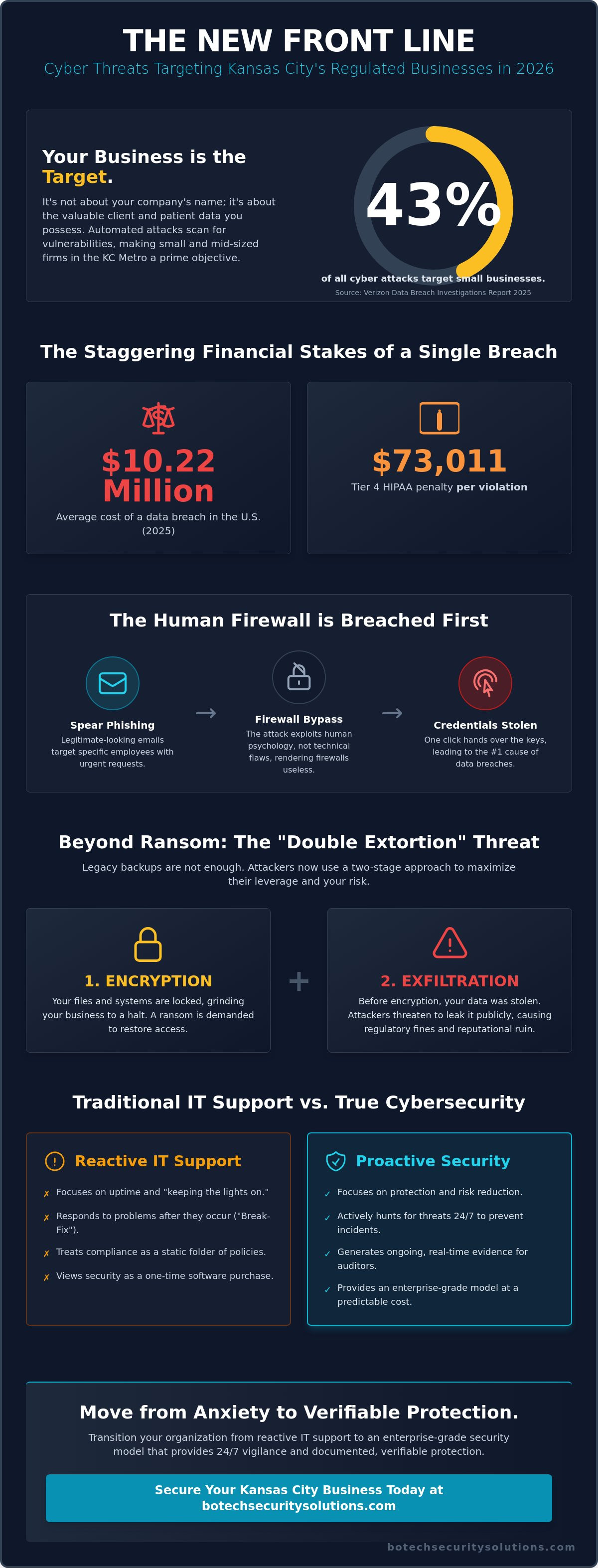
Your business is a target because you possess data that hackers can monetize, not because you're a household name. In Kansas City, common cyber attacks are no longer just random phishing emails; they are precision strikes against regulated firms that cannot afford the $10.22 million average breach cost recorded in 2025. You might believe your current firewall makes you secure, but the reality is that most are not.
It's frustrating to juggle HIPAA compliance or SOC 2 audits while trying to manage your practice or firm. You want to feel confident that your protection is real, not just a folder of stale policies sitting on a shelf. This guide reveals the specific threats facing Kansas City’s regulated industries in 2026 and the enterprise-grade strategies required to stop them before they trigger a Tier 4 HIPAA penalty of $73,011 per violation.
We'll examine why "double extortion" is the new standard and how to prove your security posture to auditors without the confusing jargon. You'll leave with a clear roadmap to move from anxiety to documented, verifiable protection.
Key Takeaways
- Understand why Kansas City small businesses are the new front line and how to identify common cyber attacks that bypass standard firewalls.
- Learn to spot high-stakes phishing and social engineering tactics that target office managers by exploiting human psychology rather than technical flaws.
- Uncover the uncomfortable truth about why legacy backups fail against modern ransomware and how to defend against "double extortion" threats.
- Discover how to transform static compliance documents into an active program that generates the real-time evidence required for HIPAA and SOC 2 audits.
- Transition your organization from reactive IT support to an enterprise-grade security model that provides 24/7 vigilance at a predictable cost.
Why Kansas City Small Businesses Are the New Front Line for Cyber Attacks
"I'm too small for a hacker to care about." It's a comforting thought. It's also a lie that could cost you your business. The reality is that 43% of common cyber attacks now target small businesses, according to the Verizon Data Breach Investigations Report 2025. These incidents are not random glitches or technical "bad luck." They are deliberate, profit-driven attempts to bypass your security controls to steal patient records, legal strategy, or financial credentials.
Most business owners in the Metro treat cybersecurity like a one-time purchase. They buy a piece of software, install it, and assume the job is done. This complacency is exactly what modern threat actors count on. While large enterprises have 24/7 security operations centers, the average Overland Park law firm or Northland medical practice often runs on outdated patches and "set it and forget it" configurations. You might think your current setup is keeping you safe. Most are not.
The Shift from Global to Local Targeting
Hackers used to hunt whales; now they use automated nets to catch everything in the pond. Automated scanning tools don't care about your company's name or your community reputation. They only care about your vulnerabilities. Kansas City’s growing healthcare and legal sectors have become a gold mine for credential harvesting because these firms hold high-value data but often lack enterprise-grade defenses. Attackers specifically look for mid-sized firms in secondary markets like ours because they expect lower resistance. A data breach in Lee’s Summit is just as devastating as one in NYC. Your location in the Midwest doesn't provide a shield; it provides a target for attackers who know you might be less prepared than a global bank.
The Difference Between IT Support and True Cyber Security
There is an uncomfortable truth that most vendors avoid: your current IT provider is likely focused on the wrong things. They care about uptime and "keeping the lights on." They ensure your email works and your printer connects. But uptime is not security. Having a firewall is like having a lock on a door that you never actually check. If nobody is watching the logs, the lock is useless. True security requires proactive Managed Security and constant threat hunting. Traditional "break-fix" IT waits for a disaster to happen before they act. We prevent it.
We operate as a Strategic Ally for organizations that cannot afford to get this wrong. While a standard IT shop gives you a document saying you're compliant, we build a program that generates ongoing evidence. In a world where a single breach can trigger a Tier 4 HIPAA penalty of $73,011 per violation, "good enough" is a dangerous gamble. You are either protected or you are vulnerable. There is no middle ground.
Phishing and Social Engineering: The Human Vulnerability in Overland Park Offices
Imagine an office manager at a busy medical clinic in Overland Park. It is 2:00 PM on a Tuesday, and they are balancing patient check-ins with vendor calls. An email arrives with the subject "Urgent: Past Due Invoice" from a local medical supply company they use every month. The branding is perfect, the tone is professional, and the link to the "payment portal" looks legitimate. By the time they enter their login credentials, the damage is done. This is how common cyber attacks bypass even the most expensive firewalls by targeting human psychology instead of software flaws.
Phishing has evolved far beyond the poorly spelled emails of the past. In 2026, attackers use sophisticated methods like session hijacking and MFA fatigue to gain entry. The IBM Cost of a Data Breach Report 2025 found that stolen or compromised credentials are the most common initial attack vector, leading to an average breach cost of $10.22 million in the U.S. When an employee clicks a malicious link, they aren't just making a mistake; they are handing over the keys to your entire network. You might believe your team is too smart to fall for these tricks, but most are not prepared for the level of precision used in modern social engineering.
Spear Phishing vs. Business Email Compromise (BEC)
Business Email Compromise is particularly dangerous for law firms and financial groups in the Metro. Attackers often "dwell" in a compromised inbox for months, silently reading threads to understand your firm’s language and settlement schedules. They wait for the perfect moment to inject a fake wire transfer request that looks like it came from a senior partner. Setting up Google Account security settings is a critical first step in hardening your defenses against these silent intruders. If you haven't audited your email permissions lately, your firm's private discovery data could be sitting in a hacker's hands right now.
The Role of Security Awareness Training
The uncomfortable truth is that your staff is your greatest liability only if you fail to train them. Technical filters will always miss a percentage of sophisticated threats. Effective defense requires a culture of vigilance where employees are trained to spot the subtle red flags of a "whaling" attack. We use simulated phishing campaigns to teach your team how to identify risks in a safe environment. This proactive approach addresses inadvertent actions such as using easy passwords or reusing credentials across multiple sites. If you want to see where your team's awareness currently stands, you can request a baseline security review to identify your most vulnerable entry points.
Ransomware and the Uncomfortable Truth About Kansas City’s Legacy Backups
Many Kansas City business owners think a nightly backup to a network attached drive is their "get out of jail free" card. That assumption is a dangerous relic of the past. Modern ransomware has evolved into "double extortion," where attackers exfiltrate your sensitive data before encrypting it. They don't just want a ransom for the key; they threaten to leak your client or patient records if you don't pay. Restoring from a backup doesn't stop the data breach notification requirements or the massive reputational damage.
Here is the uncomfortable truth: if your backups are connected to your main network, the ransomware will find and destroy them first. Attackers spend days or weeks inside a network specifically hunting for backup repositories to ensure you have no choice but to pay. A mid-sized KC clinic could be paralyzed for weeks, even with a "backup plan" that hasn't been validated. Under the HIPAA Security Rule (45 CFR § 164.308(a)(7)), you are required to establish and implement procedures to create and maintain retrievable exact copies of electronic protected health information. If your backups are wiped, you aren't just out of business; you are out of compliance.
Why Traditional Antivirus Fails Against Ransomware
Standard antivirus software relies on signatures, which are like digital mugshots of known threats. In 2026, common cyber attacks use "signature-less" techniques that bypass these basic filters entirely. These attacks change their appearance with every execution, making them invisible to legacy tools. You need endpoint monitoring that analyzes behavior rather than searching for known files. We provide this level of enterprise protection at a small business price, ensuring that malicious patterns are stopped before they can execute. Most businesses believe their antivirus is enough. Most are not.
The Importance of Backup Validation
A backup is only as good as its last successful restore. Far too many organizations discover their data is corrupted or incomplete only after a disaster strikes. Your defense must include "immutable backups," which are copies of data that cannot be altered or deleted, even by an administrator account. This creates a true "gap" between your live network and your recovery points. We specialize in backup management and validation to ensure your recovery plan works when it matters most. We test your restores regularly so that "disaster recovery" is a documented reality rather than a hopeful theory.
The Regulatory Cost of Failure: HIPAA and SOC 2 Vulnerabilities
Most Kansas City business owners carry a dangerous misconception about compliance. They believe that because they have a "HIPAA binder" or a signed security policy, they are protected. The uncomfortable truth is that a compliance document is not a compliance program. A document is a static folder sitting on a shelf; a program is a living system that generates ongoing evidence. When common cyber attacks strike, that dusty binder offers zero protection during the mandatory audit that follows.
A data breach is more than a technical hurdle; it is a legal trigger. Under the HIPAA Breach Notification Rule (45 CFR §§ 164.400-414), any compromise of protected health information requires specific, time-sensitive actions. If you cannot prove you had active safeguards in place before the incident, regulators may view the breach as willful neglect. This transitions your organization from a victim of a crime to a target of a federal investigation. You might feel secure because you haven't been audited yet, but most are not prepared for the scrutiny that follows a headline-making leak.
HIPAA Compliance for KC Healthcare Practices
Compliance requires more than just good intentions. HIPAA § 164.312 mandates specific technical safeguards, including access controls, integrity controls, and transmission security. Managed Detection and Response (MDR) is the only way to provide the continuous audit trail needed to prove you were actively monitoring for unauthorized access. Without this automated evidence, you are essentially guessing about your security posture. We position Managed IT Support Services as the foundation of your compliance, ensuring that every login and data movement is logged and verified.
SOC 2 and the Legal Sector’s Responsibility
Kansas City law firms are facing a new reality where corporate clients demand SOC 2 readiness before signing a contract. Your clients in Tulsa or OKC need to know that their sensitive discovery data won't end up on the dark web. We act as a Strategic Ally by making enterprise-grade compliance affordable for firms that don't have a massive internal IT department. We move your firm away from static policies and toward continuous evidence collection, which is the only way to satisfy modern auditors. If you aren't sure if your current setup meets these rigorous standards, you should schedule a compliance gap analysis to find out where you actually stand.
Implementing a Security-First Defense in the Kansas City Metro
Defending your organization against common cyber attacks requires a fundamental shift in how you view technology. You cannot treat security as a checkbox or an occasional IT project. We operate as a Vigilant Guardian, providing 24/7 monitoring that active threat actors cannot simply wait out. This is why a flat monthly rate model is superior to the traditional "break-fix" approach. In a managed model, our incentives are perfectly aligned with yours; we are motivated to prevent problems before they happen, not profit from your downtime.
Consider a specialized medical practice in the Northland that struggled with fragmented security. They had one vendor for their servers, another for their phones, and a "compliance consultant" who only showed up once a year. They were constantly anxious about their next HIPAA audit. By consolidating their security and compliance into one partner, they moved from a state of constant uncertainty to a documented, verifiable program. They are now one of those Organizations That Cannot Afford to Get This Wrong who sleep better knowing their protection is active, not just theoretical.
The Managed Detection and Response (MDR) Advantage
Practice managers often ask what "threat hunting" actually means in plain English. Think of it like a security guard who doesn't just sit behind a desk watching a monitor, but actively walks the perimeter looking for signs of a forced entry. MDR identifies the subtle behaviors that indicate a breach is in progress, allowing us to neutralize the threat before data is exfiltrated. Because we are focused on the KC metro, our local response times ensure that if an incident does occur, it is handled with the urgency your business deserves. You can find more educational tools and checklists on our BoTech Resources page to help train your staff.
Your First Step Toward Real Protection
You can improve your security posture today by taking one specific action: audit your Multi-Factor Authentication (MFA) settings across all professional accounts. Ensure that MFA is not just "available" but mandatory for every user, especially for email and remote access. This simple step closes the easiest door for attackers to walk through. Finding out where you actually stand is the only way to move from a place of fear to a place of control. If you are ready to stop guessing about your vulnerabilities, contact us today for a free security and compliance assessment to find out where you actually stand.
Defending Against Common Cyber Attacks: Moving Beyond Compliance Documents
Common cyber attacks in the Kansas City metro are no longer just a possibility; they are a mathematical certainty for firms that possess valuable data. You now understand that a stale policy manual provides no defense against a Tier 4 HIPAA penalty of $73,011 per violation. True security requires a transition from static documents to a living program that generates continuous evidence. Most business owners think their current IT setup is enough. Most are not.
As a veteran owned and operated firm, BoTech Security Solutions brings a disciplined, no-nonsense approach to your defense. We specialize in providing enterprise grade protection for small KC firms that must navigate the complexities of HIPAA, PCI DSS, and SOC 2. By proactively neutralizing common cyber attacks before they can execute, we act as the strategic ally for firms that need real results over marketing promises. You deserve the confidence of knowing your organization is a hard target for attackers rather than an easy victim.
Stop guessing about your vulnerabilities and start building a verifiable defense today. Find out where you actually stand with a Free Security Assessment. We are ready to help you secure your future and protect your reputation.
Frequently Asked Questions
What are the most common cyber attacks targeting small businesses in Kansas City?
Phishing, Business Email Compromise (BEC), and double-extortion ransomware are the primary threats facing local firms in 2026. These common cyber attacks often target the 43% of small businesses that attackers view as "low hanging fruit" due to weaker technical controls (Verizon DBIR 2025). Hackers don't want a challenge; they want the easiest path to your patient records or financial credentials.
Is my Kansas City law firm really a target for hackers?
Yes, your firm is a high value target because you hold sensitive client discovery and settlement data. Attackers specifically target mid sized firms in markets like Kansas City because they expect to find "set it and forget it" security. They know that a successful breach of your firm provides enough leverage for a massive extortion payout or identity theft campaign.
Does HIPAA require 24/7 security monitoring for small clinics?
While HIPAA doesn't use the phrase "24/7," it does mandate technical safeguards under § 164.312 that require you to monitor for unauthorized access. If a breach occurs at midnight and you have no system to detect it, proving you weren't "willfully negligent" is nearly impossible. Active monitoring is the only way to provide the audit trail required by federal regulators.
What is the difference between basic antivirus and Managed Detection and Response (MDR)?
Basic antivirus looks for known files, while MDR monitors for suspicious behavior in real time. Antivirus is reactive and often fails against signature-less common cyber attacks that change their code to bypass filters. MDR acts as a vigilant guardian, identifies malicious patterns, and stops them before they can exfiltrate your data. Most businesses think antivirus is enough; most are not.
How much does a typical data breach cost a Kansas City business?
The average cost of a data breach in the U.S. reached $10.22 million in 2025 according to the IBM Cost of a Data Breach Report. For a local small business, the costs of downtime, legal fees, and mandatory notification can be fatal. You aren't just paying for the technical fix; you're paying for the regulatory fallout and the loss of client trust.
Can cyber insurance replace the need for active security monitoring?
No, insurance is a financial safety net, not a security control. Most insurance carriers in 2026 now require proof of active monitoring and MFA as a condition for coverage. If you can't prove you were following best practices at the time of the breach, your carrier may deny the claim entirely. You can't insure your way out of a bad security posture.
What should I do immediately if I think my business has been hacked?
Disconnect the affected devices from the network immediately to prevent the spread, but do not turn them off. Turning off a machine can destroy volatile forensic evidence that your security partner needs to identify the entry point. Once the threat is isolated, you must follow the incident response steps required by Mo. Rev. Stat. § 407.1500 to remain compliant with state law.
How often should my Kansas City office conduct security awareness training?
You should conduct training at least quarterly, supplemented by monthly phishing simulations. Annual training is a relic of the past that fails to keep up with modern social engineering tactics. Regular, short training sessions keep security at the front of your employees' minds and turn them into a human firewall for your organization.