Cybersecurity for Real Estate Companies in Kansas City: The 2026 Resource Guide

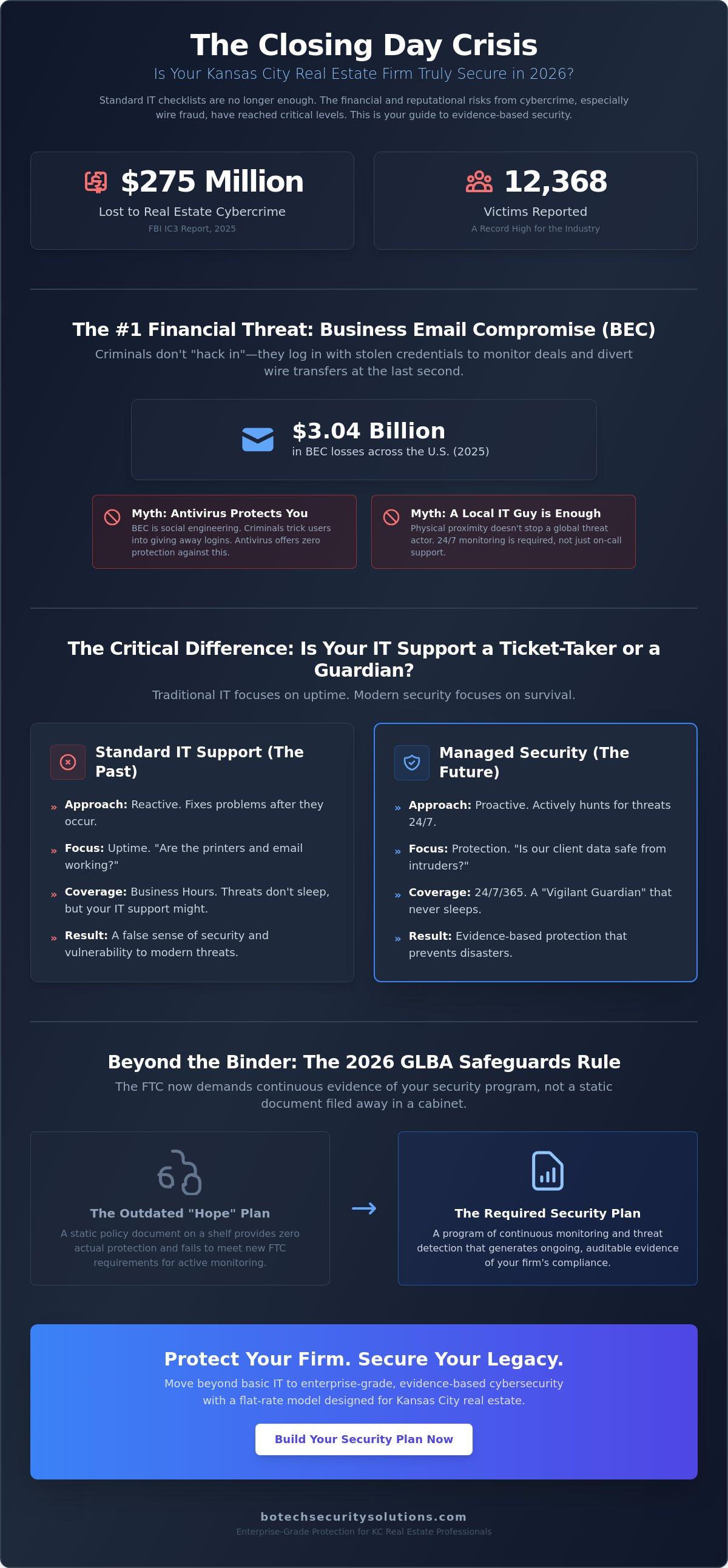
In 2025, real estate cybercrime hit a record high with over $275 million in losses across 12,368 victims according to the FBI Internet Crime Complaint Center. Most local firm owners believe their basic IT checklist or a simple firewall makes them immune to these closing day disasters. The uncomfortable truth is that most are not protected. Effective cybersecurity for real estate companies kansas city requires more than just reactive fixes; it demands a system built for high-stakes accountability.
You likely feel the constant pressure of protecting sensitive client data while agents insist on using personal devices for convenience. It's exhausting to juggle deal-closing speed with the fear of a single wire fraud incident ending your firm's reputation. This guide will show you how to move beyond basic checklists to satisfy 2026 GLBA Safeguards Rule requirements with enterprise-grade security.
We'll break down the difference between perceived security and actual evidence-based protection. You'll gain a clear framework for generating the compliance evidence the FTC now demands under the May 2024 amendment. This is how you protect your firm's legacy and your clients' money in the Kansas City market.
Key Takeaways
- Recognize why standard IT checklists fail to prevent wire fraud and how one compromised email can kill a high-stakes transaction.
- Move beyond reactive fixes to 24/7 Managed Detection and Response that actively hunts threats while your office is closed.
- Navigate the 2026 GLBA requirements by building a compliance program that generates continuous evidence instead of just filing away a static document.
- Implement a framework for cybersecurity for real estate companies kansas city that protects your firm’s reputation and satisfies the FTC’s breach-reporting mandates.
- Shift to a flat-rate security model that provides enterprise-grade protection without the overhead of an internal security team.
The Closing Day Crisis: Why Standard IT Support Fails Kansas City Real Estate
Closing day should be a celebration. For one Kansas City brokerage in late 2025, it became a legal nightmare. A single compromised email sent from an agent's account diverted a $120,000 down payment to a fraudulent account in minutes. Most agency owners believe they are safe because their printers work and their internet is fast. The uncomfortable truth is that most are not. You don't have a security problem until the moment you do, and by then, the commission and the client's trust are already gone.
Traditional IT support focuses on uptime and helpdesk tickets. If your email is "up," they consider the job done. However, according to the FBI Internet Crime Complaint Center (IC3) 2025 Report, Business Email Compromise (BEC) losses reached a staggering $3.04 billion across nearly 25,000 complaints. A "working" inbox is exactly what a criminal needs to monitor your deals and strike when the stakes are highest. Relying on reactive support in this environment is a strategy for failure.
To better understand how these local threats manifest, watch this report on a Kansas City realtor who was targeted:
The Myth of the 'Secure' Inbox
Criminals don't "hack" in; they log in. BEC specifically targets the real estate transaction lifecycle by waiting for the exact moment wire instructions are discussed. Your basic antivirus provides zero protection against a socially engineered login where the user hands over their credentials to a fake portal. Business Email Compromise is the #1 financial threat to real estate firms in 2026. Without multi-factor authentication and active email monitoring, your inbox is an open door for sophisticated actors.
Why Proximity is the Least Important Factor
Many firms rely on a local "IT guy" because they can see him in person. This proximity offers a false sense of security that does not stop a digital intruder. A local vendor acting as a "ticket-taker" cannot monitor global, 24/7 threats that evolve every hour. This is why many organizations are moving toward managed it services kansas city that prioritize a security-first mindset. You need a Strategic Ally who treats your data with the same gravity as your high-stakes transactions.
Effective cybersecurity for real estate companies kansas city requires a partner who hunts for threats before they trigger a crisis. You need a system that satisfies the GLBA Safeguards Rule through continuous evidence, not just a static document on a shelf. In the current market, you are either protected by enterprise-grade vigilance or you are one click away from a deal-killing incident. There is no middle ground for organizations that cannot afford to get this wrong.
Beyond the Checklist: Managed Detection and Response for High-Stakes Transactions
Most brokerages in the Metro area believe they are protected because their IT vendor updates their software. Most are not. They are operating on a "hope" plan rather than a security plan. In the high-stakes environment of 2026, a static checklist is an invitation for disaster. True cybersecurity for real estate companies kansas city requires moving beyond basic maintenance to Managed Detection and Response (MDR).
There is a binary distinction between Managed IT and Managed Security. Managed IT keeps your printers connected and your software running; it focuses on productivity. Managed Security keeps you safe by assuming an intruder is already trying to find a way in. MDR acts as a Vigilant Guardian that never sleeps. It provides 24/7 threat hunting that monitors your environment even when your office on Ward Parkway is closed for the weekend.
Effective protection is built on continuous action rather than annual audits. While basic vendors offer a piece of paper, a Strategic Ally provides a stream of evidence. If you want to see how these standards apply to your specific firm, you can review our managed security services to understand the enterprise-grade gap. This is the difference between hoping you are safe and knowing you are protected.
24/7 Endpoint Monitoring: The Digital Sentry
In a real estate context, an "endpoint" is any device that handles client data. This includes the laptops your agents take to open houses, the tablets used for digital signatures, and the mobile phones receiving sensitive texts. Monitoring must happen at the device level because modern attackers use "living off the land" techniques. These attacks use legitimate system tools to bypass traditional firewalls. MDR identifies these subtle anomalies in real-time before they can pivot to your financial data.
Security Awareness: Training the Most Vulnerable Link
Agents are high-value targets because they are public-facing by necessity. Their contact information is everywhere, making them the perfect entry point for phishing. According to the 2024 Verizon Data Breach Investigations Report (DBIR), 68% of breaches involved a non-malicious human element, such as falling for a socially engineered email. Building a "human firewall" through simulated phishing is not optional. It is a core requirement for any firm that cannot afford to get security wrong.
You can find more Essential Cybersecurity Resources through the FTC to help educate your team on basic hygiene. However, training alone is not a replacement for enterprise-grade monitoring. If you are concerned about your current vulnerabilities, it may be time to speak with a security expert to find out where your agency actually stands.
The GLBA Safeguards Rule: Moving from Compliance Documents to Continuous Evidence
Many brokerages treat compliance like a high school term paper. They write it once, file it away, and hope they never have to look at it again. This approach is a liability. For cybersecurity for real estate companies kansas city, the Gramm-Leach-Bliley Act (GLBA) Safeguards Rule has fundamentally changed the requirements for protecting nonpublic personal information. A compliance document is just a piece of paper; a compliance program is a continuous stream of evidence.
Section 314.4(c) of the GLBA Safeguards Rule specifically mandates the design and implementation of safeguards to control risks, along with regular monitoring and testing. If you aren't actively testing your defenses, you aren't compliant. Organizations That Cannot Afford to Get This Wrong understand that audit-readiness isn't a seasonal event. It's a daily operational standard that protects both the firm's reputation and its bank account.
Generating Ongoing Evidence for Regulators
Modern regulators aren't interested in your intent; they want proof of your actions. Automated evidence collection for a Kansas City brokerage means having a system that logs every MFA challenge, every patch applied, and every blocked threat in real-time. Simply having a "Security Policy" folder on a shared drive won't satisfy an auditor after a breach. You need a hipaa compliance solution mindset that translates to the real estate sector, ensuring that every security control is verifiable at a moment's notice.
Vulnerability Assessments: Finding the Gaps Before Hackers Do
A one-time security scan is a snapshot of a single moment. It's obsolete the day after it's finished because new threats emerge hourly. Real estate firms need recurring vulnerability assessments paired with a clear Remediation Roadmap. This roadmap prioritizes technical gaps based on risk rather than convenience. You can find more industry-specific guidance on Cybersecurity for Real Estate through the National Association of REALTORS® to help benchmark your current efforts.
The uncomfortable truth is that your current IT provider probably isn't checking their own work. Most vendors avoid third-party audits because they don't want their shortcuts exposed. True cybersecurity for real estate companies kansas city requires a partner who is willing to be held accountable by the data. You don't need a vendor who promises "everything is fine"; you need a Strategic Ally who provides the evidence to prove it.
Building a Resilient Real Estate Agency: Essential Cybersecurity Resources
If you aren't implementing these five core pillars, you're essentially inviting a breach into your firm. Protecting sensitive transaction data is about more than just convenience; it's about preserving the integrity of the professional relationships you've built. Modern cybersecurity for real estate companies kansas city requires a specific set of tools that provide high value for small to mid-sized teams without the complexity of an enterprise IT department.
You must treat your digital paper trail with the same gravity as attorney-client privilege. A single leak of closing documents or personal financial information can trigger the FTC’s 30-day breach-reporting requirement under the May 2024 amendment. Building resilience means moving from a reactive stance to a prepared one by using resources that actively defend your perimeter. If you want to see how your current setup measures up against these standards, you should request a professional security assessment today.
The Real Estate Security Resource Kit
Multi-Factor Authentication (MFA) is the non-negotiable floor of your security strategy. Without it, a single phished password gives an intruder total access to your transaction history. You also need active Dark Web monitoring to know the moment an agent’s credentials are put up for sale. Hackers often target local professionals in areas like Overland Park or Lee's Summit, hoping to catch brokerages that haven't updated their security posture in years.
Encrypted email and secure transaction management platforms are equally vital. These tools ensure that your sensitive "paper trail" remains digital and secure from end to end. If you're sending unencrypted wire instructions via standard email, you're providing a roadmap for criminals to intercept your client's funds.
Backup Management and Validation
Having a backup is useless if that backup hasn't been validated and tested recently. Many firms discover their backups are corrupted or incomplete only after a disaster strikes. This is a critical vulnerability because many common cyber attacks now specifically target and delete local backups to force a ransom payment. To secure your firm's history, follow the 3-2-1 backup rule: keep three copies of your data on two different media types with one version stored securely offsite.
Validation means more than just checking a "success" log in your software. It requires periodic recovery tests to ensure your team can actually be back online within hours, not weeks. In the real estate world, downtime equals lost deals. You need a partner who takes ownership of this process so you can focus on closing transactions with total confidence.
The BoTech Approach: Enterprise-Grade Protection for KC Real Estate Professionals
BoTech Security Solutions acts as the Strategic Ally for firms that recognize the high stakes of every local transaction. We provide enterprise-grade cybersecurity for real estate companies kansas city without the enterprise price tag. Our model is built on a flat monthly rate, ensuring you get 24/7 Managed Detection and Response without the unpredictability of hourly billing. This is the logical end to your search for peace of mind in a market that never stops.
As a Veteran-owned company, we operate with a level of discipline and integrity that most vendors cannot match. We have a mission-first approach to your safety. We don't just sell software; we take ownership of your defensive posture. This means giving you the "tough love" honesty you need to hear, even if it is uncomfortable, because we are committed to your long-term resilience.
Consolidating Security and Compliance
Managing your security with one vendor and your compliance with another is a recipe for gaps. We believe in the "One Partner" concept where protection and regulatory evidence are built into the same system. This approach simplifies the complex for busy brokerage owners who need to focus on deals rather than documentation. By consolidating these needs, you ensure that your security controls are always generating the evidence required to satisfy the GLBA.
Most vendors will tell you what you want to hear to keep a contract. We tell you what you need to hear to keep your data safe. We bridge the gap between high-end security and accessible pricing for organizations that cannot afford to get this wrong. Our goal is to move you from the chaos of potential threats to the organized calm of a compliant, secure environment.
Actionable Step: The 15-Minute Security Audit
You don't need to wait for a breach to take control of your firm's safety. Take fifteen minutes today to check the Multi-Factor Authentication (MFA) settings on your primary business email and your MLS login. These are the two most common entry points for wire fraud actors in the Kansas City market. If MFA isn't active on these accounts, you are currently operating on a "hope" plan rather than a security plan.
Once you've secured those accounts, it's time to look at your entire environment. Most agencies think they are protected because they have a firewall; most are not. Take the next step to find out where you actually stand with a free assessment. We'll show you exactly where your technical gaps are and how to build a resilient agency that protects your clients, your commissions, and your reputation.
Protecting Your Firm's Legacy in the 2026 Market
Real estate transactions are high-stakes targets. You've seen how a single wire fraud incident can destroy a decade of reputation building. Effective cybersecurity for real estate companies kansas city isn't a one-time project; it is a continuous mission. You must move from filing static compliance documents to generating the live evidence that modern regulators demand.
BoTech provides the discipline and integrity of a veteran-owned partner. We specialize in regulated sectors like real estate and legal where the cost of failure is absolute. Our flat-rate model delivers enterprise-grade MDR without the unpredictable costs of traditional vendors. We don't just fix printers; we guard your perimeter 24/7. It's time to stop guessing about your defense.
You can find out where you actually stand with a free security assessment. Secure your transactions and gain the peace of mind that comes from true protection.
Frequently Asked Questions
Is basic IT support enough for a real estate office in Kansas City?
No, basic IT support is insufficient because it focuses on productivity rather than protection. Real estate-related cybercrime resulted in over $275 million in losses in 2025 according to the FBI. While your IT guy might keep the Wi-Fi running, he isn't hunting for silent intruders in your email. Effective cybersecurity for real estate companies kansas city requires a vigilant guardian that monitors for threats every hour of every day.
What is the GLBA Safeguards Rule and does it apply to my brokerage?
The GLBA Safeguards Rule applies to any "financial institution," a definition that includes real estate brokerages handling sensitive consumer data. As of May 13, 2024, the FTC requires you to report any breach affecting 500 or more consumers within 30 days. This regulation isn't just about privacy; it's about proof. You must maintain a program that generates continuous evidence of your security controls to avoid federal penalties.
How much does professional cybersecurity cost for a small real estate firm?
Professional protection is an investment in your firm's survival, usually structured as a flat monthly rate that eliminates billing surprises. While specific costs vary based on your environment, the real question is what you can afford to lose. Total cybercrime losses exceeded $20.8 billion in 2025. Choosing comprehensive cybersecurity for real estate companies kansas city is far less expensive than managing the fallout of a single deal-killing wire fraud event.
Can managed security services help prevent wire fraud in real estate?
Yes, managed security services provide the active monitoring required to intercept Business Email Compromise before funds are stolen. In 2025, the FBI reported that BEC cost businesses $3.04 billion across nearly 25,000 complaints. Managed services enforce strict MFA and monitor for anomalous logins that reactive IT providers often miss. This proactive approach is the only way to safeguard the closing table from sophisticated digital criminals.
What is the difference between an IT provider and a Managed Security Service Provider (MSSP)?
An IT provider is a ticket-taker that fixes broken hardware; an MSSP is a strategic ally that prevents data breaches. IT vendors prioritize uptime and same-day resolution for software issues. Managed security partners prioritize threat hunting and the integrity of your client data. You need a partner who takes ownership of your safety rather than just keeping your office printers connected to the local network.
Do real estate agents need security training if they are independent contractors?
Yes, because independent contractors are often the weakest link in your digital perimeter. The 2024 Verizon Data Breach Investigations Report found that 68% of breaches involved a human element, such as an agent falling for a phishing scam. If an agent uses a personal device to access your transaction documents, they must be trained. One mistake by an uneducated contractor can trigger a full-scale notification event for your firm.
What happens if a real estate company fails a compliance audit in 2026?
Failing a compliance audit in 2026 leads to severe FTC fines and devastating reputational damage in the Kansas City market. The 30-day reporting requirement for "notification events" means your failure becomes public record very quickly. Beyond federal penalties, you face the loss of client trust and potential civil litigation from affected buyers. Compliance isn't a document on a shelf; it's the daily proof of your firm's integrity.
How does Dark Web monitoring protect my real estate agents?
Dark Web monitoring acts as an early warning system by identifying agent credentials that have been leaked in third-party breaches. If an agent's password for a personal site is the same as their MLS login, criminals will use it. This service allows you to reset passwords before a hacker uses them to access your transaction management system. It's a proactive step that stops unauthorized logins before they become financial disasters.