Employee Phishing Awareness Training: A 2026 Guide for Regulated Kansas City Firms

It’s 4:15 PM on a Friday when your office manager clicks an "urgent" link about an unpaid invoice. By Monday morning, your firm is staring down a mandatory four day SEC disclosure window and a breach that could cost your business upwards of $4.9 million. You already know that mandatory training videos are often ignored or treated as a nuisance. It’s frustrating to feel like your organization’s safety rests on the hope that no one clicks the wrong link during a busy shift.
This guide will show you how to move beyond boring slides to implement employee phishing awareness training that actually changes behavior. You'll learn how to build a culture of security vigilance that satisfies HIPAA and NIST CSF 2.0 while turning your greatest vulnerability into your strongest defense. We'll cover the transition from static compliance documents to active, evidence based security protocols that keep Kansas City firms audit ready.
Key Takeaways
- Recognize how "Kansas City Nice" is weaponized by attackers and why your office's helpful nature is now a primary security risk.
- Move beyond static PDFs to meet HIPAA 45 CFR § 164.308(a)(5) requirements through the creation of continuous, audit ready evidence.
- Implement employee phishing awareness training using a micro-learning approach that respects your staff’s time while building real defense.
- Learn why baseline testing is the only way to measure your team’s vulnerability before a real ransomware attack forces your hand.
- Bridge the gap between human error and technical protection by integrating awareness results into a broader Managed Detection and Response strategy.
The High Stakes of a Single Click in Kansas City
A paralegal at a law firm in Overland Park is rushing to finish a filing before the 5:00 PM deadline. An email pops up with a subject line about a delayed invoice that needs immediate attention. She clicks the link to resolve the issue quickly; her instinct is to be helpful and efficient. In that single moment, the firm's entire network is compromised. Her computer didn't fail, and the firewall didn't crash. She simply opened the front door and handed over the keys.
This scenario isn't just a hypothetical risk; it's a daily reality for local firms. We often talk about "Kansas City Nice" as a point of civic pride, but in the world of cybersecurity, that helpfulness is a target. Attackers weaponize our culture of cooperation to bypass millions of dollars in technical defenses. They don't need to hack your server if they can just convince a well meaning employee to click a button. To better understand how these attacks work, watch this helpful video:
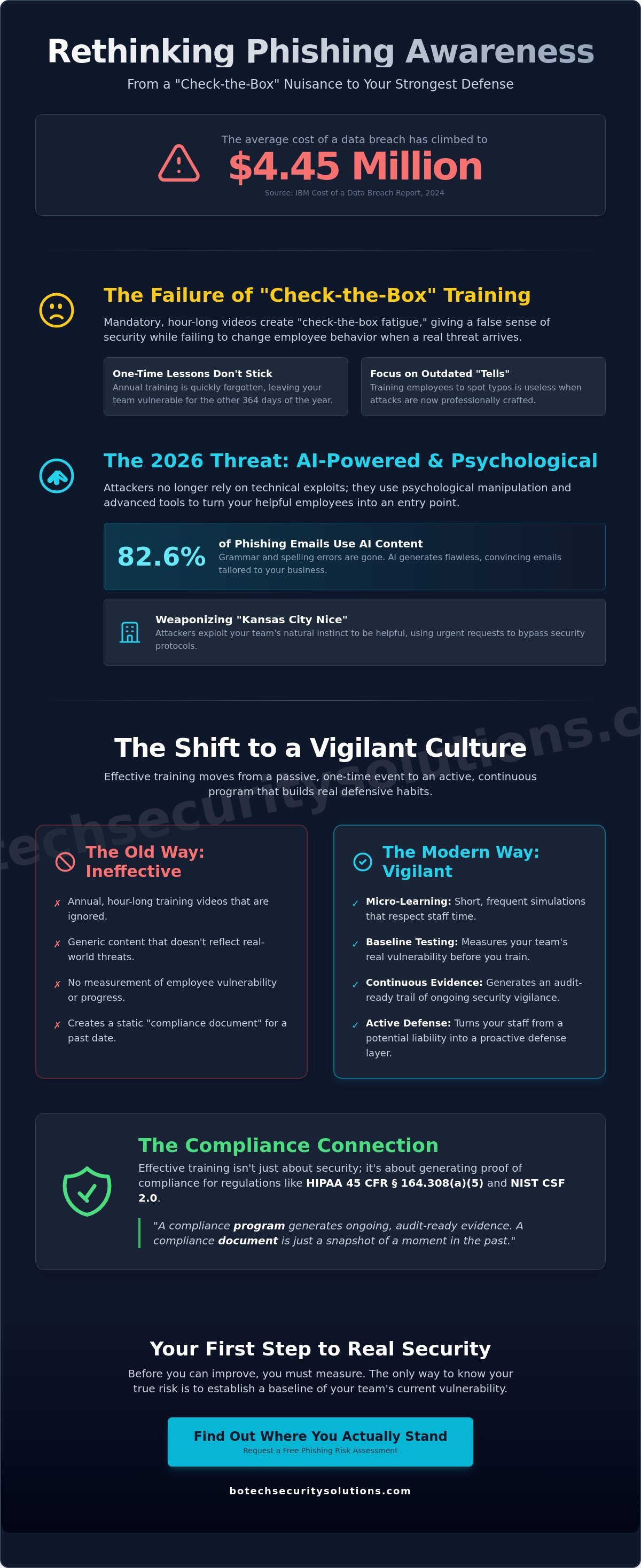
The financial disparity between prevention and failure is staggering. According to IBM’s 2024 Cost of a Data Breach Report, the average cost of a breach has climbed to $4.45 million. Investing in employee phishing awareness training is a fraction of that cost, yet many firms still treat it as an optional expense. You can have the most expensive security software in the world, but it's useless if your staff isn't trained to spot the bait. Safety isn't a technical state; it's a behavioral one.
Why Regulated SMBs are the New Primary Target
Small and mid-sized businesses in Kansas City often believe they're too small to be noticed by international hacking syndicates. This is a dangerous misconception. Most regulated SMBs lack the 24/7 monitoring that large enterprises use as a safety net, making them easy prey. Hackers frequently use smaller legal or healthcare practices as "stepping stones" to gain access to larger financial networks or sensitive patient databases. If your firm handles regulated data, you aren't just a target; you're a high-value entry point.
The Reality of Modern Social Engineering
Social engineering isn't a technical hack; it's psychological manipulation. It relies on creating a sense of urgency or fear to force a mistake. There's an uncomfortable truth that many vendors won't tell you: your most loyal, long-tenured employees are often your biggest risks. Because they feel trusted and have extensive access, they may be less likely to question an email that appears to come from a senior partner. You can learn more about these specific tactics in our guide on common cyber attacks targeting Kansas City businesses.
Modern Security Awareness Training must account for this human element. It isn't enough to tell people what to avoid; you have to train them to recognize the emotional triggers that attackers use. When an employee understands that a sense of "urgency" is actually a red flag, your defense becomes proactive rather than reactive. This shift in mindset is the difference between a secure firm and a headline in the business journal.
Why Traditional Employee Phishing Awareness Training Fails in 2026
Practice managers often feel the frustration of watching staff eye-roll through a mandatory 45-minute security video. This "Check-the-Box" fatigue is more than just an annoyance; it’s a security failure that creates a false sense of protection. The reality is that annual, one-time lessons don't stick. Recent research on training effectiveness from UC San Diego shows that traditional programs often fail to change how employees act when a real threat hits their inbox.
In 2026, the stakes are higher because the traditional "tells" have disappeared. Data from the 2026 Research Brief indicates that 82.6% of phishing emails now contain AI-generated content. This means the broken English and weird formatting we used to look for are gone. Modern employee phishing awareness training must move beyond these outdated red flags and focus on building vigilance as a daily habit.
The Death of the 'Typo' Red Flag
Cybercriminals now use Large Language Models to mimic a CEO’s specific tone and vocabulary with perfect accuracy. If your team is only looking for spelling errors, they'll miss the sophisticated attack that looks exactly like a legitimate internal request. We have moved from a world of "looking for errors" to a world where we must "verify the context" of every request. The old advice of "don't click links" is simply impossible for a modern office to follow. Staff members have to click links to process invoices and manage patient records; they need to know how to validate the source before they interact.
Punitive Training vs. Positive Security Culture
Shaming an employee who fails a simulated test is a recipe for disaster. When people feel punished for mistakes, they stop reporting them, which leaves your firm blind to active threats. A successful model celebrates the employee who flags a suspicious email rather than just punishing the one who clicks. This shift is particularly vital when considering Managed IT Services for Law Firms, where protecting attorney-client privilege requires a team that feels safe coming forward.
If your current program feels like a chore rather than a defense, it might be time to evaluate your current security culture. Effective employee phishing awareness training should empower your staff to be the first line of defense, not the weakest link. By moving away from punitive measures, you create an environment where transparency is the standard and security becomes a shared responsibility.
The Compliance Connection: Training as Regulatory Evidence
When an auditor walks through your door, they aren't looking for a mission statement or a promise to do better. They want proof of action. For many Kansas City firms, the uncomfortable truth is that a signed PDF from 2024 is not evidence of a 2026 compliance program. Auditors today demand dynamic logs that show active, ongoing participation in employee phishing awareness training.
There's a critical distinction between a compliance document and compliance evidence. A document is static; it tells a story about what you intended to do years ago. Evidence is dynamic; it provides a real-time record of your organization's current security posture. In a high stakes regulatory environment, the former is a liability, while the latter is your primary defense during an investigation.
HIPAA and the Human Element
Under HIPAA 45 CFR § 164.308(a)(5), implementing a security awareness and training program is a mandatory administrative safeguard. The Office for Civil Rights (OCR) often views the absence of recent, documented training as "willful neglect" during a breach audit. If you can't produce logs of simulated phishing results, you're essentially telling regulators that you've ignored the most common entry point for ransomware. This oversight can lead to catastrophic fines that far exceed the cost of a proactive Kansas City HIPAA Compliance Solution.
SOC 2 and Financial Services Requirements
Financial firms in the metro area face even tighter scrutiny under the SOC 2 Trust Services Criteria, specifically within the Security pillar. Continuous monitoring isn't just for your servers and firewalls; it applies to your people too. Modern auditors expect to see granular reporting on employee risk scores to prove that your organization is identifying and remediating human vulnerabilities as they appear. Maintaining these detailed, audit ready logs is a core component of Managed IT Support Services that prioritize security over simple helpdesk tickets.
Compliance is a verb, not a noun. It requires a constant stream of data to prove that your defenses are actually working. Dynamic employee phishing awareness training provides the ongoing evidence required to survive a regulatory review. It transforms a static requirement into a measurable defense layer that protects both your firm's reputation and its bottom line.
Building an Effective Phishing Awareness Program
Sending your first simulation shouldn't be about catching employees in a trap. It's about gathering baseline data to understand where your firm actually stands. You can't fix a vulnerability you haven't measured; you need to know which departments are most likely to click before you spend a dime on education. Effective employee phishing awareness training starts with this sobering reality check.
Once you have a baseline, the next step is moving away from the "death by PowerPoint" model. Busy practice managers don't have 40 minutes for a webinar, and neither do their staff. Micro-learning delivers two minute lessons that respect the reader's time while keeping security at the front of their mind. This consistent, low friction approach builds a culture of vigilance rather than a culture of resentment.
Your simulations must mirror the threats your team actually sees in their inbox. We use templates that reflect local Kansas City business themes, like Missouri tax updates or KC Chamber of Commerce invitations. A generic "PayPal" scam is easy to spot; a localized, contextually relevant email is a true test of your team's defenses. Data from the 2026 Research Brief shows it takes only 21 seconds for a user to click a phishing link, so your training must be just as fast and sharp.
Designing Simulations That Actually Teach
Simulations should vary in difficulty to challenge both the new hire and the seasoned partner. When an employee does click a link, they should be met with an immediate "teachable moment" landing page. This feedback is most effective when it happens in the flow of work, rather than weeks later in a performance review. There is an uncomfortable truth here: using "impossible" phishes that no human could detect destroys employee trust. Your goal is to build a partner in security, not to win a game of "gotcha."
Measuring Success Beyond the Click Rate
Most managers obsess over the "Click Rate," but that's only half the story. The "Report Rate" is a far more important metric for organizational safety. You want a team that doesn't just avoid the link but actively flags it for your security team to investigate. We use "Time-to-Report" as a key performance indicator; the faster a threat is reported, the faster we can neutralize it across your entire network. You can find more security templates and guidance in our Resources section.
Remediation should be targeted specifically to high-risk clickers rather than punishing the entire office. This allows you to provide extra support where it's needed most without slowing down your most vigilant staff. If you want to see how your team measures up against these benchmarks, you should request a baseline phishing assessment today. Integrating this data into your overall security posture ensures that your human defense layer is just as robust as your technical one.
BoTech’s Vigilant Approach to Human Risk Management
At BoTech, we don't believe in handing you a login and wishing you luck. We integrate employee phishing awareness training directly into our 24/7 Managed Detection and Response model. This means your human defense layer isn't an island; it's a coordinated part of your technical security stack. If a staff member misses a red flag, our system is already watching for the fallout to prevent a localized mistake from becoming a firm wide disaster.
We operate with a "Watchful Protector" philosophy. We don't just sell software; we take ownership of the outcome. For a busy office manager in Kansas City, the administrative burden of scheduling simulations and tracking remedial lessons is often what causes programs to fail. We handle that entire lifecycle for you. As a veteran owned company, we bring a level of discipline and no-nonsense protection that ensures your security protocols are executed with precision.
The BoTech Difference: Evidence Over Documents
As we discussed earlier, a static document is a liability. Our platform generates the continuous, automated evidence stream that SOC 2 and HIPAA auditors demand. You get a single point of contact for both your technical defenses and your human risk management. There is a profound sense of relief in knowing that your compliance logs are being built in the background while you focus on your practice.
Next Steps for Your Kansas City Organization
You can take one specific action right now to gauge your current risk level. Open your current employee phishing awareness training portal and check for any activity in the last 90 days. If those logs are empty or outdated, your firm is currently operating without a verified human defense layer. It’s time to move from the anxiety of the unknown to the organized calm of a managed environment.
We invite you to explore our full suite of Managed Security Services to see how we can consolidate your complex needs into a single, reliable partnership. Protecting your firm is about more than just checking a box. It’s about building a proactive defense that stands up to real world threats and regulatory scrutiny.
Moving from Anxiety to Audit-Ready Protection
Relying on a signed training sheet from last year is no longer a valid defense. True security requires a shift from passive tasks to a culture where every staff member actively protects your firm's data. You now understand that AI has erased the obvious typos of the past. Your defense depends on employee phishing awareness training that emphasizes context and builds a reporting habit to stop threats before they compromise your network.
As a veteran owned and operated firm based here in Kansas City, we specialize in the high stakes requirements of HIPAA and SOC 2 compliance. We don't just provide software; we manage the entire outcome to ensure your organization is always audit ready. It's time to stop worrying about potential vulnerabilities and start building a proactive, evidence based defense layer.
Find out where your organization actually stands with a free Security Assessment. You have the tools to transform your team into a proactive shield that satisfies regulators and protects your practice’s reputation. We're here to help you make that transition with confidence.
Frequently Asked Questions
How often should employee phishing awareness training take place?
Monthly micro-learning is the gold standard for 2026. Annual videos are forgotten within days; a recurring cycle keeps vigilance as a baseline behavior. This approach ensures your staff is prepared for the 3.4 billion phishing emails sent daily, as reported by the 2026 Research Brief.
Is phishing training required for HIPAA compliance?
Yes, HIPAA requires periodic security updates and training for all workforce members. While the regulation doesn't name phishing specifically, the Office for Civil Rights expects you to address the most common threats to Protected Health Information. Failing to provide employee phishing awareness training can be classified as willful neglect during an audit.
What happens if an employee fails a simulated phishing test?
A failure should trigger immediate, non-punitive micro-learning. We focus on teachable moments where the employee sees exactly what they missed while the context is still fresh. Punishment only encourages staff to hide their mistakes, which is the most dangerous outcome for your firm.
Can phishing awareness training prevent ransomware?
Training is your most effective defense against ransomware because phishing is the primary entry point for these attacks. While technical filters catch many threats, it only takes one successful click to encrypt your entire server. Educated employees act as a human firewall that technical tools simply cannot replicate.
How do I know if my current training program is actually working?
You measure success by your Report Rate rather than just looking at who clicked. A healthy program shows an increase in employees using the report button and a decrease in the time it takes to flag a threat. If your team isn't actively reporting suspicious emails, your training isn't sticking.
What are the most common phishing themes targeting businesses in 2026?
Attackers are currently focusing on financial exploitation and cryptocurrency scams, often mimicking local Kansas regulatory updates. In 2026, we see a rise in themes related to the Kansas Consumer Protection Law (HB 2591). These emails are highly personalized and often use AI to remove traditional errors.
Do small businesses really need simulated phishing attacks?
Small businesses are actually at higher risk because they often lack enterprise level monitoring. Simulations are the only way to safely test your team's reaction to a real world threat without risking your data. It's better to fail a controlled test than to learn the hard way during a live breach.
How long does it take to see results from a new training program?
You'll see an immediate change in awareness after the first baseline test. However, a true shift in organizational culture usually takes three to six months of consistent employee phishing awareness training. Lasting behavioral change requires repetition and reinforcement until reporting becomes second nature.