How to Prevent Phishing: A 2026 Guide for Kansas City Organizations That Cannot Afford to Get This Wrong

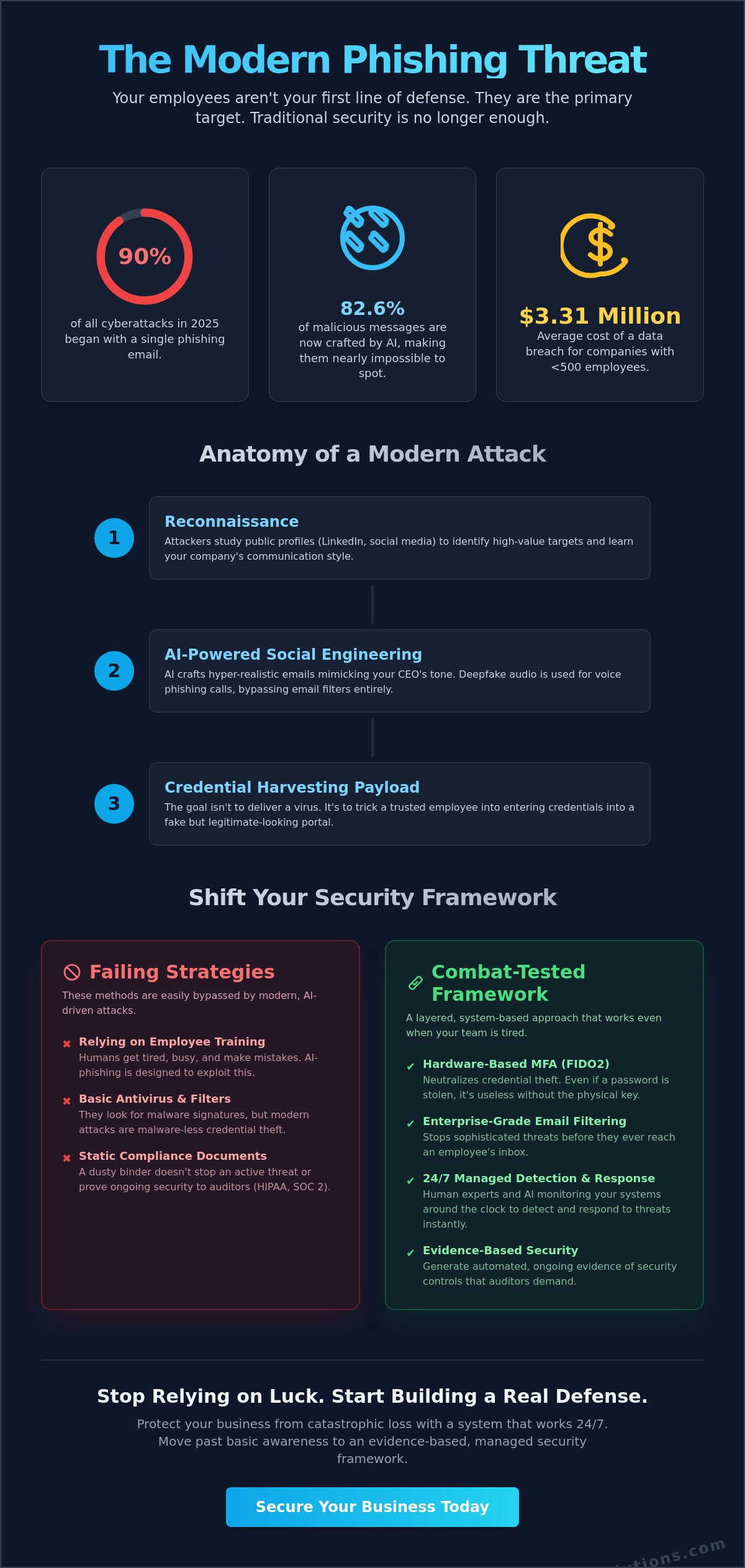
Your employees are not your first line of defense. They are your most exploited vulnerability. Over 90% of all cyberattacks in 2025 began with a single phishing email. You likely feel the pressure to figure out how to prevent phishing as AI tools now craft 82.6% of these malicious messages, making them nearly impossible for a busy office manager to spot.
We understand the anxiety of managing HIPAA compliance or the new Missouri Insurance Data Security Act while your staff faces 3.4 billion phishing attempts daily. It's exhausting to maintain audit readiness when one wrong click could cost your practice an average of $3.31 million. Most vendors tell you that more training is the answer; most are not telling you the truth. You need a system that works even when your team is tired.
This guide delivers a combat-tested framework to protect your regulated Kansas City business from catastrophic data breaches. You'll learn the high-stakes reality of modern threats and the technical shift toward passwordless authentication recommended in NIST Special Publication 800-63-4. We are moving past basic awareness into a secure environment that generates the automated evidence you need for SOC 2 or HIPAA audits.
Key Takeaways
- Understand why modern phishing bypasses standard antivirus by targeting human psychology and harvesting credentials rather than just delivering malware.
- Discover how to prevent phishing by implementing hardware-based MFA (FIDO2) that neutralizes the threat of AI-driven social engineering.
- Learn why a static compliance document fails to meet HIPAA Section 164.308 requirements and how to generate the ongoing evidence auditors actually demand.
- Stop relying on employee memory and start using enterprise-grade email filtering to stop 2026-level threats before they reach the inbox.
- Shift your strategy from basic awareness training to 24/7 Managed Detection and Response to protect your Kansas City practice from catastrophic financial loss.
The High Stakes of Phishing in the Kansas City Metro
A single click in an Overland Park medical office isn't just a mistake. It's a $2 million HIPAA settlement waiting to happen. In 2026, phishing has evolved from messy mass emails into a surgical social engineering operation targeting the heart of the Midwest. You need to know how to prevent phishing because the "good enough" security your firm relies on is effectively a screen door against a battering ram. You are either protected or you are a target. There is no middle ground.
To better understand the current landscape and how these attacks bypass traditional defenses, watch this helpful video:
Here is the uncomfortable truth: your current antivirus is likely blind to the most dangerous phishing tactics used today. Most software looks for known malicious files, but modern attackers don't use files. They use psychological manipulation and stolen credentials to walk right through your front door. To understand the Anatomy of a Modern Phishing Attack, you have to look past the technology and focus on the human element. Most vendors won't tell you that their software is failing; most are not being honest about the gap between a compliance document and actual security.
Why Kansas City Businesses Are Prime Targets
The concentration of high-value data along the Lee’s Summit and Bentonville corridors makes our region a goldmine for attackers. Hackers often prefer mid-sized, regulated firms over global giants. Global corporations have massive security budgets, but a mid-sized firm in Kansas City has the same valuable data with a fraction of the defense. Imagine a local law firm losing years of client discovery data because a paralegal clicked an "urgent invoice" link that looked identical to their accounting software. For companies with fewer than 500 employees, the average cost of a data breach is now $3.31 million according to IBM’s 2025 report. You can't afford that kind of "learning experience."
The Shift from 'Fishing' to Surgical Precision
In 2026, AI-generated phishing mimics the specific writing style and voice of a KC-based CEO with terrifying accuracy. Attackers now use deepfake audio to call office managers, bypassing traditional email filters entirely. This isn't a training problem; it's a detection problem. Organizations that cannot afford to get this wrong must move beyond basic awareness. Real security requires enterprise-grade protection that generates ongoing evidence of safety, not just a signed training sheet that gathers dust. If you aren't using a managed approach, you're just waiting for the inevitable.
Anatomy of a Modern Phishing Attack: Why Your Antivirus Fails
Your antivirus is looking for a signature that doesn't exist. Modern phishing is a surgical operation, not a random broadcast, and it moves through three distinct stages: reconnaissance, social engineering, and the final payload. In the reconnaissance phase, attackers study your public LinkedIn profiles and social media to identify high-value targets like your financial controller or practice manager. They know who you work with and what your internal emails likely sound like.
The social engineering stage in 2026 uses AI to scrape your brand's tone and mimic your internal communication style with terrifying accuracy. Finally, the payload is delivered. It's rarely a "virus" anymore; it's a legitimate-looking portal designed to harvest your data. Most security providers focus on the tools; most are not addressing the fact that your team is being outmaneuvered by AI scripts. This is why you must understand A Combat-Tested Framework for How to Prevent Phishing.
Here is the uncomfortable truth that most vendors avoid: your employees are your most exploited vulnerability. Antivirus software is designed to stop malicious code, but it's powerless when a trusted staff member willingly enters their credentials into a fake site. According to the IBM Cost of a Data Breach Report 2025, the average cost of a breach caused by phishing reached $4.88 million. This isn't a technical glitch; it's a human failure that bypasses traditional security layers.
Credential Harvesting and Session Hijacking
Simple password protection is dead. Attackers now use "Man-in-the-Middle" phishing sites that look identical to a Google Login page to capture both your password and your Multi-Factor Authentication (MFA) code in real time. Once they have this, they steal your session cookies. This allows them to bypass MFA entirely by convincing the server they are already logged in. You should review your Google Account Security Settings immediately to see where your current gaps exist.
Business Email Compromise (BEC) in Regulated Industries
BEC attacks are particularly dangerous for financial controllers in the Kansas City and Tulsa regions. These attacks don't involve malware, so your antivirus software remains silent while your money disappears. Business Email Compromise resulted in $2.77 billion in reported losses in the US in 2025 according to FBI data. Imagine a real estate closing where an attacker, who has been silently monitoring your inbox for weeks, sends a perfectly timed wire transfer request from a "lawyer's" address. The grammar is perfect, the timing is impeccable, and the loss is often permanent. If you want to see how vulnerable your current email setup actually is, we can help you find out where you stand.
Regulatory Reality: The Real Cost of a Click for Regulated KC Firms
Most business owners think compliance is a pile of papers stored in a desk drawer. Most are not prepared for the reality of a federal audit. Under HIPAA Section 164.308(a)(5)(ii)(A), you must implement a security awareness and training program. This is a mandatory requirement for any healthcare practice in the Kansas City metro. If a single click leads to a breach, you face mandatory reporting to the Office for Civil Rights (OCR). In 2025, the OCR investigated 742 large-scale breaches, many of which originated from simple phishing emails.
Here is the BoTech Core Distinction: a compliance document is not evidence of a security posture. Having a written policy that outlines how to prevent phishing is a start, but it isn't proof of protection. Auditors don't want to see your intentions; they want to see your evidence. If you cannot produce logs showing that your staff actually recognized and reported threats, your policy is just expensive wallpaper. You are either generating evidence or you are generating liability.
SOC 2 readiness requires the same level of granular detail. A training certificate from a generic HR portal won't satisfy a modern auditor. They demand proof of a living security culture. You need a managed system that generates continuous evidence of active defense and employee vigilance. Organizations that cannot afford to get this wrong know that a "one-and-done" approach is a fast track to a failed audit.
HIPAA and the Security Awareness Training Requirement
Annual training is a checkbox, not a shield. It fails the HIPAA audit test because it doesn't account for the evolving nature of social engineering. You must deploy ongoing, simulated phishing campaigns to generate the "evidence of compliance" regulators demand. HIPAA classifies training as an "Addressable" implementation specification, which leads many to believe it's optional. Most are not aware that "Addressable" means you must implement it or a documented, equivalent alternative. In 2026, there is no equivalent alternative to a well-trained, tested staff.
The PCI DSS 4.0 Standard for Kansas City Retailers
Retailers and service providers in Lee’s Summit or Overland Park must now answer to the PCI DSS 4.0 standard. This regulation demands automated email security and real-time endpoint monitoring to stop credential theft before it starts. A phishing-led breach can lead to massive fines and the permanent loss of your ability to process credit cards. We often see this overlap in the legal sector, where Managed IT Services for Law Firms are required to protect both financial data and attorney-client privilege. If your security doesn't produce evidence, it doesn't count.
A Combat-Tested Framework for How to Prevent Phishing
Basic email security is a myth. You've likely heard of SPF and DKIM, but in 2026, these are just the bare minimum. To truly understand how to prevent phishing, you must implement a multi-layered framework that assumes your perimeter will eventually be tested. Most vendors sell you a tool and walk away; we build a system that generates evidence. You are either actively defending your network or you are waiting for a breach.
Step one is moving to a DMARC "Reject" policy. Most are not configured this way, leaving their domains open to spoofing and impersonation. You also need AI-based analysis that scans for unusual sentiment or an urgent tone in messages. These technical gaps are often widened by Inadvertent Actions such as Using Easy Passwords, which make an attacker's job significantly easier. When your technical perimeter is weak, your employees are forced to make perfect decisions every single day.
Step two is deploying hardware-based MFA like FIDO2 keys for your high-privilege accounts. The NIST Special Publication 800-63-4 draft from September 2024 explicitly pushes for phishing-resistant, passwordless methods. This stops session hijacking cold, even if an employee enters their credentials on a fake site. You must also implement Endpoint Detection and Response (EDR) to catch "post-click" activity. If a user does click, EDR is the safety net that stops the threat from moving laterally through your network.
Strengthening the Technical Perimeter
Your technical defense must be proactive. DMARC "Reject" policies are the baseline for 2026 security because they tell receiving servers to block unauthorized emails immediately. AI-based email security tools now analyze the context of a message rather than just looking for bad links. They can flag a request that sounds like your CEO but originates from an unusual location. Finally, a Zero-Trust architecture ensures that no user or device is trusted by default, even if they are inside your Overland Park office.
The Human Element: Training That Actually Sticks
I don't believe in boring, corporate slide decks that employees ignore. You need simulated attacks that mirror actual local threats, like a fake email about a Kansas City tax update or a local vendor invoice. We use a "Just-in-Time" model where an employee who clicks is educated at the exact moment of failure. This allows you to measure your "Phish-Prone Percentage" and track organizational risk over time. According to 2025 industry benchmarks, regular simulation can drop this risk from over 30% to under 5% within 12 months. If you're ready to stop guessing and start securing, get a managed security assessment today to see where your framework is failing.
Beyond Training: Building a Culture of Evidence-Based Security
Training is a critical piece of the puzzle, but it isn't the whole picture. If your strategy for how to prevent phishing begins and ends with a monthly video, you're still vulnerable. You need a partner who watches your back when you're focused on your patients or your clients. Most vendors sell you a software license and hope for the best; most are not being honest about the gap between a tool and a total defense.
We provide 24/7 Managed Detection and Response (MDR) designed for Kansas City businesses that need enterprise-grade safety without the enterprise price tag. Our flat-rate model means you get predictable costs and a veteran-owned team that treats your security like a mission. This isn't just about blocking emails. It's about generating the ongoing evidence required to survive a HIPAA or SOC 2 audit. You are either generating evidence or you are generating liability.
A compliance document is just a piece of paper. Real security is the log file that proves an attack was stopped at 3:00 AM on a Sunday. Organizations that cannot afford to get this wrong know that a "one-and-done" approach is a fast track to a failed audit and a catastrophic breach. You deserve the relief of knowing an expert team is hunting for threats while you run your practice.
The BoTech Advantage: 24/7 Vigilance
Our security operation center (SOC) doesn't sleep. We monitor for "impossible travel" alerts, such as an employee logging in from Olathe and then appearing in a foreign data center ten minutes later. This proactive threat hunting stops an attack before the ransom is even demanded. We see the patterns that automated filters miss.
We are local and present across the Kansas City metro, from Olathe to Blue Springs. We understand the specific threats facing our regional healthcare and legal sectors. We don't just report problems; we take ownership of the solution. You get the peace of mind that comes from a strategic ally who understands your high-stakes environment.
Taking the First Step Toward Real Protection
You can improve your posture right now. Audit your MFA settings across every administrative account you own today. Ensure that no one has "remember this device" set for longer than 24 hours on high-privilege systems. This is a simple, actionable way to harden your defenses and close a common loophole that attackers love to exploit.
A "Free Assessment" isn't a sales pitch. It's the only way to find out where you actually stand before an attacker finds out for you. Stop guessing about your security and start building a culture of evidence. Contact BoTech for a Free Security Assessment to find out where you actually stand and secure your organization's future.
Secure Your Practice Against the Next Evolution of Phishing
You now have the framework to move from a state of anxiety to a position of strength. Phishing is a surgical operation that costs businesses an average of $4.88 million according to the IBM 2025 report. Understanding how to prevent phishing means acknowledging that your current antivirus is insufficient against AI-driven social engineering. You need a system that generates continuous evidence for HIPAA or SOC 2 audits while providing 24/7 protection.
BoTech Security Solutions bridges the gap between enterprise-grade protection and small business flat rates. As a veteran-owned partner, we specialize in the high-stakes requirements of HIPAA, SOC 2, and PCI DSS compliance. We don't just give you a compliance document; we provide the managed security posture that keeps your data safe. You are either protected or you are vulnerable. Most are not prepared for the reality of an audit; you don't have to be one of them.
Find out where you actually stand with a Free Security Assessment.
Your organization can be both secure and compliant. We are here to help you build that reality.
Frequently Asked Questions
What is the most common phishing tactic used against Kansas City businesses in 2026?
Business Email Compromise (BEC) powered by generative AI is the dominant threat facing our local metro area. Attackers use AI to scrape public data and mimic the specific tone of local executives with terrifying accuracy. In 2025, BEC resulted in $2.77 billion in reported losses according to the FBI. These attacks rarely use malicious links; instead, they rely on fraudulent wire requests that look perfectly legitimate to a busy office manager.
Can MFA really be bypassed by a phishing attack?
Traditional push-notification or SMS multi-factor authentication is frequently bypassed through session cookie theft or "man-in-the-middle" proxy sites. Attackers capture your login credentials and your MFA code simultaneously in real time. To truly understand how to prevent phishing in 2026, you must move to phishing-resistant hardware keys like FIDO2. These stop session hijacking because the physical key must be present to authenticate the session.
Is security awareness training required by HIPAA for my medical practice?
Yes, HIPAA Section 164.308(a)(5)(ii)(A) mandates a security awareness and training program for all covered entities. While the regulation labels this as "Addressable," you cannot simply ignore it. You must implement the training or a documented equivalent that provides the same level of protection. In a 2026 audit, a lack of ongoing training evidence is a primary cause for significant financial penalties and settlement agreements.
What should I do immediately if an employee clicks a phishing link?
You must immediately reset the user's password and revoke all active login sessions across your entire cloud environment. Revoking sessions is a critical step because attackers often steal cookies to stay logged in without needing to re-enter a password. After securing the account, your team must scan for lateral movement and check your mail rules for unauthorized forwarding. If you don't have 24/7 monitoring, this detection process often starts too late to prevent data exfiltration.
How much does enterprise-grade phishing protection cost for a small law firm?
Enterprise protection is delivered through a predictable monthly flat rate rather than the chaotic and devastating costs of a data breach. For companies with fewer than 500 employees, the average breach cost reached $3.31 million in 2025 according to IBM data. We focus on providing high-end security and compliance management that fits a small business budget. You are either paying for proactive protection now or paying for a catastrophic recovery later.
What is the difference between a compliance document and compliance evidence?
A compliance document is a statement of intent; compliance evidence is the technical proof that you actually followed your own rules. A signed policy saying you train your staff is just a document. A system log showing that an employee failed a simulated test and immediately completed a remediation module is evidence. Auditors in 2026 prioritize evidence because it proves your security posture is active and effective rather than just theoretical.
How do I report a phishing email to my IT provider in Overland Park?
You should forward the suspicious message as an attachment rather than using a standard forward. This method preserves the original email headers which contain the routing information your provider needs to block the sender's infrastructure. Most modern systems in Overland Park now include a "Report Phishing" button directly in the email toolbar. This action alerts your security team and can automatically remove the threat from other employee inboxes.
Can AI help me detect phishing emails before my staff sees them?
Yes, AI-driven email security is a core component of a modern, multi-layered defense system. These tools analyze the sentiment and intent of an email rather than just checking for known malicious attachments. They can flag a message that creates an artificial sense of urgency or requests a sudden change in banking details. This technical layer stops 82.6% of AI-generated threats before they ever reach your employee's inbox.