Managed Detection and Response Services in Kansas City: The 2026 CISO Advisory Guide

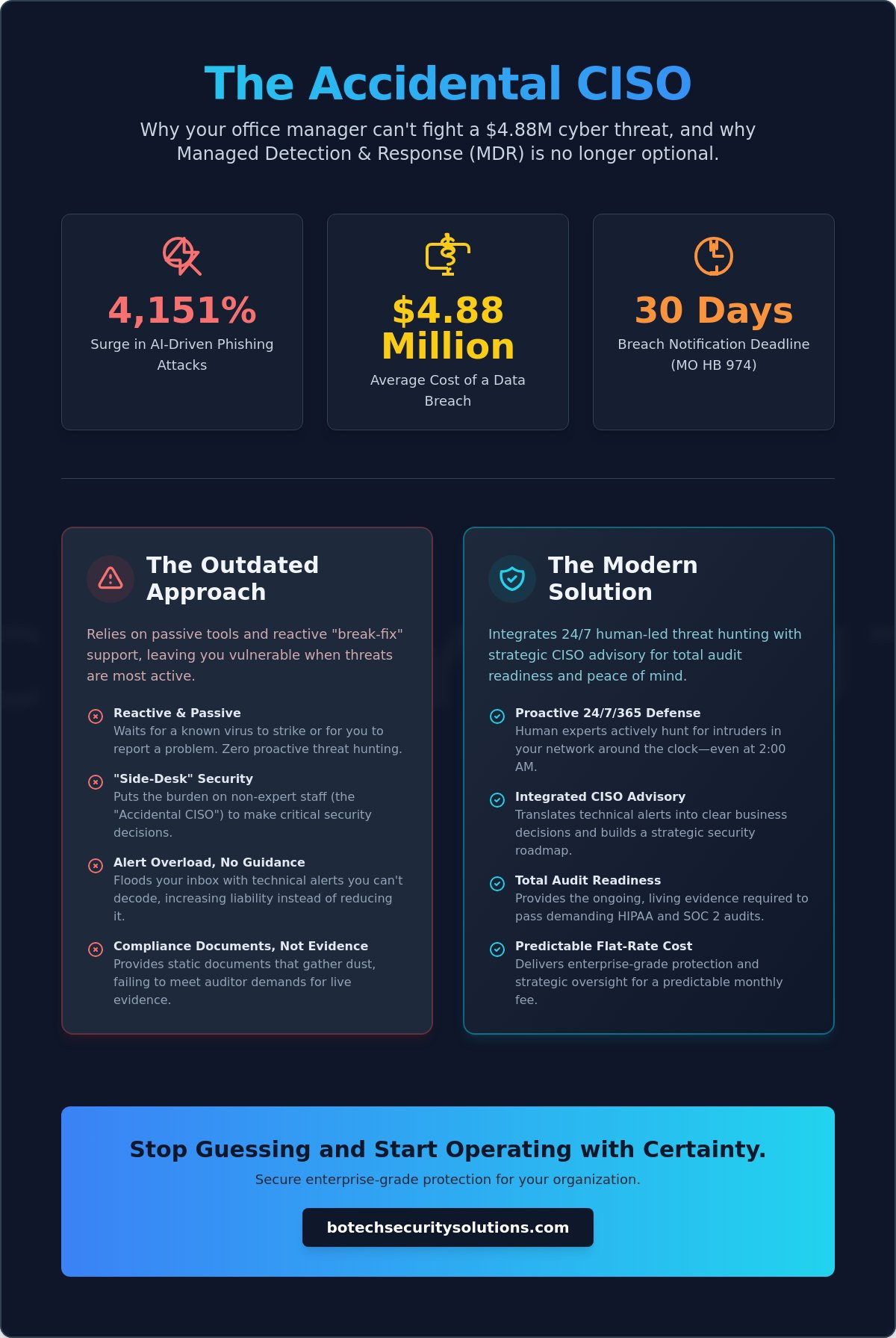
Your office manager is brilliant at operations, but they are not a cybersecurity expert. Expecting a non-technical staffer to defend against a 4,151 percent surge in AI-driven phishing attacks is a liability that could cost your firm an average of $4.88 million according to KLRD data. Securing professional managed detection and response services kansas city is no longer optional for organizations that cannot afford to get this wrong. You shouldn't have to choose between business growth and the constant fear of a 30-day breach notification deadline under Missouri House Bill 974.
You already know that vague promises from generic vendors won't satisfy a HIPAA or SOC 2 auditor. Most providers promise safety, but the uncomfortable truth is that most are not actually watching your network at 2:00 AM. This guide reveals how integrated MDR and CISO advisory services move you from high-stakes anxiety to total audit readiness. We'll show you how to secure enterprise-grade protection at a predictable flat rate while building a clear, compliant roadmap for 2026 and beyond.
Key Takeaways
- Understand why passive antivirus is insufficient and why true protection requires 24/7 active threat hunting and response.
- Learn how to bridge the gap between technical security alerts and business risk management with integrated CISO advisory services.
- Discover the critical difference between compliance documents that gather dust and the ongoing evidence required to pass a HIPAA or SOC 2 audit.
- Follow a five-step framework to evaluate managed detection and response services kansas city and avoid vendors who offer tools without oversight.
- Stop relying on the "Accidental CISO" model by securing enterprise-grade protection at a predictable, flat-rate price.
The Accidental CISO: Why Managed Detection and Response Services in Kansas City Are No Longer Optional
Most small business owners in the Midwest believe their current IT setup is a shield. They assume that because they pay a monthly fee for "support," they are protected from a catastrophic breach. This is a dangerous myth. Traditional antivirus is a passive tool that waits for a known virus to strike; Managed Detection and Response (MDR) is a proactive, 24/7 human-led hunt for intruders already inside your wire.
The 2026 threat landscape has shifted the burden of defense onto people who never asked for it. We call this the Accidental CISO syndrome. It happens when a practice manager in Overland Park or a law firm partner in Lee's Summit is forced to make high-stakes technical security decisions without a roadmap. When you rely on managed detection and response services kansas city, you stop guessing and start operating with enterprise-grade certainty.
To better understand this concept, watch this helpful video:
The Burden of the Accidental CISO
Imagine a healthcare practice manager trying to audit firewall logs while managing patient flow. They are intelligent and capable, but they are not trained to spot a lateral movement attack. Misconfiguring a single security setting can lead to massive non-compliance fines under HIPAA or the new Missouri Insurance Data Security Act (HB 974). This law, effective January 1, 2026, requires insurers to notify individuals of a breach within 30 days. Most are not prepared for that level of accountability.
The financial stakes are too high for amateur defense. KLRD reported in March 2026 that the average cost of a data breach has climbed to $4.88 million. You cannot afford to treat cybersecurity as a "side desk" responsibility for your office staff. Organizations that cannot afford to get this wrong must realize that a folder of compliance PDFs is not the same as a living security program.
IT Support vs. Managed Detection and Response
There is a massive gap between keeping the lights on and defending the perimeter. Your current IT vendor might be excellent at fixing a printer or resetting a password. However, helpdesk services are fundamentally reactive. They wait for you to call with a problem. MDR is the opposite; it is a strategic guardian that monitors your endpoints, email, and cloud 24/7 to stop an attack before your staff even knows it started.
Choosing the right partner means distinguishing between basic maintenance and sophisticated protection. You need a team that understands the difference between a "managed" service and a "monitored" one. If you want to understand how security-first support differs from the old break-fix model, read more about Managed IT Support Services in Kansas City. True MDR providers don't just alert you to a fire; they are the ones holding the extinguisher while everyone else is still asleep.
Beyond Basic Monitoring: Integrating CISO Advisory with 24/7 Threat Hunting
Watching a screen is not the same as leading a defense. Many vendors offer basic monitoring that floods your inbox with technical alerts you don't have the time or expertise to decode. True managed detection and response services kansas city must include a strategic CISO advisory component to bridge the gap between a detected threat and a business decision. Without executive leadership, an alert is just noise that increases your liability.
We operate as your strategic ally by consolidating 24/7 monitoring with high-level security roadmaps. This "One Partner" model eliminates the friction between finding a problem and fixing it. According to Gartner's definition of MDR, these services provide remotely delivered security operations center capabilities. However, for organizations that cannot afford to get this wrong, technical capabilities are useless without the disciplined oversight of a veteran-led team.
Our flat-rate model brings enterprise-level leadership to Kansas City small businesses without the six-figure salary of a full-time executive. This approach provides a predictable cost structure while the global MDR market grows at a compound annual rate of 15.12 percent through 2035, according to Research and Markets. You get the stability of a fixed budget and the security of a vigilant guardian who owns the outcome of your protection. If you are ready to stop managing tools and start managing risk, you can reach out to our team for a direct conversation.
Strategic Risk Management and Mitigation
A once-a-year vulnerability assessment is a liability in 2026. Threats evolve daily; your strategy must keep pace. We identify hidden weaknesses in healthcare and legal networks across the KC metro before they become breach notifications. For a deeper look at how we build these roadmaps, see our guide on IT Consultants in Kansas City. We move you from a reactive "patch and pray" mindset to a proactive stance that prioritizes your most critical business assets.
Regulatory Alignment: HIPAA, SOC 2, and PCI DSS
Regulated firms in the financial and legal sectors face immense pressure from shifting standards. We manage the technical requirements of HIPAA, SOC 2, and PCI DSS by translating complex regulatory jargon into actionable security protocols. Most vendors sell you a document; we build a program that generates the ongoing evidence auditors actually demand. Whether you are navigating HIPAA Section 164.308 or preparing for a SOC 2 Type II audit, we ensure your security posture meets the highest legal standards.
The Uncomfortable Truth: Why Your Security Documents Are Not Compliance Evidence
Here is the uncomfortable truth most IT vendors avoid: that folder of security policies you paid for is practically worthless during a real audit. Most vendors sell a static collection of PDFs and call it a compliance program. In reality, a document is just a promise of what you intend to do; evidence is the hard proof of what you actually did. When you utilize Managed detection and response (MDR), you aren't just buying a tool. You are building a system that generates evidence every second of the day.
A local healthcare provider in the Northland recently learned this the hard way. They had a perfectly formatted security manual sitting on a shelf. When a minor breach occurred, the Office for Civil Rights (OCR) didn't care about the binder. They demanded six months of access logs and incident response records. The provider had the documents, but they had zero evidence. They were found non-compliant because they lacked managed detection and response services kansas city to document their active defense. Most are not providing the technical logs required to survive a forensic audit.
The Failure of Static Compliance Folders
Federal regulations are very clear about this distinction. HIPAA Section 164.308(a)(1) requires organizations to implement procedures to regularly review records of information system activity. A check-the-box approach might satisfy a lazy internal review, but it won't protect attorney-client privilege during a forensic investigation. Law firms protecting sensitive discovery data need more than a binder. If you want to see how we specifically handle these high-stakes environments, look at our guide on Managed IT Services for Law Firms. We focus on the active verification that static folders simply cannot provide.
Building an Evidence-Generation Machine
MDR serves as the primary source of real-time compliance evidence for your organization. It acts like a flight data recorder for your network, capturing every login, file access, and blocked threat. This automated collection is essential for maintaining SOC 2 readiness, where the auditor expects to see that your controls were active every day. A CISO advisor ensures that this evidence remains aligned with your written policies at all times. This creates a closed loop where your actions always match your promises, transforming your business from vulnerable to audit-ready.
Evaluating Managed Detection and Response Providers: A Framework for Kansas City Firms
Choosing a partner for managed detection and response services kansas city is a high-stakes decision that most businesses treat as a commodity purchase. You aren't just buying a software license; you're hiring a team to defend your reputation. Many local IT vendors claim to offer "security," but they lack the executive leadership required to manage business risk. If a vendor doesn't offer integrated CISO advisory, they're just selling you a dashboard you don't have time to watch. You need a framework to separate the vigilant guardians from the generic resellers.
Transparency is the baseline for a secure partnership. As of June 2025, typical MDR pricing for small businesses ranges between $15 and $30 per endpoint monthly. If a provider cannot give you a predictable flat rate, they likely haven't built a scalable process. You should demand regular reporting that proves your controls are active, rather than accepting vague promises of safety. To find out where your organization stands today, you can schedule a direct strategy session with our team.
Step 1: Verify Industry-Specific Regulatory Expertise
Ask any potential partner if they've navigated a HIPAA or SOC 2 audit for a firm of your size. Generic IT consultants often lack the specialized credentials to handle the 2026 regulatory landscape. You need a partner who understands local shifts, such as the Missouri Insurance Data Security Act (HB 974). This law requires specific breach investigation standards that most generalists simply don't know. Avoid vendors who treat compliance as a "one-size-fits-all" document rather than a technical requirement.
Step 2: Demand Integrated Detection and Response
Advice without action is useless during a 3:00 AM ransomware attack. You need a partner who provides both the strategic shield of a CISO and the tactical response of an MDR team. Most vendors will alert you that a fire has started, but they won't pick up the extinguisher. We consolidate strategy and 24/7 monitoring into a single point of accountability. For a better understanding of how this fits into your broader technology plan, read our guide on Managed IT Services for Small Businesses in Kansas City.
The remaining steps in your evaluation should focus on proof. Demand to see how their system generates ongoing evidence for auditors. Verify that they have a local presence in the KC metro to understand our specific business environment. Finally, ensure their team operates with the discipline and integrity of a veteran-led organization. If they can't meet these five standards, they aren't the right partner for an organization that cannot afford to get this wrong.
The BoTech Standard: Enterprise Protection for Organizations That Cannot Afford to Get This Wrong
BoTech Security Solutions operates as a strategic ally rather than a distant vendor. We are a veteran-owned firm that values results over marketing jargon. Our team brings a level of discipline and integrity that is often missing in the IT world. We act as the vigilant guardian for organizations that cannot afford to get this wrong. By choosing our managed detection and response services kansas city, you move from the chaos of the accidental CISO to a state of organized calm.
Our "One partner" model is the bridge between high-end security and small business reality. We consolidate 24/7 monitoring, executive leadership, and compliance management into a single predictable relationship. Most vendors sell you a tool and leave you to manage it. We take ownership of the outcome. This ensures your protection is active, your evidence is ready, and your business remains resilient against evolving threats.
Enterprise Protection at a Small Business Price
We believe that enterprise-grade safety should be accessible to firms of all sizes. Our flat monthly rate model removes the expert hourly barrier that stops many firms from hiring a CISO. We build tailored roadmaps specifically for the healthcare, legal, and financial sectors in the KC metro. In 2026, with the global MDR market projected to reach $3.92 billion according to Research and Markets, you cannot afford to wait for a breach to realize your strategy was flawed.
Your Next Actionable Step: The Access Audit
You can make your organization safer right now without spending a dime. Review your administrative access list today. Most are not aware that "too many admins" is the number one vulnerability for Kansas City firms. If every employee has the power to install software or change settings, your defense has a massive hole. Limit administrative rights to only those who absolutely need them for their daily tasks to immediately reduce your attack surface.
Once you have cleaned up your access list, you need a professional look at your remaining gaps. Schedule a free assessment to find out where you actually stand.
Securing Your Business with Strategic Vigilance
The era of relying on luck and a binder of static PDFs is over. True security requires a shift from passive monitoring to the active evidence generation provided by managed detection and response services kansas city. You've learned that your office manager shouldn't be your last line of defense and that your IT vendor's helpdesk isn't a security operation. Organizations that cannot afford to get this wrong need a partner that combines 24/7 threat hunting with the strategic oversight of a CISO.
BoTech Security Solutions has been veteran-owned and operated since 2021. We specialize in navigating the complex technical requirements of HIPAA, PCI DSS, and SOC 2. We don't just alert you to problems; we provide 24/7 managed detection and response to stop them in their tracks. It's time to trade your security anxiety for a roadmap built on discipline and integrity.
Take the first step toward a more resilient organization today. Schedule a free assessment to find out where you actually stand. You deserve the confidence that comes with enterprise-grade protection.
Frequently Asked Questions
What are managed detection and response services in Kansas City?
Managed detection and response services in Kansas City provide 24/7 proactive monitoring and incident neutralization that goes far beyond basic antivirus software. While traditional IT support focuses on maintenance, MDR utilizes human analysts to hunt for intruders already inside your network. This is critical for local firms since cyberattacks on state and local governments increased by 48 percent between 2023 and 2024 according to KLRD. It ensures your defense never sleeps.
How much do CISO advisory services cost for a mid-sized business?
Typical MDR pricing for mid-market companies with 100 to 500 endpoints ranges from $12 to $20 per endpoint monthly according to June 2025 data. We provide these enterprise-grade leadership services through a predictable flat-rate model rather than high hourly consulting fees. This approach removes the financial barrier to expert guidance. It allows Kansas City firms to access executive-level security strategy without the six-figure salary of a full-time hire.
Does a law firm need a vCISO if we already have an IT company?
Yes, because most IT companies focus on operational availability rather than strategic risk management and regulatory compliance. An IT provider keeps your computers running; a CISO advisor ensures your firm is audit-ready and legally protected. Under the Missouri Insurance Data Security Act (HB 974), firms must follow strict breach investigation standards. A CISO provides the specialized oversight needed to navigate these legal mandates that general IT vendors often miss.
Can MDR services help our practice pass a HIPAA audit?
MDR services are essential for passing a HIPAA audit because they generate the ongoing technical evidence required by Section 164.308(a)(1). While a consultant might give you a binder of policies, MDR provides the logs and incident records that prove your controls are active. Auditors demand proof of regular system activity reviews. Our managed detection and response services kansas city act as a flight recorder for your practice's data security.
What is the difference between an IT consultant and a CISO advisor?
An IT consultant typically focuses on project-based technical implementations like cloud migrations or hardware upgrades. A CISO advisor manages the long-term intersection of security, business risk, and legal compliance. One builds the system; the other defends it and ensures it meets regulatory standards like SOC 2 or HIPAA. Most are not qualified to handle both roles. You need a dedicated guardian who understands the high stakes of data liability.
How often should a CISO advisor review our security posture?
Security posture requires 24/7 continuous monitoring, but a CISO advisor should lead formal strategic reviews at least once per quarter. In a landscape where phishing incidents surged 4,151 percent following the release of ChatGPT according to KLRD, annual reviews are a liability. Quarterly sessions allow your firm to adapt to new regulations like the Kansas Senate Bill 51. This cadence ensures your security roadmap stays aligned with current local and federal laws.
Do your MDR services include incident response?
Yes, our service includes the active neutralization of threats once they are detected. Unlike "monitored" services that simply send an alert to your inbox at 3:00 AM, we take immediate tactical action to isolate compromised endpoints and stop lateral movement. This proactive approach is the core of the "Response" in managed detection and response services kansas city. We don't just tell you there is a fire; we are the ones holding the extinguisher.
Is BoTech Security Solutions a local Kansas City company?
Yes, we are a veteran-owned and operated firm deeply rooted in the Kansas City business community since 2021. We understand the specific regulatory challenges facing Missouri and Kansas organizations, from the Overland Park medical corridor to the downtown KC legal district. Being local means we are your neighbors, not a distant call center. We take personal ownership of your organization's safety because we live and work in the same community.