Managed IT Services for Small Businesses in Kansas City: The 2026 Security Myth-Busting Guide

Your current IT setup is likely a collection of myths that will fail you before 2026. Most Kansas City firms believe they're protected because they have a firewall and a tech guy on speed dial. Most are not. You've likely felt the frustration of billable hours evaporating during a recurring glitch or the anxiety of a looming HIPAA audit. It's exhausting to pay for managed it services for small businesses when your provider seems to be learning the latest security protocols on your dime.
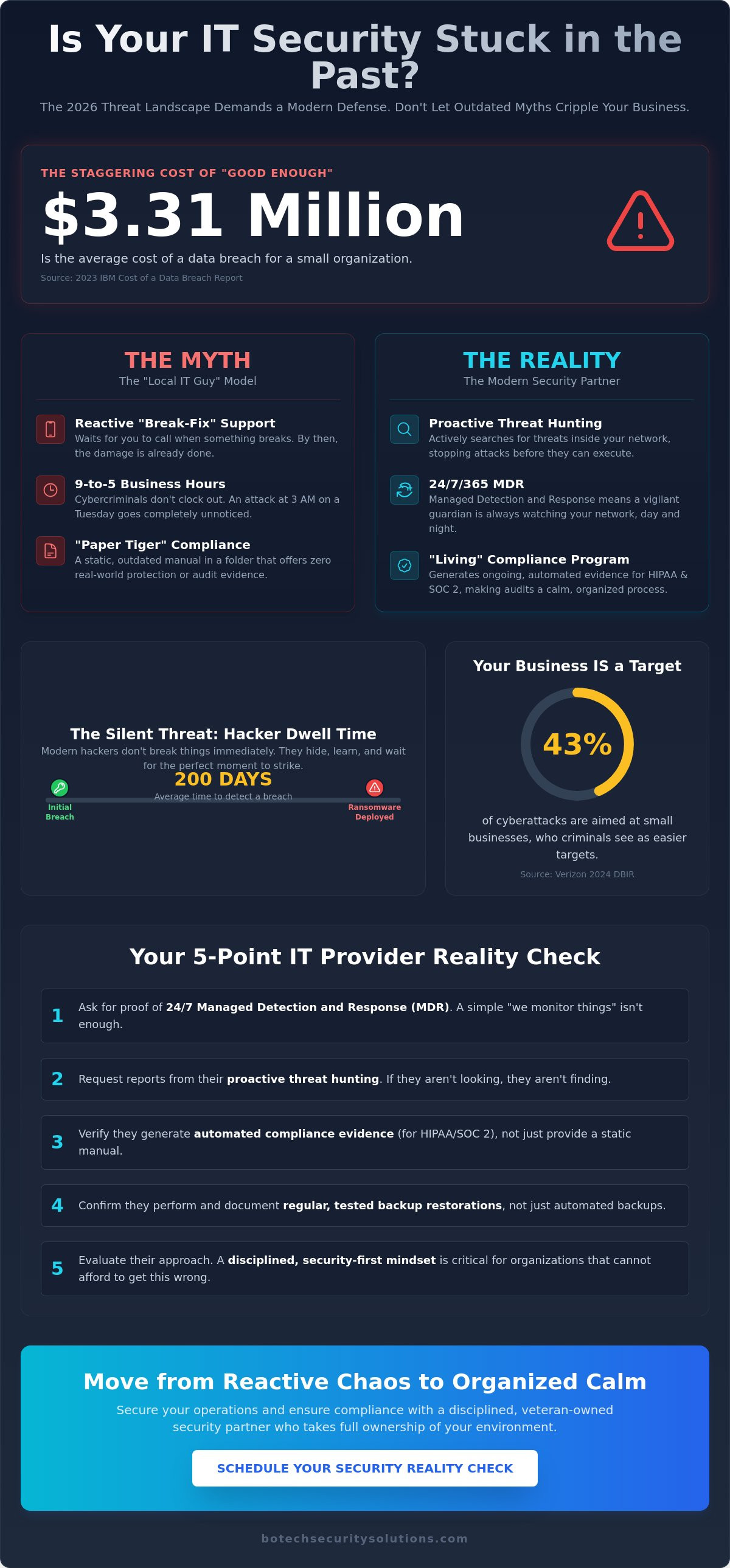
Organizations that cannot afford to get this wrong need more than a folder of outdated policies. According to the 2023 IBM Cost of a Data Breach Report, small organizations face average breach costs of $3.31 million. I'm going to dismantle the misconceptions about "good enough" security and show you the specific enterprise-grade standards required for your firm to remain operational and compliant in a high-stakes environment.
You'll discover the critical difference between a static compliance document and a living compliance program that generates ongoing evidence. We'll outline a clear path to eliminate IT downtime and pass audits without the usual panic. It's time to move from reactive chaos to the organized calm of a truly secure environment.
Key Takeaways
- Move beyond the "local IT guy" myth and discover why the reactive break-fix model is a fatal strategy for Kansas City firms in a high-stakes 2026 threat landscape.
- Learn why modern managed it services for small businesses must include 24/7 Managed Detection and Response (MDR) to stop ransomware actors who no longer work standard business hours.
- Identify the "Paper Tiger" trap by understanding the difference between a static compliance manual and a living program that generates automated evidence for HIPAA and SOC 2.
- Execute a 5-point reality check to audit your current IT provider, including specific steps to verify if they are actually performing proactive threat hunting.
- Discover how a disciplined, veteran-owned approach consolidates security and compliance into a single partner for organizations that cannot afford to get this wrong.
The Local IT Guy Myth vs. 2026 Reality in Kansas City and Overland Park
Many Kansas City law firms still rely on a "local IT guy" who shows up only when a printer stops working or a server goes dark. In 2026, this reactive approach is no longer just inefficient; it's a liability that invites total operational disaster. True managed it services for small businesses have evolved from basic tech support into a high-stakes security operation that runs every second of every day. You need a Managed service provider (MSP) that acts as a vigilant guardian rather than a passive helpdesk clerk.
To better understand how the landscape of professional IT support has shifted for local firms, watch this helpful video:
The "Break-Fix" trap is a common point of failure for organizations in Overland Park that value their uptime. If your strategy relies on waiting for something to break before calling for help, your security is already compromised. Modern hackers don't break things immediately; they sit silently in your network for an average of 200 days before deploying ransomware. Most are not prepared for this level of persistence because they are looking for broken hardware instead of stolen credentials.
You might think your firm is too small to attract international attention. The Verizon 2024 Data Breach Investigations Report (DBIR) tells a different story, revealing that 43% of all cyberattacks specifically target small businesses. Criminals prefer small targets because they often lack the enterprise-grade protection found in larger corporations. This makes a robust model of managed it services for small businesses a requirement for survival rather than a luxury line item.
Why Managed IT Services for Small Businesses Require a Vigilant Guardian
Why Basic Support Fails Regulated Firms in Lee’s Summit
Generalist support fails regulated firms in Lee’s Summit because compliance is not a part-time job. Healthcare and financial sectors require specific, documented adherence to standards like HIPAA or PCI DSS. If your provider isn't hunting threats 24/7 using Managed Detection and Response (MDR), you are essentially unprotected. Simple antivirus is a relic of the past that cannot stop modern, fileless malware attacks. You need a partner that generates ongoing evidence of security rather than just a signed contract.
The High Cost of the "Friend of a Friend" IT Model
Consider a small clinic in Rogers that lost an entire week of patient data because their part-time IT person missed a backup failure notification. The hidden costs of "cheap" IT include massive downtime, permanent reputation damage, and heavy regulatory fines. Managed must mean proactive, not just available by phone when the crisis hits. Organizations that cannot afford to get this wrong need managed security services that take full ownership of the environment. Waiting for a "friend" to call you back during a data breach is a cost no business can actually afford.
Why Managed IT Services for Small Businesses Must Include 24/7 Detection
Many Kansas City business owners believe their IT provider is watching their network at 3:00 AM on a Tuesday. Most are not. If your provider only reacts when you call them to report a problem, you don't have a security partner; you have a digital janitor. Real managed it services for small businesses in 2026 require proactive Managed Detection and Response (MDR) that stays awake while your team sleeps.
Think of basic antivirus as a locked door. It works until someone picks the lock or finds an open window. MDR is the armed security guard standing in your lobby who notices the intruder the second they step inside. Ransomware actors now leverage automation to strike during off-hours, making 24/7 monitoring a baseline requirement for any organization that cannot afford to get this wrong.
Consider a law firm we recently assisted in Tulsa that suffered a credential harvest at midnight. Their previous IT provider didn't see the suspicious login from a foreign IP because they weren't monitoring logs after hours. By sunrise, the firm's entire document management system was encrypted. This is the "Most Are Not" reality of the KC market. Many local providers claim to offer security, but few actually run a 24/7 Security Operations Center (SOC) to stop threats in real-time.
Moving Beyond Basic Antivirus and Firewalls
Traditional perimeters are dead because modern threats mimic legitimate user behavior to bypass firewalls. We use a combination of AI and human threat hunters to spot these anomalies before they escalate into full-blown breaches. You can learn more about why this security-first approach is mandatory by reviewing our guide on Managed IT Support Services in Kansas City. True protection requires identifying behavior that looks "off," such as a user accessing five hundred files in three minutes.
Continuous Monitoring for the KC Metro Workforce
Your employees in Blue Springs or Olathe are often working from home on unmanaged Wi-Fi networks. This makes email security your biggest vulnerability, as 90% of successful breaches start with a single phishing link according to 2024 CISA reports. Multi-Factor Authentication (MFA) is no longer a suggestion; it's a non-negotiable standard. The Cybersecurity for Small Business guidelines from the FTC emphasize that human error is the primary entry point for attackers.
Furthermore, the FTC Safeguards Rule (16 CFR Part 314) specifically requires multi-factor authentication for anyone accessing sensitive customer information. This isn't just a technical best practice; it's a federal requirement that carries heavy penalties for negligence. If you aren't sure if your current provider actually has eyes on your network right now, you should find out where you actually stand before the next threat arrives.
Compliance Documents vs. Programs: The $50,000 Misunderstanding
Most Kansas City business owners treat compliance like a high school diploma. They think you earn it once, frame it, and never think about it again. This is the $50,000 misunderstanding. High-quality managed it services for small businesses must do more than keep the lights on. They must ensure you aren't holding a paper tiger when an auditor walks through your door. A manual sitting on a shelf provides zero protection during a breach investigation.
True compliance is a living program, not a dusty document. HIPAA Section 164.308(a)(1)(ii)(A) is very clear about this requirement. It demands an accurate and thorough assessment of potential risks and vulnerabilities to the confidentiality of ePHI. You can't meet this standard with a one-time PDF from 2023. If your risk assessment doesn't reflect your current network state, it's legally useless. Organizations that cannot afford to get this wrong understand that compliance requires continuous evidence collection.
Your Managed Service Provider (MSP) should be your Compliance Officer’s best friend. They are the ones who actually implement the technical controls that your policies describe. The FTC cybersecurity guidelines emphasize that protecting data is a continuous cycle of assessment and adjustment. If your IT partner isn't providing monthly reports that map directly to your regulatory requirements, you're just guessing. Most are not prepared for the scrutiny of a modern audit.
The Reality of HIPAA and SOC 2 Audits in 2026
Imagine an Overland Park practice manager facing a surprise OCR audit. She pulls down a thick binder labeled "Compliance" only to realize the last entry was made three years ago. The auditor doesn't care about your good intentions. They care about continuous alignment. BoTech automates the evidence gathering that auditors actually want to see. We replace the "readiness" panic with a steady stream of verifiable logs. This ensures you're always prepared, rather than scrambling to recreate history during an investigation.
PCI DSS and the Small Business Retailer
Retailers in the Country Club Plaza or Brookside face unique pressures with credit card data. PCI DSS 4.0 has increased the burden on small businesses to prove they are monitoring their systems 24/7. Many vendors charge extra project fees every time a regulation changes. We believe managed it services for small businesses should include compliance as a standard feature. Our flat rate model ensures you avoid surprise bills while maintaining enterprise-grade protection for your customer data.
Take one specific action today: Open your compliance manual and look at the date on your last Risk Assessment. If it's more than 12 months old, your organization is currently out of alignment with federal standards. You need to schedule a formal review before an auditor or a breach does it for you.
Stop guessing about your legal exposure. Contact BoTech for a free assessment to find out where you actually stand with your current security and compliance controls.
Auditing Your Managed IT: A 5-Point Reality Check for Rogers and Tulsa Firms
Most business owners pay their monthly invoice and assume the fortress is secure. This is a dangerous mistake. When evaluating managed it services for small businesses, you have to move past the marketing brochures and look at the evidence. If your provider cannot produce proof of work, they aren't doing the work. Use these five steps to audit your current arrangement before a breach forces your hand. Organizations that cannot afford to get this wrong must demand transparency over promises.
Step 1: Request a recent Threat Hunting report. Most providers rely on passive alerts that tell them when a virus is already inside. Active threat hunting is different; it involves searching for indicators of compromise that haven't triggered an alarm yet. According to the 2024 IBM Cost of a Data Breach Report, the average breach lifecycle lasts 292 days. If your provider can't show you a report of what they found while hunting, they're just waiting for your house to burn down before they call the fire department.
Step 2: Check the Last Patch date on your most critical server. You don't need to be a "techie" to do this. Ask your provider to screen-share and show you the update history on your SQL or file server. If the last security patch was applied more than 30 days ago, you're operating with known vulnerabilities. Most are not keeping up with the rapid release cycle of modern exploits.
Step 3: Ask for proof of a successful backup restoration. A "backup successful" email only means the data moved from point A to point B. It doesn't mean that data is usable. Demand a log showing a random file was successfully restored and opened within the last quarter. HIPAA Section 164.308(a)(7)(ii)(D) specifically requires periodic testing of restoration procedures; a simple email notification won't satisfy a federal auditor.
Step 4: Verify real-time dark web monitoring. Stolen credentials are the primary entry point for 40 percent of modern attacks. Your provider should be able to show you a dashboard of your company's exposed emails and passwords. If they only run a scan once a year, they're giving you old news that's already been exploited.
Step 5: Review Security Awareness Training participation rates. Your employees are your largest attack surface. If your provider doesn't give you a monthly report showing who completed their training and who failed the latest phishing simulation, the training isn't happening. Security is a culture, not a software installation.
The "Hard Conversation" With Your Current Vendor
You need to determine if your provider is a "Vigilant Guardian" or just a "Ticket Taker." A ticket taker waits for you to call when something breaks. A guardian tells you what they fixed before you even knew it was a problem. Ask them why security isn't included in your flat monthly rate. If they treat cybersecurity as a hidden add-on, it means they don't view it as a core component of managed it services for small businesses. Watch out for "geek speak" used to deflect simple questions about uptime and protection. Clarity is a sign of competence; jargon is a sign of a cover-up.
The Role of Vulnerability Assessments
Annual scans are no longer enough for businesses in Bentonville and Fayetteville. The threat landscape moves too fast for a once-a-year checkup. You need a continuous remediation roadmap that identifies weaknesses and provides a clear timeline for fixing them. Knowing what's wrong is only half the battle. You need a partner who takes ownership of the solution. For more on building a strategy that puts security first, review our guide for IT Consultants in Kansas City.
Stop guessing about your company's safety and start verifying it. You can request a technical audit to find out where you actually stand today.
The BoTech Approach: Enterprise Security for Organizations That Cannot Afford to Get This Wrong
Security isn't a product you buy; it's a discipline you maintain. Our veteran-owned roots mean we don't treat your network like a hobby or a side project. We apply the same mission-driven focus to managed it services for small businesses that we used in the field. This military mindset ensures that every patch, firewall rule, and user permission follows a strict protocol. Most vendors guess. We verify.
You shouldn't have to hire three different companies to handle your IT, your security, and your compliance. We consolidate these into a single, cohesive strategy to maximize efficiency. This eliminates the finger-pointing that happens when a breach occurs. By merging these functions, we ensure that your HIPAA 164.308(a)(1) risk analysis isn't just a PDF in a drawer. It's the actual blueprint for your daily operations.
The BoTech Flat Rate promise removes the financial friction from staying safe. You pay one predictable monthly fee for continuous protection and 24/7 monitoring. There are no surprise invoices when a new threat emerges or a server needs attention. Our success is measured by the silence in your inbox and the lack of exciting security events. If your security is exciting, we aren't doing our job.
Strategic Alliance for Kansas City Small Businesses
We act as your outsourced Chief Information Security Officer (CISO) without the $200k salary. This is vital for Kansas City law firms, medical practices, and financial advisors who handle sensitive data daily. We don't just fix broken printers; we manage your entire risk profile. Our team focuses on the specific needs of the KC metro, ensuring you meet regional and federal standards without the overhead of a full-time executive.
Beyond security, a proactive IT partner helps you leverage tools that drive business growth while maintaining a secure environment. To explore how modern collaboration features can be implemented with an enterprise-grade focus, learn more about Gradient Data Solutions, Inc. and their expertise in digital transformation.
Your Next Step Toward Vigilance
Don't wait for a ransomware note to discover your IT guy is out of his depth. Most small businesses believe they're protected until the first audit or attack proves otherwise. You need to know exactly where your vulnerabilities lie before a bad actor finds them for you. Our Find Out Where You Stand assessment provides a clear, no-nonsense look at your current posture. It's not a sales pitch; it's a reality check for your organization's survival.
Take fifteen minutes today to run through this high-stakes checklist. If you cannot answer "yes" to every point, your organization is currently at risk.
- Are all employee passwords unique and changed from factory defaults?
- Is Multi-Factor Authentication (MFA) active on every single email and financial account?
- Do you have a written record of who accessed your sensitive data in the last 24 hours?
- Is your backup system isolated from your main network to prevent ransomware encryption?
If you found gaps in your audit, visit our Managed Security page to see how we close them. Contact us today to schedule your assessment and secure the future of your KC business. It's time to stop hoping you're safe and start knowing you are.
Securing Your Business Beyond the 2026 Myth
The days of relying on a reactive local IT guy are over for Kansas City firms. True managed it services for small businesses in 2026 require more than just patching software; they demand 24/7 Managed Detection and Response. You shouldn't settle for a compliance document that sits in a drawer while the OCR issues fines. A single misunderstanding regarding compliance evidence can result in a $50,000 penalty before a formal investigation even begins. It's time to shift from a static folder to a living compliance program that generates evidence every single day.
As a veteran-owned and operated firm, we've built our reputation on helping organizations that cannot afford to get this wrong. We specialize in the rigid demands of SOC 2, PCI DSS, and HIPAA because your security shouldn't be a guessing game. Take ten minutes today to review your last security audit report. If that report is more than six months old, your current defense is already obsolete in the face of modern threats. You deserve a partner that acts as a vigilant guardian for your data and your reputation.
Stop wondering if your current setup will hold up during a breach or a regulatory audit. Find out where you actually stand with a Free Security and Compliance Assessment. We'll help you bridge the gap between small business pricing and enterprise-grade protection so you can get back to running your practice or firm with total confidence.
Frequently Asked Questions
What is the average cost of managed IT services for small businesses in Kansas City?
According to 2024 industry benchmarks from ChannelE2E, the national average for comprehensive support ranges between $100 and $250 per user per month. Kansas City rates typically align with these mid-market figures. This flat rate covers monitoring, security, and help desk support, preventing the unpredictable spikes of hourly billing. It's a predictable expense that allows you to budget for growth rather than reacting to failures.
How does managed IT help with HIPAA compliance for small medical practices?
Managed IT creates the technical safeguards required under HIPAA Security Rule 45 CFR § 164.312. This includes implementing audit controls and unique user identification that most small practices lack. While you might assume you're compliant because you use an EMR, 70 percent of breaches occur due to missing safeguards on the local network. Most are not prepared for a random audit by the Office for Civil Rights.
Can managed IT services replace my one-person internal IT department?
Professional managed it services for small businesses can replace or augment a single internal hire by providing a team with diverse certifications. A single employee cannot realistically monitor security 24/7 while also managing hardware procurement and user support. This transition is a national standard; for instance, organizations seeking managed it services minneapolis are increasingly adopting this model to eliminate the single point of failure risk that exists when one person holds all the keys to your kingdom. It's about moving from a reactive individual to a proactive system.
What is the difference between an MSP and an MSSP for KC businesses?
An MSP focuses on availability and performance, while an MSSP prioritizes security and risk mitigation. While an MSP ensures your printer works, an MSSP manages the Security Operations Center (SOC) that monitors for lateral movement within your network. For Kansas City firms in regulated sectors, relying solely on an MSP often leaves a gap in the continuous monitoring required by modern insurance carriers. You need both to survive.
How quickly should a managed IT provider respond to a security incident?
You should expect a critical incident response time of 15 to 30 minutes from a qualified provider. The 2023 IBM Cost of a Data Breach Report found that the average time to identify and contain a breach was 277 days. A professional partner works to shrink that window to minutes to prevent a minor intrusion from becoming a total ransomware event. Speed is the only thing that saves your data when an attack begins.
Does my small business in Tulsa really need 24/7 security monitoring?
Yes, because 43 percent of cyberattacks target small businesses, and hackers don't work on a 9 to 5 schedule. Automated threats and brute force attacks are constant; a breach at 2:00 AM on a Tuesday can go unnoticed until your staff arrives in the morning. Real time monitoring ensures that suspicious activity is blocked before your data is exfiltrated. Without it, you're leaving your front door unlocked every single night.
Is a flat-rate IT model better than hourly billing for a law firm?
A flat-rate model aligns your interests with the provider's interests because they're incentivized to keep your system running perfectly. Hourly billing creates a conflict where the provider makes more money when your system breaks. For law firms managing strict deadlines, the predictability of a monthly fee is superior to the break-fix chaos that leads to billable hour loss. You shouldn't be penalized for your provider's inefficiency.
What happens if my business fails a SOC 2 or PCI audit?
Failing an audit often results in the immediate loss of client contracts and potential fines from the PCI Security Standards Council ranging from $5,000 to $100,000 per month. managed it services for small businesses focus on building a continuous evidence stream rather than a one time document to prevent this. Organizations That Cannot Afford to Get This Wrong understand that a failed audit is a catastrophic business failure, not a minor paperwork error.