Managed IT Support Services for Law Firms in Kansas City: The 2026 Security Gap

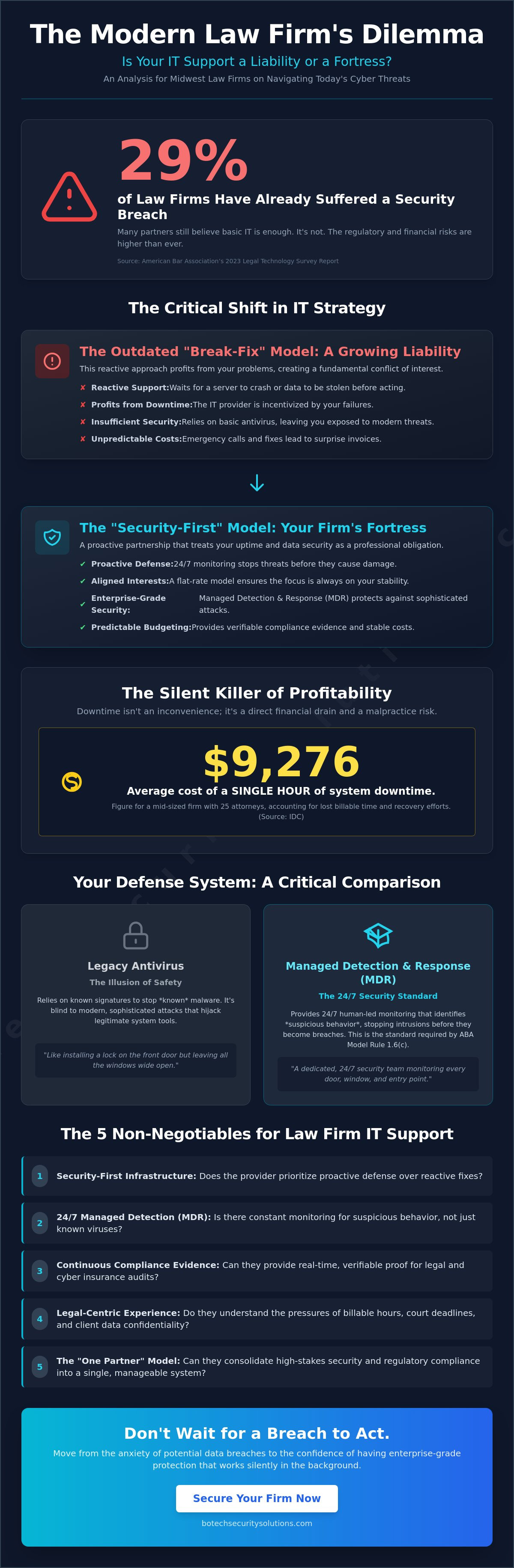
Your current IT provider is likely a liability you can no longer afford. The American Bar Association’s 2023 Legal Technology Survey Report reveals that 29% of law firms have already suffered a security breach, yet many Kansas City partners still believe they're protected by basic it support services for law firms. Most are not. By 2026, the regulatory gap between simple technical maintenance and the evidence-based security required for SOC 2 or HIPAA compliance will leave unprepared firms uninsurable and legally exposed.
You already know the frustration of waiting for a callback during a critical discovery phase while your billable hours evaporate. You deserve a partner that treats your uptime as a professional obligation rather than just another ticket number. This article explains why traditional models are failing and how to implement a security-first infrastructure built for organizations that cannot afford to get this wrong. We'll preview the path to zero downtime during trials and the shift toward predictable, flat-rate costs that provide verifiable compliance evidence for your clients.
Key Takeaways
- Identify why traditional "break-fix" IT is failing Kansas City firms and how to transition to a proactive, security-first infrastructure.
- Understand why basic antivirus is insufficient for protecting sensitive client discovery and how 24/7 monitoring stops breaches before they escalate.
- Learn the critical difference between static compliance documents and the continuous evidence collection required to survive a rigorous legal audit.
- Use a strategic 5-point framework to evaluate it support services for law firms and ensure your partner possesses non-negotiable legal-centric experience.
- Discover the "One Partner" model for consolidating high-stakes security and regulatory compliance into a single, manageable system.
The Evolution of Legal IT in the Kansas City Metro: Why IT Support Services for Law Firms are No Longer Enough
The legal landscape in Kansas City has shifted. It's no longer about whether your printer works or if your email loads. It's about whether your client data is still your own. Most law firm partners believe they have adequate protection because they have a "tech guy" on call. Most are not. High-quality it support services for law firms must now prioritize proactive defense over simple repair. You are part of a group we call "Organizations That Cannot Afford to Get This Wrong." If your systems go dark, your billable hours stop, but your liability keeps growing.
The traditional model of a Managed Service Provider (MSP) used to be reactive. You called when something broke; they billed you to fix it. This created a fundamental conflict of interest where your provider profited from your downtime. In 2026, waiting for a failure is a professional death wish. Kansas City firms are now prime targets for ransomware because attackers know lawyers hold sensitive data and face rigid court deadlines. A single breach can dismantle a decade of reputation building in an afternoon.
Security is no longer a technical choice; it's a regulatory requirement. Between evolving data privacy laws and the high stakes of discovery, the tension between billable hours and technical downtime has never been tighter. Every minute your staff spends troubleshooting a login issue is a minute not billed to a client. We move our partners from the anxiety of potential data breaches to the confidence of having enterprise-grade protection that works silently in the background.
Moving Beyond the Break-Fix Mentality in Lee’s Summit and Overland Park
In Lee’s Summit and Overland Park, many firms still rely on a break-fix mentality. This is a liability. When you wait for a server to crash before calling for help, you've already lost. Client trust in the KC legal community is built on responsiveness and confidentiality. If a breach occurs, that trust evaporates. The old "computer guy" approach cannot handle modern threats. You need enterprise-grade managed services that monitor your network every second of every day. This isn't just about fixing laptops; it's about building a fortress around your firm's reputation.
The High Cost of Downtime for Oklahoma City and Tulsa Legal Teams
Downtime is a silent killer of profitability. For a mid-sized firm with 25 attorneys, the average cost of a single hour of system downtime is approximately $9,276 according to industry data from IDC. This figure accounts for lost billable time, administrative overhead, and recovery efforts. The ripple effect on court deadlines and discovery is even more damaging. Missing a filing deadline due to a technical glitch isn't an excuse; it's a malpractice risk. We define it support services for law firms as a strategic asset that ensures your team stays billable and your evidence remains secure. You can see how we build these systems on our services page.
Managed Detection and Response (MDR): The 24/7 Security Standard for Law Firms
Most law firms believe their legacy antivirus software provides a sufficient shield. It doesn't. Traditional antivirus relies on signatures of known malware, meaning it only stops threats that have already been identified elsewhere. In the high-stakes world of legal discovery, modern attackers don't use obvious viruses. They use "living off the land" techniques that hijack legitimate system tools to exfiltrate data quietly. Relying on basic software for your it support services for law firms is like installing a lock but leaving the windows open.
The ABA Model Rule 1.6(c) requires lawyers to make reasonable efforts to prevent the unauthorized disclosure of client information. If your security only reacts after a file is encrypted, you've already failed that standard. Managed Detection and Response (MDR) moves beyond prevention into active visibility. It provides 24/7 monitoring that identifies suspicious behavior, such as an unusual login from a foreign IP at 3 AM. This constant vigilance is what stops a minor intrusion from becoming a firm-ending data breach.
Firms in Bentonville and Rogers are increasingly targeted because they handle sensitive corporate data for global retail and logistics partners. Attackers know these mid-sized firms often lack enterprise-grade oversight. You cannot afford to treat security as a set-it-and-forget-it task. True protection requires a partner who monitors your environment every second of every day. You can evaluate your current response time to see if your firm is actually prepared for a midnight exploit.
Endpoint Protection and Threat Hunting in Tulsa and Broken Arrow
Attorneys in Tulsa and Broken Arrow are rarely tethered to a single desk. They work from courtrooms, home offices, and coffee shops. Every laptop and mobile device is an endpoint that acts as a potential gateway for hackers. Basic security waits for an alarm to sound. Proactive threat hunting searches for the silent indicators of a compromise before the attacker can move laterally through your network. It's the difference between finding a small leak and coming home to a flooded basement.
Email Security: Protecting the Discovery Process in Rogers and Fayetteville
Business Email Compromise (BEC) is the primary threat to the discovery process in Rogers and Fayetteville. The FBI 2023 Internet Crime Report noted that BEC accounted for over $2.9 billion in adjusted losses globally. Attackers impersonate partners or clients to divert wire transfers or steal sensitive case files. Advanced email filtering goes beyond spam detection by analyzing communication patterns to flag impersonation attempts. This level of scrutiny is a core component of it support services for law firms that prioritize security over simple maintenance.
Compliance Documents vs. Continuous Evidence: The Uncomfortable Truth About Legal Audits
Many Kansas City law firms keep a thick binder on a shelf labeled Compliance. They believe this document satisfies an auditor or a malpractice carrier during a crisis. It's a dangerous myth. A static policy written three years ago offers zero protection during a 2026 data breach inquiry. Real security isn't a document; it's a stream of telemetry.
Professional it support services for law firms must move beyond set it and forget it configurations. An auditor doesn't care what your policy says you do. They care what your logs prove you actually did on a random Tuesday at 3:00 AM. Most local providers fail the evidence test because they rely on manual spot checks. Manual checks are prone to human error and provide gaps that regulators will exploit.
The difference between a policy and evidence is the difference between a map and a GPS track. One shows where you intended to go, while the other proves where you actually traveled. Organizations that cannot afford to get this wrong prioritize the latter. If you can't produce a report showing every login attempt from the last ninety days, your compliance binder is just expensive wallpaper.
Why ABA Model Rules Demand More Than Basic Antivirus
ABA Model Rule 1.1, specifically Comment 8, requires lawyers to maintain technological competence. This isn't a suggestion or a vague guideline. In Missouri, Supreme Court Rule 4-1.1 mirrors this standard, demanding that you understand the risks associated with the technology you use to manage client files. Basic antivirus is no longer a reasonable effort when modern threats bypass signature-based detection in seconds.
You need 24/7 monitoring to fulfill the ethical obligation of protecting client confidentiality under Rule 1.6(c). If a breach occurs in a firm in Oklahoma, the bar looks for proof of continuous oversight. Firms that can't produce real-time logs of access attempts are often found to have failed the reasonable efforts standard. You're either collecting evidence of your diligence every hour or you're effectively admitting negligence. Most are not prepared for this level of scrutiny.
SOC 2 and HIPAA: Moving Beyond Check-the-Box Compliance
If your firm handles medical records or sensitive corporate data, HIPAA and SOC 2 requirements apply to your internal systems and your vendors. A check-the-box approach leads to regulatory fines that can reach $63,973 per violation according to 2024 OCR penalty adjustments. You need automated evidence collection that captures system states continuously. Manual reporting is a liability because it's slow, incomplete, and often reflects what a technician thinks happened rather than the technical reality.
We've built specialized compliance management services to replace these guesses with hard data. Most it support services for law firms aren't built to handle the rigors of a SOC 2 audit. We are. A successful audit requires proof that your firewalls were active, your patches were applied, and your MFA was enforced every single day of the year. If your current provider can't pull those reports in five minutes, you don't have a compliance program; you have a collection of wishes.
Evaluating IT Support Services for Law Firms: A Strategic Framework
Most law firm office managers mistake an IT vendor for a utility provider. They treat technology like water or electricity. It either works or it doesn't. This mindset is dangerous because it ignores the regulatory reality of the 2026 security gap. Choosing the wrong it support services for law firms leads to more than just downtime; it leads to ethical violations and data spillage. To vet a potential partner in the Kansas City area, use this five-point framework:- Regulatory Proof: Does the provider offer evidence of their own SOC 2 compliance or HIPAA alignment?
- SLA Specificity: Do they guarantee a two-hour onsite response for critical hardware failures in the KC metro?
- Software Depth: Can they demonstrate past migrations or troubleshooting for Clio, PCLaw, or iManage?
- Security Architecture: Do they prioritize zero-trust environments over the outdated model of server proliferation?
- Pricing Alignment: Does their contract use a flat-rate model that incentivizes your firm's stability?
The Myth of the Generalist IT Provider
A provider that spends their morning fixing a retail point-of-sale system cannot secure a law firm in the afternoon. Generalists lack the nuance required for legal-specific workflows and the strict confidentiality mandates of the American Bar Association. They often push a strategy of server proliferation to pad their margins, adding unnecessary hardware that increases your attack surface and your monthly bill. Your firm relies on specialized tools like Clio, PCLaw, or iManage. If your tech doesn't understand the database structure of these platforms, they will likely break your compliance chain during a routine update. Most are not prepared for this level of technical liability.Local Response and Vigilance in Blue Springs and Olathe
Distance is a liability during a hardware failure. While remote support handles most issues, that final 10 percent of "catastrophic" problems requires a physical presence in places like Blue Springs or Olathe. A "Strategic Ally" lives in your time zone and understands the local business climate. They act as a guardian rather than a distant vendor. This proximity ensures that when a firewall dies or a local server fails, your billable hours don't vanish while you wait for a tech to drive from three states away. The debate between flat-rate and hourly pricing is settled by the concept of shared risk. Hourly billing creates a conflict of interest where the vendor makes more money when your systems fail. Flat-rate models align the partner's goals with your own. When we profit from your stability, we work harder to prevent problems before they start. Organizations that cannot afford to get this wrong choose partners who take ownership of the outcome.Your current provider might be "nice," but are they actually protecting your firm from the 2026 security gap? You can find out where you actually stand with a focused security assessment.
The BoTech Approach: Specialized IT Support Services for Law Firms Across the Midwest
BoTech Security Solutions operates on a veteran-owned, security-first philosophy. We don't view technology as a convenience. We view it as a perimeter that requires constant defense. Most firms believe they have adequate protection because they pay for a help desk. Most are not. We provide it support services for law firms that treat every workstation like a high-value target.
Our "One Partner" model eliminates the finger-pointing that happens when security and IT are handled by different vendors. We consolidate your technical infrastructure and your compliance requirements into a single point of accountability. This ensures that a patch isn't just an update; it's a verified security event. We focus on organizations that cannot afford to get this wrong.
Traditional IT support focuses on uptime and convenience. We focus on the integrity of your client files and the continuity of your practice. Legal professionals handle sensitive data that is highly targeted by ransomware groups. If your current provider isn't talking about specific encryption standards or audit trails, they are leaving you exposed. We bridge the gap between high-end security and accessible pricing for firms that value their reputation.
Flat-Rate Security for Growing Firms in Bella Vista and Lowell
Mid-sized firms in Bella Vista and Lowell often feel priced out of enterprise-grade security. We changed that by building a model that makes advanced protection affordable. You pay a transparent monthly managed security service fee without hidden costs or surprise invoices for emergency fixes. This removes the "billable hour" friction that stops staff from reporting suspicious activity. Security is a 24/7 commitment. Our incident response team monitors your network around the clock to neutralize threats before they escalate.
Taking the First Step: Find Out Where You Actually Stand
A BoTech security and compliance assessment is a technical deep dive into your existing environment. We look for the uncomfortable truths your current provider might be hiding, such as unpatched legacy software or unsecured remote access points. Knowing your gaps is the only way to prevent a breach before it happens. We provide a clear roadmap based on evidence, not assumptions. This is the difference between hoping you are compliant and proving it with data. Find out where your firm actually stands with a free assessment.
Closing the 2026 Security Gap
The transition from basic IT to enterprise-grade security isn't a luxury for Kansas City firms anymore. It's a survival requirement. Most firms believe they're protected because they have a signed compliance document, but the reality is that regulators now demand continuous evidence of 24/7 monitoring. If your current it support services for law firms don't provide real-time Managed Detection and Response, you aren't actually secure.
As a veteran-owned firm specialized in HIPAA, SOC 2, and PCI DSS compliance, we know that true protection requires more than a reactive help desk. You need a partner that generates the evidence required to survive a high-stakes audit. Take ten minutes today to look at your security logs. If those logs don't show active, 24/7 monitoring from the last 24 hours, your firm is currently operating at an unacceptable level of risk.
Don't wait for a breach to discover the holes in your strategy. Find out where your firm actually stands with a free assessment. It's time to build a foundation that actually holds up under pressure. You've worked too hard to let a preventable security gap compromise your practice.
Frequently Asked Questions
What are the most critical IT support services for law firms in 2026?
Law firms in 2026 must prioritize Zero Trust Architecture and Managed Detection and Response (MDR) to survive the current threat landscape. Traditional firewalls are no longer sufficient when 82 percent of breaches involve a human element according to the 2023 Verizon Data Breach Investigations Report. You need it support services for law firms that focus on continuous identity verification and encrypted communication channels to protect client privilege.
How much should a mid-sized law firm in Kansas City expect to pay for managed IT?
Most mid-sized firms should budget based on industry benchmarks rather than flat guesses. According to 2024 ChannelE2E data, managed services typically range from 150 dollars to 300 dollars per user per month depending on the security stack complexity. Legal teams requiring SOC 2 Type 2 evidence often sit at the higher end of that spectrum because the average cost of a data breach has risen to 4.45 million dollars per incident.
Is our current law firm IT support compliant with HIPAA and SOC 2?
Your current support is likely not compliant if they cannot produce a real-time evidence log. Most vendors provide a compliance document which is just a static PDF that becomes obsolete the day it's signed. True compliance requires continuous monitoring and a System and Organization Controls (SOC) 2 report that proves your controls are actually functioning every hour of the day.
Why is 24/7 Managed Detection and Response (MDR) necessary for legal teams?
MDR is necessary because hackers don't work 9 to 5, and automated tools alone miss 35 percent of sophisticated "living off the land" attacks. If an adversary gains access to your network at 2:00 AM on a Saturday, a standard antivirus won't stop them from exfiltrating discovery documents. MDR provides human analysts who hunt for threats and stop them before your team even wakes up on Monday morning.
Can managed IT services help our firm with ABA Model Rule compliance?
Managed IT services directly address your obligations under ABA Model Rule 1.6(c) regarding the protection of client information. This rule requires "reasonable efforts" to prevent unauthorized access, which the ABA's Formal Opinion 477R clarifies as a need for competent technological safeguards. We implement the technical controls that turn these ethical requirements into verifiable security protocols that satisfy your professional responsibility.
What is the difference between an IT generalist and a legal-centric MSP?
A legal-centric MSP understands that a five-minute outage during a court filing is a catastrophe, while a generalist sees it as a low priority ticket. Generic it support services for law firms often fail to secure specialized practice management software or maintain the strict chain of custody required for digital evidence. We focus on the intersection of technical uptime and regulatory accountability that generalists typically ignore.
How does BoTech handle data backups and disaster recovery for Kansas City firms?
BoTech utilizes the 3-2-1-1 backup strategy to ensure Kansas City firms never lose a billable hour. This means we keep three copies of your data on two different media types, with one copy offsite and one copy stored in an immutable, air-gapped vault. If a tornado hits your office or ransomware locks your server, we can restore your entire environment to a clean state in under four hours.
What happens if our law firm experiences a security breach after hours?
If a breach occurs at midnight, our Security Operations Center (SOC) immediately isolates the affected workstation to prevent the threat from spreading. We don't wait for a phone call to start the incident response process. Your firm receives an alert that a threat was detected and neutralized, ensuring your client data remains secure while your partners sleep.