Managed Security Services in Kansas City: The 2026 Evaluation Template for Regulated Firms

Your IT provider just told you the network is "fine," but they cannot produce the specific evidence required for your upcoming SOC 2 audit. You are paying more every month for support that fixes broken laptops while ignoring the silent data breaches currently targeting local firms. It is a common trap for practice managers who confuse basic maintenance with actual protection. Finding legitimate managed security services in Kansas City requires looking past the marketing jargon to find a partner who understands business risk.
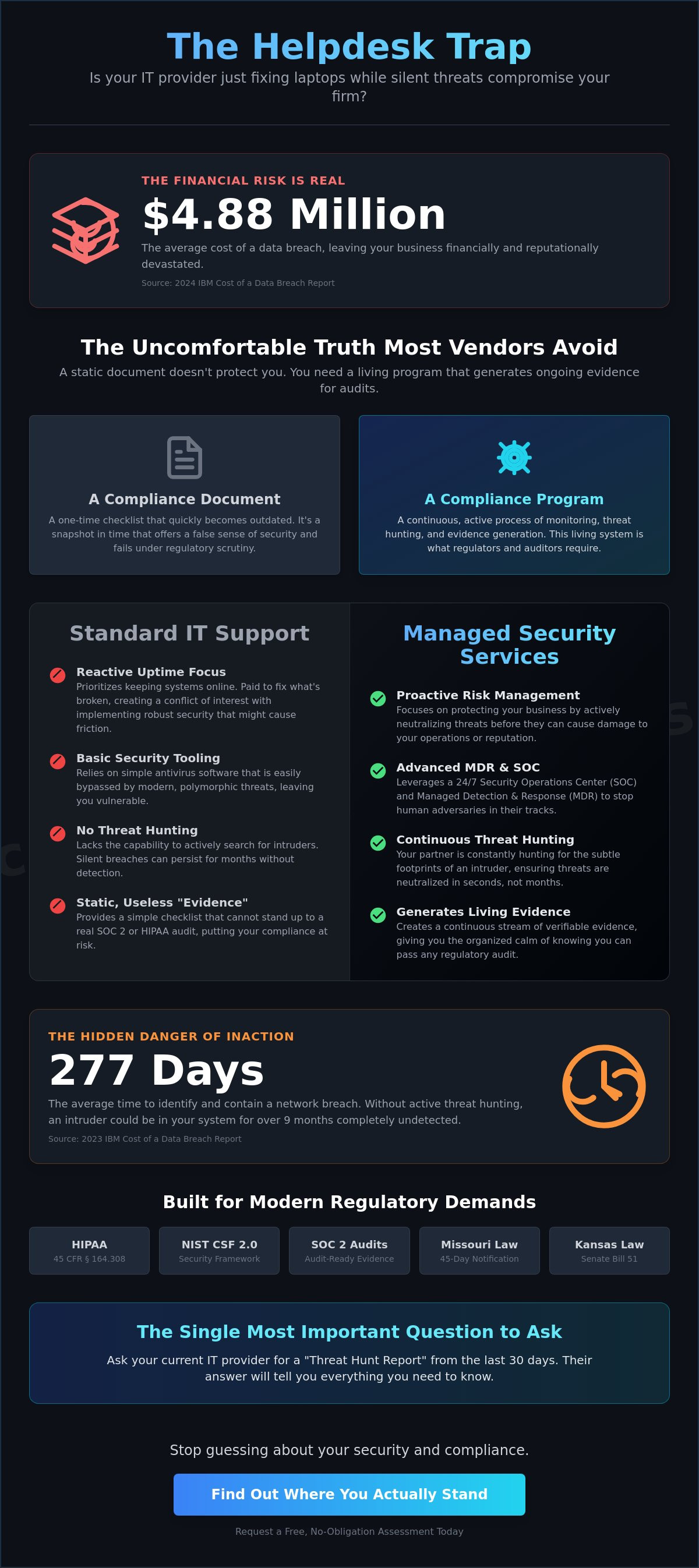
You likely feel that your security posture is stagnant despite your rising technology bills. It is an uncomfortable truth that most vendors sell you a static compliance document when you actually need a program that generates ongoing evidence. According to the 2024 IBM Cost of a Data Breach Report, the average breach now costs $4.88 million. You cannot afford to simply hope your "IT guy" has it covered.
This guide provides a rigorous 2026 evaluation template to help you vet providers against modern standards like the NIST CSF 2.0 and Missouri’s 45 day breach notification law. You will learn to distinguish between simple helpdesk support and a vigilant partner that speaks the language of regulatory evidence. We will move from the anxiety of potential vulnerabilities to the organized calm of a compliant environment that meets the latest mandates like Kansas Senate Bill 51.
Key Takeaways
- Identify the "Helpdesk Trap" where providers prioritize system uptime over the actual detection of silent, sophisticated network threats.
- Master the 2026 criteria for managed security services in Kansas City to ensure you are getting 24/7 monitoring instead of just occasional software patches.
- Avoid the "hidden fee" model common in the metro area by using a structured framework to vet a vendor's pricing and service level.
- Learn to verify that your compliance program generates living evidence as required by HIPAA 45 CFR § 164.308 rather than just a dead, static document.
- Gain the confidence to pass a SOC 2 or HIPAA audit by partnering with a protector who manages business risk, not just code.
The Helpdesk Trap: Why Your IT Support is Not Managed Security
Imagine sitting in your office near the Country Club Plaza when a notification arrives from a federal regulator. You discover that your "secure" network was actually breached six months ago. Your IT provider assured you everything was fine because the servers were up and the email was working. This is the nightmare scenario for practice managers who confuse basic IT maintenance with comprehensive managed security services kansas city.
The uncomfortable truth is that most IT firms in the metro area are incentivized by your uptime, not by the absence of threats. If your employees can log in and the printers are functioning, the technician considers their job done. They are paid to keep you productive, which often means they prioritize convenience over the rigorous protocols required to stop a modern adversary.
To better understand this concept, watch this helpful video:
A helpdesk is a reactive utility designed to fix what is broken. It is a defensive crouch. In contrast, true Managed Security Services (MSS) represent an offensive discipline. While your IT support handles software updates, a security partner is actively hunting for the subtle footprints of an intruder who has already bypassed your perimeter.
The Conflict of Interest in Standard Managed IT
Generalist technicians often overlook critical security gaps to avoid generating helpdesk tickets. If they implement strict Multi-Factor Authentication or lock down folder permissions, it might frustrate a user and create more work for the IT team. This "convenience vs. security" binary leaves law firms in Lee’s Summit and medical practices in Overland Park vulnerable. Standard IT is about availability; managed security is about integrity and the verifiable protection of your data.
Antivirus is a Minimum, Not a Strategy
Basic antivirus software fails against modern polymorphic threats that change their code to evade detection. Relying on signatures is like looking for a criminal based on a ten year old photograph. The 2023 IBM Cost of a Data Breach Report found that it takes an average of 277 days to identify and contain a breach. If your provider is not performing active threat hunting, an intruder could be living in your network for months. Ask your current vendor for a "threat hunt" report today. If they cannot produce one, you are likely caught in the helpdesk trap.
Defining Managed Security Services in Kansas City for 2026
In 2026, true managed security services kansas city are defined by a shift from passive observation to active intervention. It is no longer enough to have a dashboard that turns red when something breaks; you need a team that stops the fire before it spreads. This involves the 24/7 monitoring and response of network traffic and endpoints to ensure that suspicious behavior is neutralized in seconds, not days.
Modern protection relies on Managed Detection and Response (MDR). This is the technical engine that identifies anomalies, but the human intelligence comes from a Security Operations Center (SOC). In a local, veteran-owned context, this means having experts who understand the specific regulatory pressures facing Midwest firms and are ready to act as your watchful protector. If you want to see how this fits your specific risk profile, you can speak with a strategist today.
24/7 Managed Detection and Response (MDR)
MDR acts as a continuous digital sentry. It goes beyond identifying a known virus to spotting a human adversary attempting to move laterally through your network. For a law firm in Overland Park, this level of vigilance is the only way to truly protect attorney-client privilege in an era of sophisticated phishing. The goal is a transition from simply "detecting" an alert to "responding" to a threat in real-time, effectively evicting intruders before they can exfiltrate sensitive data.
Endpoint Protection and Email Security
The traditional office perimeter has dissolved. Your security boundary is now the individual employee’s inbox, especially with a hybrid KC workforce. According to the FTC cybersecurity basics, protecting these entry points is fundamental to business survival. Multi-Factor Authentication (MFA) is now a non-negotiable requirement for every login, regardless of company size.
Endpoint protection ensures that a laptop in a coffee shop is just as secure as a workstation in your main office. BoTech secures these endpoints for clients with satellite offices stretching from Bentonville to Tulsa. This unified approach consolidates complex needs into a single point of accountability, ensuring that your data remains private no matter where your team logs in.
The 2026 Evaluation Template: How to Vet a Managed Security Provider
Most office managers feel like they are being sold a black box during a sales pitch. You see a list of technical acronyms and a monthly price tag, but you don't know if the solution actually stops a breach. For regulated firms, the difference between a vendor and a partner is the ability to prove what they are doing every single day. This template helps you look under the hood of managed security services kansas city to find a provider that truly takes ownership of your safety.
Demand a flat monthly rate for your protection. Some larger competitors in the Kansas City metro area use a "hidden fee" trap. They lure you in with a low per-user cost but then bill you hourly for "incident response" or "remediation" when a real threat occurs. This creates a conflict of interest where your provider profits from your misfortune. A true partner should have a vested interest in preventing the incident from happening in the first place.
Don't settle for a provider that only monitors "automated alerts." An automated alert is just a computer saying it saw something weird; it is often too late by the time a human looks at it. You need proof of active threat hunting. This is the difference between a burglar alarm that rings after the door is kicked in and a live guard walking the perimeter to spot the intruder before they reach the building. To understand why this security-first mindset is vital for your management strategy, see our guide on Managed IT Support Near Me.
Critical Questions for Your Potential Partner
Ask if they provide a dedicated SOC or if they are simply reselling a third-party license. Many local firms just install software and walk away. You should also demand to know exactly how they generate ongoing evidence for your specific regulatory body, such as HIPAA or SOC 2. Finally, ask for their documented incident response time for a critical endpoint alert. If they can't answer these with specific numbers, they aren't a security firm; they are a helpdesk with a new coat of paint.
Red Flags in a Managed Security Proposal
The biggest red flag is a provider that promises "guaranteed compliance." Compliance is a result of your internal culture and ongoing effort; it is not a product you can buy off a shelf. Be wary of proposals that don't include employee security awareness training as a core component. Humans are the weakest link in the chain. If a provider refuses to cite their specific monitoring tools or methodologies, they are likely hiding a lack of depth in their managed security services kansas city offering.
The Evidence Distinction: Why Compliance is Not a Document
Most Kansas City IT firms will hand you a binder full of policies and tell you that you are compliant. This is a dangerous lie. A document is a snapshot in time; it is dead the moment it is printed. For firms seeking managed security services kansas city, the only thing that matters during an audit is evidence. If you cannot prove that you reviewed your system logs last Tuesday, your written policy saying you do review them is worthless.
The HIPAA Security Rule 45 CFR § 164.308(a)(1)(ii)(D) explicitly requires the implementation of procedures to regularly review records of information system activity. This includes audit logs, access reports, and security incident tracking. Generic KC IT firms often promise compliance, but without the telemetry provided by true managed security services kansas city, they are just guessing. Automated evidence collection replaces the frantic fire drill of audit preparation with a calm, organized repository of facts.
Generating Continuous Evidence for HIPAA and SOC 2
Your MDR logs serve as the primary evidence for these required system activity reviews. They prove that someone was watching your network 24/7 and that every anomaly was investigated. Vulnerability assessments further strengthen this by maintaining a reasonable and appropriate security posture as mandated by federal law. A practice manager feels an immense sense of relief when an auditor asks for access logs and they are already indexed and ready for review. It turns a week of stress into a five minute task.
The Reality of PCI DSS and Financial Scrutiny
Financial services firms in the KC metro area face even tighter scrutiny. A static security policy won't protect your firm from a PCI DSS non-compliance fine if a breach occurs. These regulations demand active, documented defense. We consolidate your security and compliance needs into a single point of contact, ensuring that your technical defenses and your regulatory evidence are always in sync. Don't wait for an audit failure to realize your documents are insufficient. You can request a compliance evidence review to see where your current program falls short.
Securing Your Kansas City Business: From Anxiety to Relief
The journey from feeling exposed to achieving watchful protection is a fundamental shift in how you view your business risk. By implementing the evaluation template we have discussed, you move away from the helpdesk trap and toward a model where security is a constant, living discipline. Securing your organization with legitimate managed security services kansas city means you no longer bear the burden of technical vigilance alone.
Our veteran-owned, no-nonsense approach is designed for practice managers who are tired of corporate jargon and vague promises. We act as a strategic consultant that takes full ownership of your safety, allowing you to focus on your clients or patients. You deserve a partner that understands the high stakes of your accountability and provides the stability needed to meet evolving mandates like the Kansas Cybersecurity Act.
One specific, actionable step you can take today is to audit your current IT contract for the word "Response." Most standard agreements focus heavily on "Uptime" or "Availability," which only guarantees that your systems are running. If your contract doesn't explicitly define a rapid response to security incidents, you are paying for maintenance while remaining entirely vulnerable to an active attack.
The BoTech Partnership: Vigilance as a Service
We utilize a flat-rate model because it aligns our interests with your stability. We don't profit from your downtime or bill you extra hours to fix a breach that should have been prevented. This commitment ensures that we are always incentivized to maintain the highest level of protection for your network. You can explore our full range of protection, including 24/7 Managed Detection and Response, on the BoTech Services page.
The human element is what truly distinguishes a professional security partner. Our team has seen the worst-case scenarios and works tirelessly to prevent them from occurring within your environment. We provide the high-end capabilities usually reserved for large enterprises but deliver them in an accessible way for regulated small businesses in the KC metro area.
Your Immediate Next Step
Pick up the phone and ask your current provider for a "Vulnerability Roadmap" today. This should be a documented plan that details your existing gaps and the specific steps being taken to close them over the next twelve months. If your provider cannot produce this roadmap immediately, it is a sign that your business is currently operating in the dark. A provider without a roadmap is simply waiting for you to call them with a problem.
You don't have to guess about your level of protection or worry if you are meeting regulatory evidence requirements. It's time to find out where you actually stand with a comprehensive review of your current posture. Schedule a free assessment today to gain the clarity and confidence your organization requires.
Move Toward a State of Organized Calm
You now have the framework to distinguish between simple IT support and the rigorous protection your firm requires. Legitimate managed security services kansas city must offer more than just uptime; they must provide the continuous evidence needed for HIPAA and SOC 2 audits. By demanding a vulnerability roadmap and auditing your contracts for active response, you take control of your organization's integrity. BoTech has been veteran-owned and operated since 2021. We specialize in navigating the high stakes of HIPAA, SOC 2, and PCI DSS compliance through 24/7 Managed Detection and Response. Our flat-rate model ensures you never face hidden fees during a crisis. You don't have to navigate these regulatory pressures in the dark.
The transition from vulnerability to vigilance starts with a clear understanding of your current gaps. You deserve a partner that speaks the language of business risk and takes full ownership of your technical defense. Stop guessing if your "IT guy" has you covered and start building a program that generates the evidence your regulators demand.
Find out where your security actually stands with a free assessment. Taking the first step toward a secure partnership is the only way to replace anxiety with the confidence of high-level protection.
Frequently Asked Questions
What is the difference between an MSP and an MSSP in Kansas City?
An MSP manages technology availability while an MSSP manages business risk. Most Kansas City MSPs focus on helpdesk tickets and server uptime to keep your employees productive. An MSSP focuses on threat detection and generating the regulatory evidence required for audits. It is the difference between keeping the lights on and keeping the intruders out of your network.
Does my small healthcare practice really need 24/7 monitoring?
Yes, because automated cyberattacks do not follow standard business hours. Small practices are often targeted specifically because they lack the sophisticated defenses of large hospitals. Without continuous monitoring, a breach could go undetected for months. This delay leads to massive penalties under the HIPAA Security Rule because you failed to identify and respond to the threat in real time.
How much do managed security services cost for a small business in KC?
Pricing for managed security services kansas city depends on your specific regulatory requirements and the number of endpoints in your network. You should look for a flat monthly fee that covers both detection and response. Be wary of providers that offer a low entry price but hide incident remediation fees in the fine print. Predictable costs allow you to budget for security as a fixed operational expense rather than a series of financial surprises.
Can managed security services help me pass a HIPAA audit?
Managed security provides the ongoing activity logs and telemetry that auditors demand. A static compliance binder is insufficient because it only proves you have a policy, not that you are following it. You need technical evidence proving you reviewed system activity as required by 45 CFR § 164.308(a)(1)(ii)(D). We provide the reporting that turns a stressful audit into a routine verification of your existing protocols.
What happens if a breach occurs while I am using managed security services?
The primary goal is to minimize the "blast radius" through immediate isolation and remediation. If an incident occurs, your security partner should move to evict the intruder and secure your data before exfiltration happens. This rapid intervention is critical for meeting the 45 day notification deadline required by the Missouri Data Breach Notification Law. It transforms a potential catastrophe into a managed incident with a documented response path.
Do managed security services include employee phishing training?
Security awareness training is a non-negotiable component of a modern defense strategy. Since humans are the primary entry point for ransomware, training your team to spot sophisticated phishing attempts is essential. We include regular simulations to ensure your employees act as a human firewall. This proactive approach reduces the likelihood of a successful social engineering attack from compromising your entire firm.
How long does it take to onboard with a managed security provider?
Onboarding typically takes between two to four weeks for a standard professional firm. This period involves deploying endpoint protection, configuring email security, and establishing your initial compliance baseline. It is a structured process designed to close immediate gaps without disrupting your daily operations. A disciplined transition ensures that your "watchful protection" is fully functional before you phase out your legacy IT support.
Why should I choose a local Kansas City provider over a national firm?
Local providers have a direct understanding of regional mandates like the Kansas Cybersecurity Act and Senate Bill 51. A national firm often treats small businesses as a ticket number in a massive, distant queue. A local partner provides a watchful, human presence and maintains a shared interest in the stability of the Kansas City business community. Accountability is much higher when your security consultant is a neighbor rather than a voice in a call center.