How to Prevent Ransomware Attacks: The 2026 Strategy for Regulated Kansas City Businesses
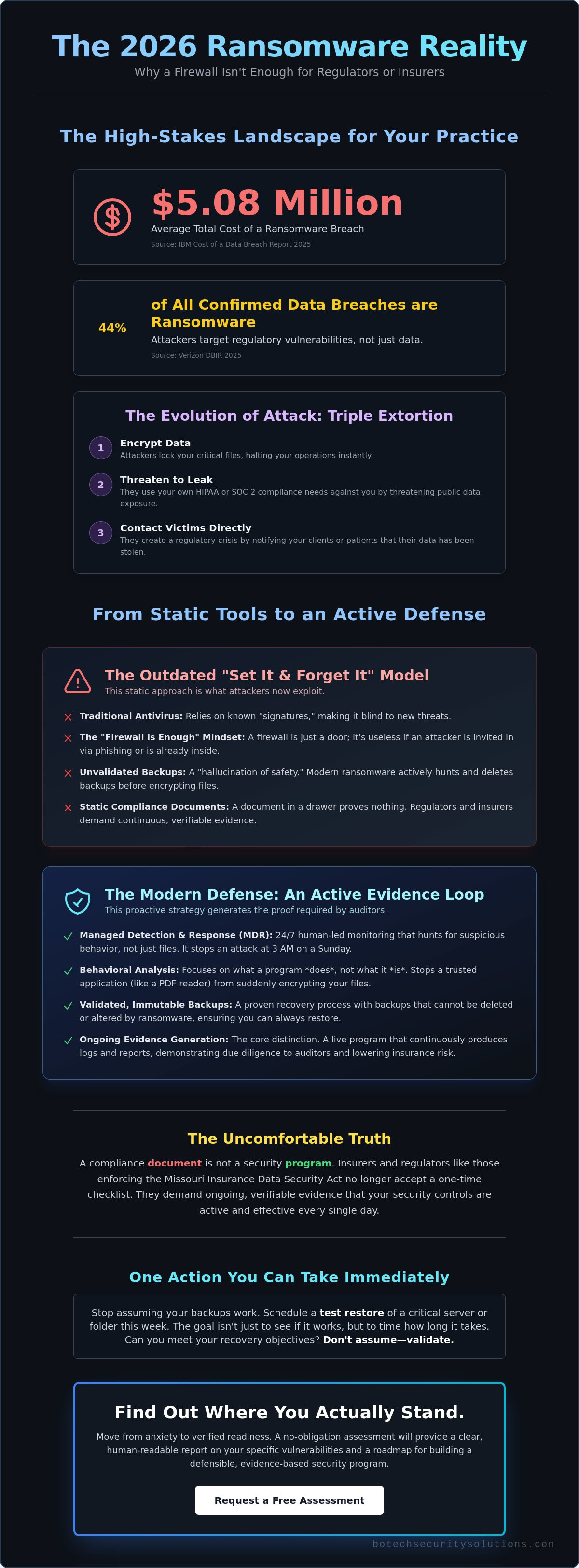
Your current cyber insurance renewal probably feels more like an interrogation than a business transaction. It's because the uncomfortable truth in 2026 is that having a firewall is no longer enough to satisfy underwriters or regulators. Ransomware accounted for 44% of all confirmed data breaches in 2025 according to the Verizon DBIR; simply hoping your antivirus catches every threat is a recipe for a $5.08 million disaster. You need a proactive, evidence-based strategy on how to prevent ransomware attacks that actually holds up under the scrutiny of the Missouri Insurance Data Security Act.
I know you're tired of the tech-speak and the mounting pressure of HIPAA or SOC 2 compliance. You want to focus on your Kansas City practice, not worry about whether a single phishing email will result in weeks of downtime. This guide provides a clear roadmap to modern security, moving you from a state of anxiety to one of verified readiness through comprehensive Managed Security. We will examine the specific, high-stakes steps required to lower your insurance risk and build a defense that generates the ongoing evidence regulators now demand.
Key Takeaways
- Shift your mindset from simple encryption to data extortion and learn why Kansas City firms are now targeted for their regulatory vulnerabilities.
- Discover a multi-layered strategy on how to prevent ransomware attacks by moving beyond static antivirus to a dynamic, human-led defense.
- Stop relying on the hallucination of safety and implement a backup validation process that protects against modern ransomware’s hunt-and-delete tactics.
- Transition from static compliance documents to an active evidence loop that satisfies both HIPAA auditors and cyber insurance underwriters.
- Explore how Managed Detection and Response (MDR) provides enterprise-level vigilance for professional firms without the need for an internal security team.
Beyond the Threat Landscape: The Reality of How to Prevent Ransomware Attacks in 2026
Many Kansas City practice managers still believe they're flying under the radar. They assume hackers only want the "big fish," but that logic is exactly what makes you a target. The uncomfortable truth is that most small businesses are targeted specifically because their security is a "set it and forget it" model that hasn't been touched in years. For a local law firm or medical clinic, the "we're too small" mindset isn't just a misconception; it's your primary vulnerability.
Defining the 2026 Ransomware Threat
Ransomware is no longer just about locking your files. It's evolved into a multi-layered extortion machine designed to use your own compliance requirements against you. Threat actors now use triple extortion tactics. They encrypt your data, threaten to leak it publicly, and then contact your patients or clients directly to tell them their private information is for sale. This surgical precision is fueled by Ransomware-as-a-Service (RaaS) platforms that allow even low-level criminals to execute sophisticated attacks.
If you're still asking What is Ransomware? in the modern context, it's essentially a regulatory weapon used to force your hand. According to the IBM Cost of a Data Breach Report 2025, the average total cost of a ransomware incident has climbed to $5.08 million. That's a figure that would bankrupt most Kansas City firms before they ever have a chance to recover from the initial downtime.
The Tension of the Unprotected Network
Imagine walking into your office on a Monday morning to find every screen displaying a countdown timer and a demand for payment. Your first instinct might be to pay the ransom just to make the nightmare go away, but that creates a new crisis. Paying could result in a violation of OFAC (Office of Foreign Assets Control) regulations if the criminal group is on a sanctions list. Refusing means losing years of client trust and sensitive case files. Failure to act quickly also triggers the Missouri Data Breach Notification Law (Mo. Rev. Stat. § 407.1500), which mandates notification to affected residents without unreasonable delay.
This is where the old way of thinking fails. Understanding how to prevent ransomware attacks requires accepting that prevention isn't a product you buy once. It's a 24/7 operational requirement. You can't stop an attack at 3:00 AM on a Sunday if nobody is watching the network. Breaking the attack chain requires constant vigilance and a Managed Security approach that identifies suspicious lateral movement before the encryption begins.
Your IT vendor might tell you that your firewall is enough, but a firewall is just a door. If someone has the key, or if they're already inside, that door is useless. Real security requires a program that generates ongoing evidence of safety rather than just a static compliance document sitting in a drawer. Most vendors avoid telling you how vulnerable you really are because they don't want to manage the complexity of a real security program, but in 2026, transparency is the only way to survive.
The Anatomy of a Breach: Why Static Defenses Fail
Most business owners think a green checkmark on their antivirus means they're safe. It doesn't. Antivirus is a static tool in a dynamic war. It only stops what it has seen before. Modern attackers don't use old files; they use your own systems against you. This is why knowing how to prevent ransomware attacks requires a shift from passive tools to active hunting.
The Failure of Traditional Antivirus
Traditional antivirus relies on "signatures," which are like digital fingerprints of known viruses. If a hacker creates a new variant, the signature changes and the antivirus is blind. Behavioral analysis is different because it watches for what a program does rather than what it is. If your PDF reader suddenly starts encrypting your hard drive, a behavioral tool stops it. Many Kansas City firms rely on "Managed IT" that focuses on fixing printers, but you need Endpoint Protection that actively hunts for these anomalies.
Social Engineering and the Human Firewall
Hackers don't always break in; sometimes they're invited. Consider a busy paralegal at a KC law firm who receives an email marked "Urgent: Unpaid Invoice" that looks exactly like a message from a regular vendor. They click the link, enter their credentials, and just like that, the perimeter is breached. This is why phishing remains the top entry point for ransomware. Annual "check-the-box" training is useless because it doesn't build a culture of vigilance. You need recurring, scenario-based training and advanced Email Security that catches these sophisticated lures before they reach the inbox.
While patching software is a critical baseline, it's only one piece of the puzzle. As noted in CISA's #StopRansomware Guide, a comprehensive defense must address both technical vulnerabilities and the human element. The uncomfortable truth most vendors avoid is that your employees are your biggest risk. Without a program that turns them into a "human firewall," your technical defenses will eventually be bypassed by a single misplaced click.
Attackers often use "living off the land" techniques, using legitimate administrative tools already on your computer to move through the network. This bypasses traditional firewalls because the activity looks like normal IT work. Hackers often spend weeks inside a network, a period known as "dwell time," before they ever launch the final payload. During this time, they're stealing data and deleting your backups. If you're concerned about your current visibility, you can request a security review to see what might be hiding in your environment.
Why Your Current Backup Strategy is Likely a Liability
Most office managers feel a sense of relief when they see a "Backup Successful" notification on their screen. In 2026, that notification is often a hallucination of safety. Modern ransomware groups spend their dwell time identifying and purging your recovery options before they ever touch your live production data. If your backup is visible on your network, the attackers have already found it and likely deleted it.
A true strategy on how to prevent ransomware attacks must treat your backup as the ultimate target of the breach. If an attacker can destroy your ability to recover, they have total leverage over your firm's survival. This is why simple data storage is no longer enough for a regulated practice; you need a comprehensive Disaster Recovery program that ensures your data is strictly separated from your daily operations.
The Backup Validation Gap
To survive a modern attack, your strategy must follow the 3-2-1-1 rule. This requires keeping three copies of your data on two different types of media, with one copy offsite and one copy that is strictly immutable. An immutable backup is a locked copy that cannot be changed or deleted by any user, including a hacker who has stolen your administrative credentials. As emphasized in the federal #StopRansomware Guide, having a disconnected, air-gapped copy of your data is the only baseline for 2026.
Compliance requirements add another layer of accountability for your practice. HIPAA Security Rule § 164.308(a)(7)(ii)(A) mandates a formal data backup plan, but a static document won't satisfy an auditor after a breach occurs. You need a program that generates ongoing evidence of successful, tested restores. For firms managing high-stakes client data, understanding the nuances of Backup and Disaster Recovery is critical for long-term stability.
Scenario: The Failed Restore
Consider a Kansas City law firm that diligently backed up their case files every night to a local server. When ransomware hit, the hackers spent two weeks inside the network and quietly corrupted those backups before launching the encryption. When the firm tried to restore, they found nothing but junk. Even if the data had been clean, they discovered their "restore speed" was so slow it would take 14 days to get back online. Most small businesses cannot survive two weeks of zero productivity; that firm effectively died because they didn't understand their metrics.
Every manager must know their Recovery Time Objective (RTO) and Recovery Point Objective (RPO). RTO is how long you can afford to be down, while RPO is how much data you can afford to lose. BoTech Security Solutions focuses on validation as a service because the storage of data is cheap, but the ability to recover it instantly is what keeps you in business. We don't just hope your backups work; we prove they work through regular, automated testing that generates the evidence your insurance provider demands.
Building a Defensible Perimeter: The Compliance Evidence Loop
A compliance document is a static piece of paper. It usually sits in a binder on a shelf, gathering dust until an auditor asks to see it. A compliance program, however, is a constant stream of evidence. If you want to know how to prevent ransomware attacks effectively, you have to stop treating compliance as a checkbox and start treating it as a pulse.
HIPAA Security Rule § 164.308(a)(1)(ii)(A) specifically requires an ongoing risk analysis. This isn't a suggestion; it's a federal mandate. Most vendors will sell you a template and tell you you're protected. They're lying. True protection comes from the logs, reports, and alerts that prove your security controls were active at 2:00 PM on a Tuesday.
Multi-Factor Authentication (MFA) has also undergone a massive shift. It used to be a best practice for the security-conscious. In 2026, it's mandatory for almost every cyber insurance policy in the United States and is a core expectation under the Missouri Insurance Data Security Act. Without MFA on every entry point, you aren't just vulnerable; you're likely uninsurable.
Continuous Monitoring vs. Periodic Audits
An annual audit is a snapshot of one moment in time. It leaves you blind for the other 364 days of the year. If a vulnerability appears on day two, you won't find it until next year. The 24/7 Managed Detection and Response provided by BoTech Security Solutions ensures the continuous diagnostics required by SOC 2 and HIPAA. Our Compliance Services focus on generating the ongoing evidence that proves your firm is actually defending its perimeter.
Closing the Technical Gaps
Patch management is often viewed as a boring IT chore. In reality, it's a proactive compliance requirement. Every unpatched server is an open window for a hacker. Building a perimeter is about more than just software; it's about the technical standards that define how to prevent ransomware attacks in a regulated environment. We use vulnerability assessments to find these gaps before threat actors do.
We also implement "Least Privilege" access across your network. This ensures that even if a single employee's account is compromised, the damage is contained. The attacker shouldn't be able to hop from the front desk computer to your most sensitive patient or client records. When you pair this with dark web monitoring for stolen credentials, you build a perimeter that actually defends your firm.
If you're unsure whether your current setup generates the evidence your insurance company requires, request a compliance gap analysis today.
Managed Detection and Response: The Kansas City Standard for 2026
Managed Detection and Response (MDR) represents the bridge between enterprise-grade security and small business budgets. In 2026, Kansas City firms are moving away from unpredictable hourly billing toward a flat monthly rate for total security vigilance. This model allows a local law firm or medical practice to access the same level of protection used by global institutions without the overhead of an internal security department. BoTech Security Solutions applies military-grade discipline to this process, ensuring that your defense is an active operation rather than a static product.
The distinction between a standard vendor and a proactive partner lies in the shift from reactive maintenance to active hunting. You don't just need someone to call when things break; you need a team that stops the break from happening. This level of oversight is the only way to effectively master how to prevent ransomware attacks in an environment where threats evolve daily. You need a sentry that has seen the worst-case scenarios and is dedicated to preventing them for your organization.
The 24/7 Security Operations Center (SOC)
A critical component of how to prevent ransomware attacks is the speed of response. If a threat is detected at 2:00 AM on a Saturday, a standard IT provider won't see it until Monday morning. By then, the encryption is complete and your data is stolen. Our SOC model acts as a watchful protector, identifying and isolating threats in real-time before they can spread. This human-led approach provides the continuous diagnostics required for modern compliance, moving beyond the limitations of simple break-fix support. For many local businesses, this level of care is the primary reason to transition to Managed IT Services in Kansas City.
Immediate Action: Find Out Where You Stand
You can take one specific step today to verify your organization's safety. Log into your administrative dashboard and review your MFA logs and your backup validation reports. If you see repeated failed login attempts from unknown locations or backups that haven't been successfully "test-restored" in the last 30 days, your firm is exposed. The uncomfortable truth is that you cannot manage what you do not monitor. If you aren't looking at the evidence daily, you are simply hoping for the best in a high-stakes environment.
Transitioning from the anxiety of potential vulnerabilities to a state of "audit-ready" security requires a proactive partner. The first step in learning how to prevent ransomware attacks is admitting exactly where your current gaps are. We invite you to schedule a free assessment to find out where you actually stand and get a clear roadmap to the peace of mind you deserve.
Securing Your Firm’s Future in a High-Stakes Environment
You now understand that modern protection requires more than a simple antivirus. It demands a shift from static documents to a dynamic evidence loop that satisfies both regulators and insurance carriers. By implementing immutable backups and 24/7 Managed Detection and Response, you move from a state of constant anxiety to one of verified readiness. Mastering how to prevent ransomware attacks is about taking ownership of your data before a crisis forces your hand.
As a veteran-owned and operated partner, BoTech Security Solutions applies military-grade discipline to your HIPAA, SOC 2, and PCI DSS compliance needs. We don't just sell software; we provide the constant vigilance required to keep your Kansas City practice running safely. Take the first step today by reviewing your current security logs for any visible gaps. If you want a professional perspective, Find out where you actually stand with a Free Security Assessment. You've worked too hard to build your business to let a single breach take it all away. You've got this.
Frequently Asked Questions
Is paying the ransom ever a good idea for a small business?
Paying the ransom is almost never a good idea and often results in double extortion where attackers keep your money and leak your data anyway. The FBI and CISA strongly discourage payment because it funds future attacks and offers no guarantee of recovery. Additionally, paying a sanctioned criminal group can lead to heavy legal fines for OFAC violations.
Can our current IT person handle ransomware prevention alone?
Most internal IT staff are focused on availability, like fixing printers and keeping the internet running, rather than active threat hunting. Ransomware prevention requires 24/7 monitoring and specialized compliance expertise that a single person simply cannot maintain. You need a partner who takes ownership of your security while your IT person focuses on daily operations.
What is the most common way ransomware enters a law firm network?
Phishing remains the most common entry point for ransomware in professional services. Attackers send highly targeted emails that trick employees into clicking malicious links or providing credentials. Training your staff on how to prevent ransomware attacks through these social engineering lures is just as important as your technical firewall.
Does cyber insurance require 24/7 monitoring for coverage?
While requirements vary, many modern cyber insurance policies now mandate 24/7 Managed Detection and Response to maintain coverage or lower premiums. Under the Missouri Insurance Data Security Act, businesses must prove they have established data security standards. Carriers are moving toward a model where they only insure firms that can provide ongoing evidence of active monitoring.
How often should we conduct vulnerability assessments for HIPAA compliance?
You should conduct vulnerability assessments at least quarterly or whenever there is a significant change to your network environment. HIPAA Security Rule § 164.308(a)(1)(ii)(A) requires an ongoing risk analysis, not a one-time event. Frequent assessments help you close the technical gaps that hackers use to gain a foothold in your systems.
What happens to our data if we have backups but no recovery plan?
If you have backups but no recovery plan, you'll likely face catastrophic downtime that could last two weeks or more. Data is only useful if you can restore it within your Recovery Time Objective (RTO). Without a validated plan, you're just storing encrypted junk that might fail during the most critical moment of a breach.
How does BoTech's flat-rate model differ from traditional IT support?
Traditional IT support is a reactive "Break-Fix" model where the vendor only makes money when your systems fail. Our flat-rate model aligns our interests with yours because we take ownership of your safety 24/7. We focus on proactive vigilance and compliance evidence rather than just billing for hours spent fixing avoidable problems.
Will MFA completely stop ransomware attacks?
MFA is a critical layer of defense, but it won't completely stop a determined attacker. Hackers use techniques like "MFA fatigue" or session hijacking to bypass these prompts. A comprehensive strategy on how to prevent ransomware attacks must include endpoint protection and behavioral analysis to catch attackers who have already bypassed your initial login controls.