What is a Vulnerability Assessment? The 2026 Security Guide for Regulated SMBs

Your IT provider tells you the network is fine, but you still lose sleep over the thought of a HIPAA auditor walking through your front door. Most business owners mistakenly believe a simple software scan is a safety net. The reality is that a scan is just a list of problems. It isn't a solution. If you want to protect your practice, you must understand what is a vulnerability assessment and why it's the only way to bridge the gap between patching things and actual security.
It's exhausting to feel like you need a full-time CISO just to satisfy the 2026 HIPAA Security Rule updates or a SOC 2 audit. You're likely tired of technical jargon and tools that cost a fortune but leave you guessing about your actual risk. This guide cuts through the noise to show you how to identify and prioritize network gaps before they turn into a $4.8 million breach or a compliance nightmare.
We'll explain the difference between a basic scan and a professional strategy that generates the ongoing evidence regulators demand. You'll learn how to get a clear, prioritized list of what to fix first so you can stop guessing and start protecting your organization. This is about moving from the anxiety of the unknown to the confidence of high level, comprehensive protection.
Key Takeaways
- Understand what is a vulnerability assessment and why it functions as a diagnostic tool rather than a standalone security shield.
- Learn to distinguish between the breadth of a vulnerability scan and the depth of a penetration test to choose the right strategy for your risk level.
- Recognize the uncomfortable truth that a security report is just paper without a remediation plan that prioritizes patching and configuration hardening.
- Shift your focus from static compliance documents to a program that generates the continuous evidence required by 2026 HIPAA and SOC 2 standards.
- Discover how to transition from reactive scanning to a proactive, 24/7 managed detection and response model that protects your network around the clock.
Defining the Vulnerability Assessment: Why Your Checklist Is Not a Shield
Many business owners believe their IT guy has everything under control because the office lights are green and the internet is fast. This complacency is dangerous because it assumes your network is a static fortress that never changes. If you want to understand your true risk, you have to ask what is a vulnerability assessment and how it differs from the basic scans your current provider might be running.
A vulnerability assessment (computing) is a systematic review of security weaknesses in your information system. It isn't a one-time chore or a simple checklist that you file away in a drawer. This process identifies, quantifies, and prioritizes flaws in your software, hardware, and network configurations to give you a clear, data-driven picture of your risk.
To better understand this concept, watch this helpful video:
A professional assessment is far more than a basic scan that any entry-level technician can run. It provides a strategic roadmap for your security budget so you aren't wasting money on the wrong tools. Without this data, you're just guessing where to spend your security dollars, which is a luxury regulated businesses can't afford. It moves you away from a "hope for the best" mentality toward a stance of authoritative vigilance.
The Anatomy of a Security Weakness
Vulnerabilities aren't just complex "hacker stuff" found in movies. They are often simple, overlooked mistakes that happen during a busy workday. Imagine a medical practice in Kansas City that leaves a legacy server unpatched because "it still works fine." A vulnerability assessment would flag that server as a high-priority risk before a ransomware group exploits the flaw. It clearly distinguishes between a software bug in your EHR and a dangerous configuration error in your wireless network.
The Regulatory Mandate for Kansas City Businesses
Regulators don't care if your office manager is "too busy" to check logs or update firmware. HIPAA Section 164.308(a)(1)(ii)(A) requires a rigorous risk analysis, and you simply cannot analyze risk you haven't identified through technical means. For those handling credit cards, PCI DSS Requirement 11.2 mandates regular internal and external scans to maintain your merchant status. If you're pursuing SOC 2 Type 2, you'll need to show continuous monitoring evidence rather than just a one-time document. You can explore our compliance services to see how we automate this evidence collection to keep you audit-ready.
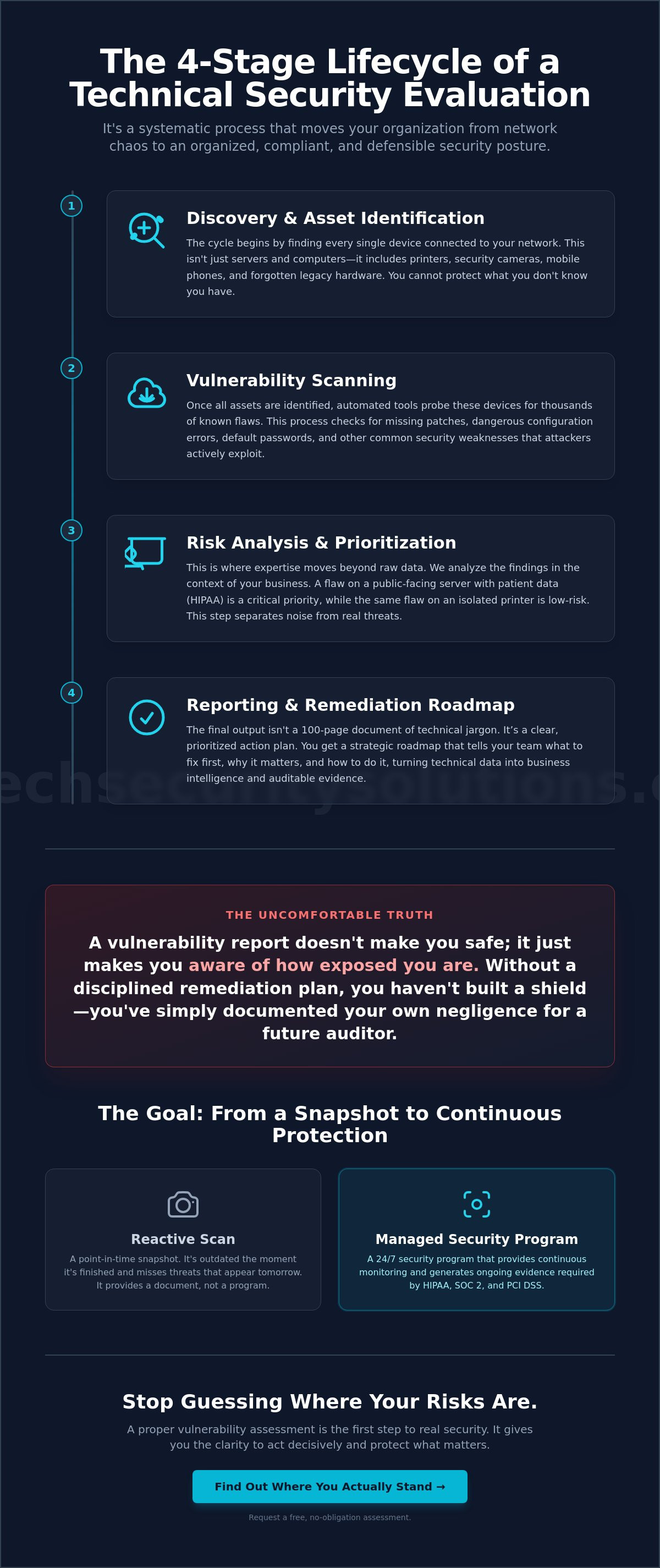
Here is the uncomfortable truth most vendors avoid. A vulnerability report doesn't make you safe; it just makes you aware of how exposed you are. If you have a list of holes but no disciplined remediation plan, you haven't built a shield. You've simply documented your own negligence for a future auditor to find after a breach occurs.
The Four-Stage Lifecycle of a Technical Security Evaluation
Understanding what is a vulnerability assessment requires looking past the software scan and seeing the entire lifecycle. It's a four-stage process that moves from total network chaos to an organized, compliant environment. Without these stages, you're just running a tool and hoping it catches the right things. This systematic approach ensures that your security posture is grounded in reality rather than assumptions.
The cycle begins with discovery, where we find every single device connected to your network. Next is the scanning phase, where automated tools probe these devices for known flaws. Then comes the analysis phase, where we move beyond raw data to understand the actual business context of those flaws. Finally, the reporting phase provides a clear roadmap for your leadership team to follow. This structured flow is what transforms technical data into business intelligence.
Asset Discovery and Inventory
You cannot protect what you do not know exists. In small law firms or medical clinics, "shadow IT" is a constant threat. This happens when a staff member plugs in a personal printer or an old hard drive without telling anyone. Asset discovery is the foundation of any audit because it ensures no device is left exposed to the public internet. It's the only way to verify that your security perimeter is actually where you think it is.
Prioritization and Risk Scoring
Not every security flaw is an emergency. We use the Common Vulnerability Scoring System (CVSS) to rank threats on a scale from 0 to 10. However, a "technical high" score on a guest Wi-Fi router is less dangerous than a "medium" score on a server holding patient records. We filter out the technical noise so you can focus on the risks that actually threaten your business survival. To decide which approach fits your current budget, you should review the differences in a Vulnerability Assessment Versus Penetration Test.
Most IT vendors will hand you a 100-page report and consider their job done. This is the uncomfortable truth: a report without a prioritized action plan is just a list of reasons why you'll fail your next audit. You need a partner who turns that data into a defense strategy rather than a stack of paper. If you're unsure if your current provider is doing this, you can reach out for a second opinion to see where you truly stand.
A compliance program generates ongoing evidence, whereas a simple document does not. By following this four-stage lifecycle, you ensure that every scan contributes to a body of evidence that satisfies auditors and protects your reputation. It's a disciplined, recurring service model that replaces the chaos of external threats with the organized calm of a secure environment.
Vulnerability Assessment vs. Penetration Testing: Choosing Your Strategy
If you're trying to figure out what is a vulnerability assessment, you've likely been pitched a penetration test as well. These services are not interchangeable, and buying the wrong one is a fast way to blow your security budget. Think of a vulnerability assessment as an inspector walking around your building to find every unlocked window and door. A penetration test is a professional thief actually trying to climb through one of those windows to see how far they can get into the vault.
Most small businesses waste money on pen tests before they've even fixed the basics found in a vulnerability assessment. It's like hiring a bodyguard when you haven't even locked your front door. The uncomfortable truth is that many vendors sell expensive pen tests because they sound impressive, even when a standard assessment would provide more immediate value. You shouldn't pay someone to "break in" until you've at least tried to close the open windows first.
Scope and Depth Differences
Vulnerability assessments are generally automated and cover the entire breadth of your network. They provide a comprehensive list of flaws across all your devices, making them highly cost effective for a typical Kansas City financial services firm. Penetration tests are manual, labor intensive, and focus on one specific target. While HIPAA Section 164.308(a)(1)(ii)(A) mandates a thorough risk analysis, it doesn't always require a full pen test for every small practice.
The Myth of the One-and-Done Test
A single annual scan leaves you exposed for the other 364 days. Cyber threats don't wait for your yearly audit to find a hole in your network. According to data from 2024, sixty percent of security breaches result from known but unpatched vulnerabilities. This proves that most organizations are failing at the basics of maintenance rather than falling victim to "super hackers."
For those handling credit cards, quarterly or continuous scanning is often a hard requirement for PCI compliance. The 2026 HIPAA Security Rule update now mandates that covered entities conduct these scans at least every six months on all systems handling ePHI. You can learn more about how this fits into a broader, security first strategy by reading about Managed IT Services in Kansas City. Ongoing support ensures that when a new flaw is discovered, it's addressed before it becomes a $4.8 million breach.
Translating Data into Defense: The Remediation Roadmap
A stack of papers on your desk won't stop a cybercriminal. If you've asked what is a vulnerability assessment and only received a PDF in return, you've been sold a half-finished product. The report is merely a diagnostic tool. Remediation is where the actual protection happens.
Most small businesses fall into the remediation gap where they identify problems but never close the loop. This failure often stems from a lack of clear ownership or a fear that technical changes will disrupt daily operations. You must move past the discovery phase and into the disciplined execution of your security roadmap to achieve true safety.
Patch Management and Configuration Hardening
Patching is the process of fixing software flaws before they can be exploited. Configuration hardening takes this a step further by disabling unnecessary features that attackers use for lateral movement across your network. It's about shrinking your attack surface until there's nothing left for a hacker to grab.
Consider a Kansas City law firm that recently faced an attempted intrusion through a known printer vulnerability. Because they maintained strict patch discipline, the exploit failed before the attacker could access the firm's document management system. This wasn't luck. It was the result of a systematic approach to fixing known weaknesses before they became a crisis.
Generating Audit-Ready Evidence
There is a massive difference between a static compliance document and a living compliance program. A document is a snapshot that becomes obsolete the moment your network changes. A program generates the ongoing evidence required to satisfy a HIPAA or SOC 2 auditor during an unannounced inspection.
Automated evidence collection replaces the nightmare of manual spreadsheets and frantic email chains. It provides a verifiable trail of every patch applied and every configuration hardened. This transparency turns your security efforts into a strategic asset rather than a hidden burden. If you're ready to stop collecting paper and start building a defense, you should contact our team to see how we automate your compliance evidence.
Managed Security in Kansas City: Moving Beyond the Scan
A scan is a snapshot of a single moment in time. A security program is a movie that never stops playing. While you now understand what is a vulnerability assessment, you must realize that identifying a hole is only the first step in a much larger journey toward total network resilience. In a world where 60 percent of breaches stem from unpatched flaws, staying static is the same as staying exposed.
BoTech operates a 24/7 Managed Detection and Response (MDR) model that takes the burden of vigilance off your shoulders. We don't just hand you a report and wish you luck. We take ownership of your security posture so you can focus on running your practice or firm without the constant fear of a regulatory nightmare. This is how we move you from a state of vulnerability to a state of authoritative protection.
The Role of Continuous Monitoring
Once an assessment identifies your baseline risks, 24/7 endpoint monitoring becomes the logical next step. This allows us to catch threats in real time before they can exploit the very vulnerabilities we've identified. You can explore our Compliance Services to see how we bridge high end capabilities with the practical budgets of local small businesses. We ensure that your compliance program generates ongoing evidence rather than just a stack of dead documents.
The Veteran-Owned Advantage for Kansas City Firms
BoTech is rooted in Kansas City and built on military grade discipline. We've seen the worst case scenarios and we are dedicated to preventing them for our neighbors. This no-nonsense approach provides a sense of relief that most distant vendors simply cannot match. When you partner with a local expert who takes ownership of your safety, you move from the anxiety of exposure to the organized calm of a compliant environment.
If you want to take an immediate step toward better security, perform an external scan of your primary domain today. Many free tools allow you to see what a hacker sees from the public internet. It's a sobering way to realize how much information you're actually leaking to the world. It provides the immediate, standalone value of knowing exactly what your front door looks like to a stranger.
Ready to stop guessing? Contact BoTech today for a free assessment to find out where you actually stand and get a clear, prioritized roadmap for your organization.
Securing Your Organization for the Road Ahead
Understanding what is a vulnerability assessment is the first step toward moving your business from a state of exposure to a state of resilience. You now know that a list of flaws is useless without a disciplined remediation roadmap and the ability to generate ongoing evidence for auditors. Real security isn't found in a one-time document; it's found in the consistent, daily management of your technical gaps.
BoTech is a veteran-owned and operated firm dedicated to protecting our neighbors right here in Kansas City with local, rapid response. We replace the anxiety of potential breaches with the organized calm of continuous protection at a flat monthly rate. You don't need to hire a full-time CISO to achieve high level security and regulatory compliance.
It's time to stop guessing about your network's safety and start building a verifiable defense. We invite you to find out where you actually stand with a free vulnerability assessment. Let's work together to ensure your organization remains safe, compliant, and ready for whatever 2026 brings.
Common Questions About Vulnerability Management
Is a vulnerability assessment required by HIPAA?
Yes, HIPAA mandates this process as part of your required risk analysis. Section 164.308(a)(1)(ii)(A) requires covered entities to identify potential risks and vulnerabilities to the confidentiality, integrity, and availability of ePHI. The 2026 HIPAA Security Rule update now specifically mandates that these scans occur at least every six months on all systems handling protected health information.
How often should a small business perform a vulnerability assessment?
You should conduct an assessment at least twice a year to meet basic 2026 compliance standards. However, if you handle credit card data, PCI DSS requires quarterly scans at a minimum. For businesses in high stakes environments, continuous scanning is the only way to catch new threats before they are exploited by automated botnets.
What is the difference between an internal and external scan?
An external scan looks at your network from the outside in, mimicking what a hacker sees when they probe your firewall or website. An internal scan happens from within your office walls to find out what an attacker could access if they successfully tricked an employee with a phishing email. You need both to have a complete picture of your security posture.
Will a vulnerability assessment slow down my network or cause downtime?
Professional assessments are designed to be non-intrusive and should not disrupt your daily operations. Modern tools are highly efficient and can be configured to run during off-peak hours if you have sensitive legacy equipment. If a provider tells you that downtime is inevitable, they are likely using outdated or overly aggressive tools.
How much does a professional vulnerability assessment cost in Kansas City?
The cost depends entirely on the number of devices on your network and the complexity of your regulatory requirements. We avoid providing generic price ranges because your specific risk profile is unique. You should look for a partner that offers a flat, transparent fee rather than one that hides behind "consulting hours" or unexpected surcharges.
Can my current IT company perform a vulnerability assessment?
They can, but asking your IT provider to audit their own work is a conflict of interest. A third party provides the unbiased validation that auditors and insurance carriers look for during a review. This independence ensures that what is a vulnerability assessment remains a true security check rather than a way to hide maintenance gaps.
What happens if we find hundreds of vulnerabilities during the scan?
Don't panic if your first report is long. Most of those findings will be low risk or informational "noise" that doesn't require immediate action. The goal of what is a vulnerability assessment is to use CVSS scores to find the three or four critical holes that actually put your patient or client data at risk.
Is a vulnerability assessment the same as a SOC 2 audit?
No, an assessment is a technical test of your systems, while a SOC 2 audit is an exhaustive review of your entire organization's controls and culture. An assessment is a vital component of SOC 2 readiness, but it is only one piece of the puzzle. You use the assessment to generate the technical evidence that the SOC 2 auditor will eventually need to see.