Managed IT Support Services for Law Firms in Kansas City: The 2026 Security Gap

For law firms in Kansas City, the conversation around technology has fundamentally changed. The old model of calling a technician when a printer breaks is a dangerous liability in a world where a single email can compromise decades of client trust. The search for effective it support services for law firms is no longer about convenience; it is about survival, compliance, and professional responsibility. This guide explains why traditional IT is failing local firms and outlines a security-first framework that satisfies auditors, clients, and your ethical obligations.
By 2026, the gap between basic IT support and true cybersecurity will determine which firms thrive and which face regulatory fines or reputational ruin. The question is no longer if you will be targeted, but whether your infrastructure is built to defend against modern threats. Discover how to move from a reactive, break-fix mentality to a proactive security posture that protects your practice from the ground up.
The Evolution of Legal IT in the Kansas City Metro: Why Support is No Longer Enough
The role of technology in a modern law firm has shifted from a back-office utility to the very foundation of client service and data protection. This evolution demands a move from reactive break-fix IT to proactive managed security. Firms in Kansas City, Springdale, and the surrounding region are now prime targets for ransomware attacks, not because they are large, but because the value of their data—privileged communications, discovery documents, and financial records—is immense.
Every minute of technical downtime directly conflicts with billable hours, creating a tension that office managers and partners know all too well. A slow network or an inaccessible server is not just an inconvenience; it is a direct hit to revenue and a threat to court deadlines. Law firms are quintessential examples of "Organizations That Cannot Afford to Get This Wrong," where the stakes of a data breach include not only financial loss but also ethical violations and irreparable damage to the firm’s reputation.
According to Managed Detection and Response (MDR), this is a well-documented area of ongoing research and practical application.
Moving Beyond the Break-Fix Mentality in Lee’s Summit and Overland Park
Waiting for something to break before you fix it is a failed strategy. For law firms in Lee’s Summit and Overland Park, this reactive approach creates unacceptable liability. When a server goes down during discovery or a laptop is compromised before a trial, the impact extends far beyond the technical issue. It erodes the client trust that is the bedrock of the KC legal community.
The traditional "computer guy" model, where a technician is paid by the hour to resolve issues, is misaligned with a law firm's need for constant uptime and security. This approach incentivizes problems, not prevention. In contrast, enterprise-grade managed services operate on a proactive, flat-rate model designed to prevent issues before they can disrupt your practice.
The High Cost of Downtime for Oklahoma City and Tulsa Legal Teams
The cost of an hour of IT downtime for a mid-sized firm is not just a line item on an invoice; it's a cascade of lost opportunities and escalating risks. For legal teams in Oklahoma City and Tulsa, IT failures can derail court deadlines, compromise discovery schedules, and force attorneys to spend non-billable time troubleshooting technology instead of practicing law.
This ripple effect undermines the firm's efficiency and its professional standing. True managed IT support services are not a cost center but a strategic asset that ensures operational continuity and protects attorney-client privilege in a digital world. Understanding how to safeguard that data is a core component of modern legal practice, a concept further explored in our guide on protecting attorney-client privilege in Kansas City.
Managed Detection and Response (MDR): The 24/7 Security Standard for Law Firms
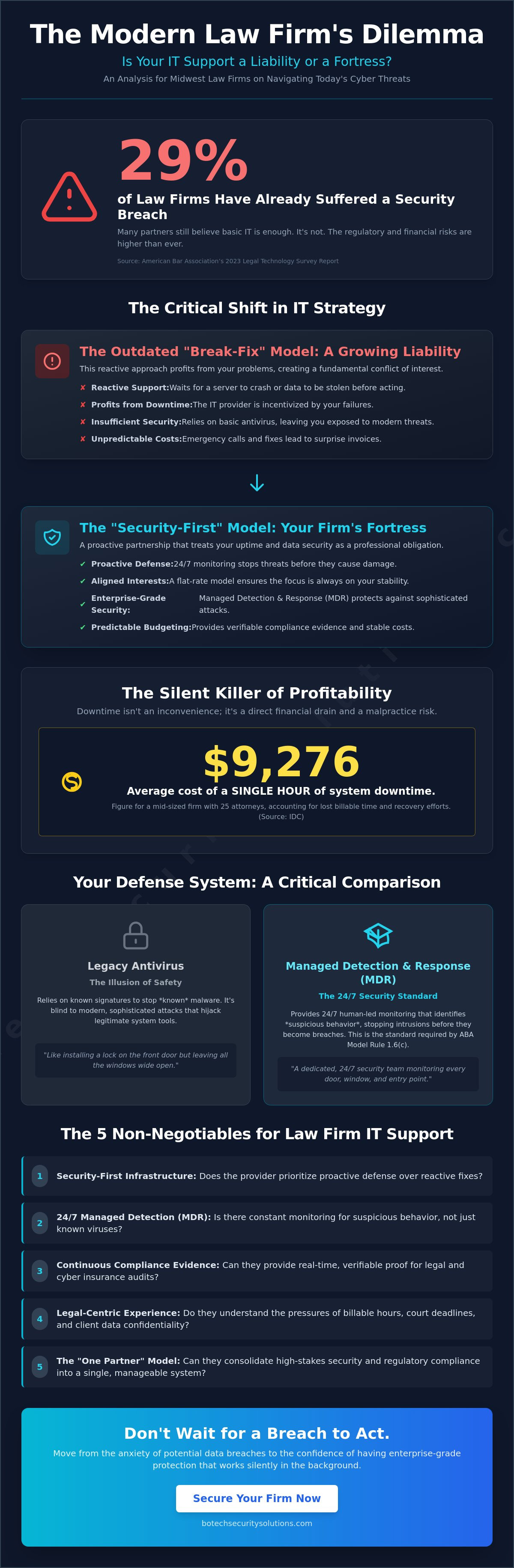
Basic antivirus software is no longer sufficient to protect the sensitive client data and discovery documents that law firms handle daily. It is a check-the-box solution in an era of sophisticated, targeted attacks. The modern standard is 24/7 Managed Detection and Response (MDR), a service that provides constant monitoring of your network to stop breaches before they can escalate into catastrophic events.
The role of a 24/7 Security Operations Center (SOC) is to actively hunt for threats, analyze alerts, and respond to incidents in real-time. For firms in Bentonville and Rogers, which sit at a hub of corporate and legal activity, the threats range from ransomware to corporate espionage. A strong security posture is not just a best practice; it is directly linked to the ABA Model Rules of Professional Conduct, which mandate technological competence and the protection of client information.
Research published by FTC cybersecurity guidance for businesses shows that this is a well-documented area of ongoing research and practical application.
Endpoint Protection and Threat Hunting in Tulsa and Broken Arrow
Endpoint protection is about securing every device that connects to your firm's network—laptops, desktops, and mobile phones. In an age of remote work, where attorneys in Tulsa and Broken Arrow access sensitive files from courtrooms, homes, and client offices, every device is a potential entry point for an attacker. Securing these endpoints is the first line of defense.
Proactive threat hunting goes a step further. Instead of waiting for an alarm, security analysts actively search for vulnerabilities and indicators of compromise within your network. This approach identifies weaknesses before they can be exploited, a critical function for securing mobile devices used by attorneys who are constantly on the move.
Email Security: Protecting the Discovery Process in Rogers and Fayetteville
Email remains the number one attack vector for the legal sector. Business Email Compromise (BEC) is a prevalent threat where attackers impersonate partners or clients to authorize fraudulent wire transfers or exfiltrate sensitive data. For firms in Rogers and Fayetteville, protecting the discovery process means securing the primary channel through which it is communicated.
Advanced email filtering, threat intelligence, and user training are essential to prevent phishing attacks and data loss. This is a core pillar of any security-first IT support model, as it directly protects the firm from both financial fraud and devastating data breaches.
To further secure your financial workflows and document handling, you can discover Chaindoc to see how integrated e-signatures and payment processing can protect your practice from transaction-based fraud.
Compliance Documents vs. Continuous Evidence: The Uncomfortable Truth About Legal Audits
Here is the uncomfortable truth most IT providers avoid: a binder full of compliance documents will not protect your firm during an audit or a lawsuit. The myth of the "compliance binder"—a collection of static policies and procedures—creates a false sense of security. Regulators and auditors do not just want to see your policies; they want to see real-time evidence that you are enforcing them.
There is a critical difference between static documents and a continuous evidence collection program. A document says you have a policy for data access, while evidence proves who accessed what data, from where, and at what time. For firms that handle data subject to HIPAA or act as vendors requiring a SOC 2 report, this distinction is everything. Most IT providers in the Kansas City area are not equipped to deliver this level of evidence, leaving their clients dangerously exposed.
Why ABA Model Rules Demand More Than Basic Antivirus
The American Bar Association's ethical obligations require attorneys to provide competent representation, which, according to formal opinions, includes technological competence. ABA Model Rule 1.1 and 1.6 require attorneys to make "reasonable efforts" to prevent the inadvertent or unauthorized disclosure of, or unauthorized access to, information relating to the representation of a client.
A basic antivirus subscription does not meet this "reasonable efforts" standard in 2026. A 24/7 monitoring and response service, however, provides a defensible position that demonstrates a serious commitment to protecting client data. In jurisdictions like Missouri and Oklahoma, failing to meet these evolving standards can lead to professional sanctions and malpractice claims.
SOC 2 and HIPAA: Moving Beyond Check-the-Box Compliance
For firms that serve clients in healthcare or technology, achieving and maintaining compliance with standards like SOC 2 and HIPAA is a business necessity. A successful audit for these frameworks requires automated, continuous evidence collection. You must be able to produce logs, reports, and alerts on demand to prove your controls are working every day, not just on the day of the audit.
Relying on manual reporting or ad-hoc data gathering is inefficient, prone to human error, and a red flag for auditors. This check-the-box approach often leads to failed audits and regulatory fines. True compliance management requires a system built to generate evidence automatically, a core function of dedicated compliance management services.
Evaluating IT Support Services for Law Firms: A Strategic Framework
When evaluating a new IT partner in Kansas City, your checklist must go beyond response times and pricing. You need a strategic framework to find a partner who understands the unique risks and regulatory pressures of a modern law practice. Utilizing resources from specialized firms like Heights Consulting Group for strategic advisory and risk governance can help you identify the best security partners for your firm’s specific needs. Legal-centric experience is non-negotiable; your IT provider must understand the stakes of your work.
Key evaluation points include their ability to provide 24/7 security monitoring, their deep understanding of compliance evidence generation, and their commitment to local response times across the KC-Bentonville corridor. It is also critical to address the pricing model. The "flat-rate" vs. "hourly" debate is simple for law firms: a predictable, flat-rate security model aligns your provider's incentives with your own, prioritizing prevention over billable repair hours.
The Myth of the Generalist IT Provider
The IT provider that services the local retail shop or restaurant is not equipped to support a law firm. Generalist providers lack the specific expertise required to manage the software and security needs of a legal practice. They may not have experience with critical applications like Clio, PCLaw, or iManage, leading to inefficient support and potential data vulnerabilities.
Worse, generalists often push generic solutions like "server proliferation," adding unnecessary complexity and cost without addressing the core security and compliance requirements of your firm. This one-size-fits-all approach is a significant liability for an industry built on specificity and precision.
Local Response and Vigilance in Blue Springs and Olathe
While much of security can be managed remotely, having a partner who understands the local Kansas City business climate is invaluable. For firms in Blue Springs and Olathe, the availability of prompt onsite support for hardware-critical issues provides a crucial layer of operational stability. Technology problems do not wait for a technician to drive in from out of state.
This is about more than just proximity; it is about the difference between a distant vendor and a Strategic Ally. A true partner is invested in your firm's success and security, offering proactive guidance and a vigilant presence that a national, faceless helpdesk simply cannot replicate.
The BoTech Approach: Securing High-Stakes Legal Practices Across the Midwest
BoTech was founded on a veteran-owned, security-first philosophy. We believe that for law firms, IT support and cybersecurity cannot be separate services. They must be fully integrated into a single, cohesive strategy. Our "One Partner" model simplifies this for our clients, providing 24/7 managed security, compliance evidence generation, and strategic IT guidance under one roof.
We eliminate the friction of unpredictable, billable-hour IT support with a transparent, flat-rate model. This allows your firm to budget effectively while receiving enterprise-grade protection. The first step is always to understand your current posture, which is why we begin every partnership with a BoTech Vulnerability Assessment.
Flat-Rate Security for Growing Firms in Bella Vista and Lowell
Enterprise-grade security should not be reserved for the largest corporations. BoTech makes robust, 24/7 protection affordable and accessible for mid-sized law firms in areas like Bella Vista and Lowell. Our monthly managed security service fee is transparent and predictable, covering everything from endpoint protection to active threat hunting.
This model provides the peace of mind that comes from knowing a team of experts is watching over your network around the clock. With 24/7 incident response included, you are never left to handle a security crisis alone, regardless of when it occurs.
Taking the First Step: Find Out Where You Actually Stand
You cannot protect your firm from threats you cannot see. The BoTech security and compliance assessment is a comprehensive process designed to identify the specific gaps in your current infrastructure. We analyze your technical controls, review your policies, and provide a clear roadmap for remediation.
Knowing your vulnerabilities is the only way to build a defensible security program and prevent a breach. It is not a sales pitch; it is a critical diagnostic for the health of your practice. The first step is to get an honest, expert opinion on your current risk level.
Find out where your firm actually stands with a free assessment.
Frequently Asked Questions
What are the most critical IT support services for law firms in 2026?
The most critical services are those that integrate security and compliance directly into IT support. This includes 24/7 Managed Detection and Response (MDR), advanced email security, endpoint protection for remote work, and automated compliance evidence generation for regulations like HIPAA or standards like SOC 2.
How much should a mid-sized law firm in Kansas City expect to pay for managed IT?
Pricing is typically on a per-user or per-device basis and varies based on the level of security and compliance management required. A flat-rate monthly fee is standard for proactive services, providing predictable costs and aligning the provider's goals with the firm's need for uptime and security. Expect to invest more than a basic break-fix model, as you are paying for prevention and risk management, not just repairs.
Is our current law firm IT support compliant with HIPAA and SOC 2?
Most traditional IT support is not inherently compliant. Compliance requires specific administrative, physical, and technical controls, along with the ability to produce evidence that those controls are working. If your provider is not actively managing and documenting these controls for you, you are likely not audit-ready.
Why is 24/7 Managed Detection and Response (MDR) necessary for legal teams?
Cyberattacks do not happen only during business hours. MDR is necessary because it provides constant monitoring by security professionals who can detect and respond to threats in real-time. For a law firm, where a breach can happen at any moment, this 24/7 vigilance is essential to protecting sensitive client data and privileged information.
Can managed IT services help our firm with ABA Model Rule compliance?
Yes. A security-first managed services provider helps fulfill the "reasonable efforts" requirement for technological competence under ABA Model Rules. By implementing and managing advanced security measures, they provide a defensible posture that demonstrates your firm's commitment to protecting client confidentiality.
What is the difference between an IT generalist and a legal-centric MSP?
An IT generalist serves a wide range of industries and lacks deep knowledge of the specific software (e.g., Clio, iManage), security risks, and compliance obligations of a law firm. A legal-centric Managed Service Provider (MSP) understands the ethical and regulatory pressures of the legal profession and builds its services to address those specific needs.
How does BoTech handle data backups and disaster recovery for Kansas City firms?
We implement a robust backup and disaster recovery strategy that includes regular, automated backups of all critical data to secure, redundant locations. We also perform routine validation to ensure that backups are viable and can be restored quickly, minimizing downtime in the event of a server failure, natural disaster, or ransomware attack.
What happens if our law firm experiences a security breach after hours?
With our 24/7 Managed Detection and Response service, our Security Operations Center (SOC) is alerted the moment suspicious activity is detected. The team immediately investigates, contains the threat to prevent it from spreading, and begins remediation. You are not left to handle a crisis alone; we manage the incident from detection to resolution, day or night.