Managed IT Support in Kansas City: The Security-First Reality for 2026

Your current IT provider is likely leaving your front door wide open while they focus on fixing your office printer. While you might check out Mega Control Security Services to secure your physical premises, your digital 'front door' requires an equally vigilant set of guardians. Most Kansas City business owners believe that paying for a monthly plan means they're automatically protected from a HIPAA or SOC 2 audit. Most are not. Traditional managed it support has become a race to the bottom, prioritizing ticket speeds over actual risk mitigation.
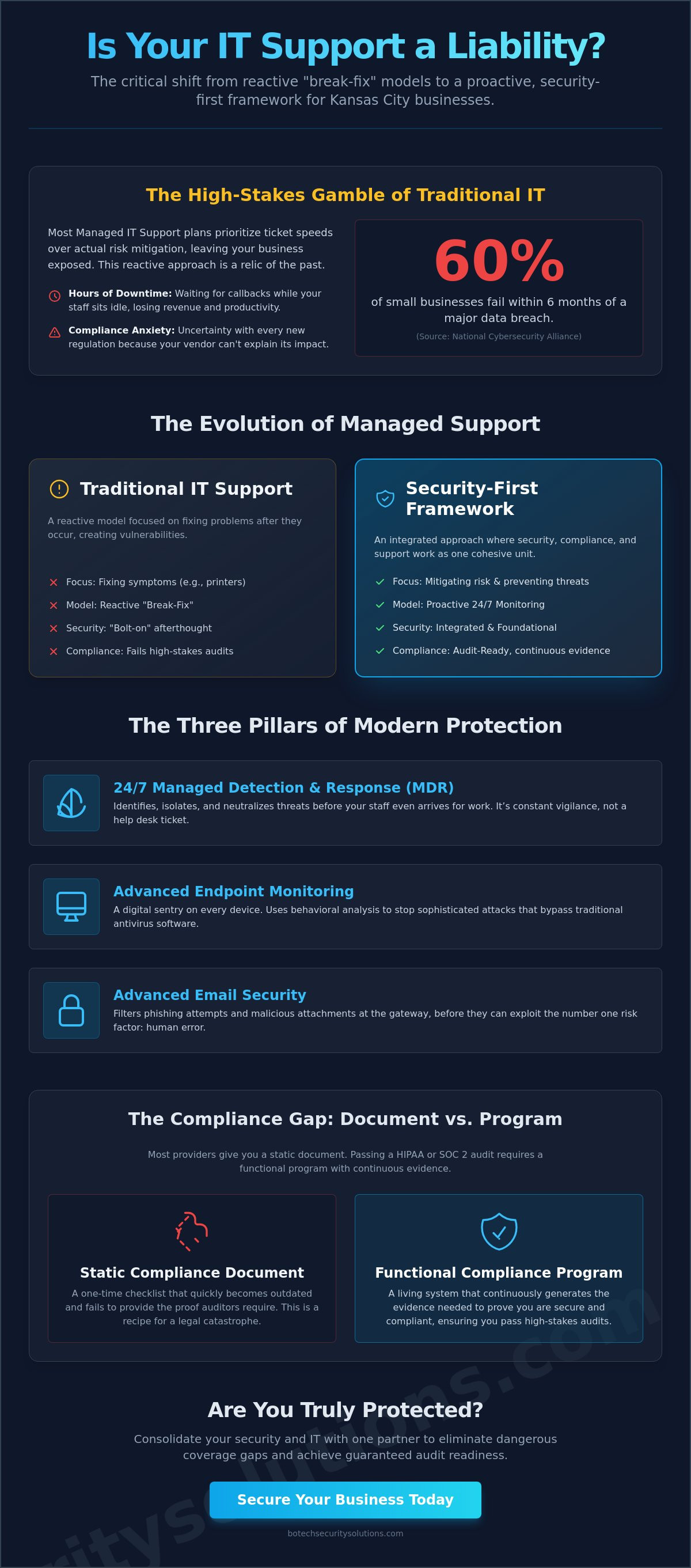
You already feel the frustration of waiting hours for a callback while your staff sits idle. You likely experience a growing anxiety every time a new regulation is announced because your vendor can't explain how it impacts your specific practice. It's a high-stakes gamble that 60 percent of small businesses lose within six months of a major data breach, according to data from the National Cybersecurity Alliance. Organizations that cannot afford to get this wrong need a different approach.
You'll learn why the old help desk model is failing and how to transition to a security-first framework that guarantees audit readiness. We'll examine the hidden gaps in common flat-rate plans and provide a roadmap for achieving 24/7 proactive monitoring before 2026 arrives.
Key Takeaways
- Identify why traditional help desks in Kansas City are failing and how to shift from reactive "break-fix" repairs to a proactive security posture.
- Learn how to implement a security-first managed it support model that integrates 24/7 MDR and compliance into your daily business operations.
- Distinguish between a static compliance document and a functional compliance program that produces the continuous evidence needed to pass high-stakes audits.
- Apply a "tough love" checklist to your current IT vendor to reveal whether you are truly protected or just paying for business-hour help desk support.
- Discover the "One Partner" advantage of consolidating security and compliance to eliminate the coverage gaps common in national MSP models.
The Evolution of Managed IT Support in the Kansas City Metro
The Kansas City business community is waking up to a harsh reality. For years, firms in Overland Park and Lee’s Summit treated managed it support as a basic utility. You called a technician when a printer failed or the internet went dark. That reactive model is now a liability. In 2026, the local landscape is a high-stakes environment where a single misconfiguration leads to total operational paralysis.
To better understand this concept, watch this helpful video:
The concept of Managed services has shifted from simple maintenance to a discipline of constant vigilance. Most business owners in the Metro believe their current provider has them covered. Most are not. We categorize our clients as Organizations That Cannot Afford to Get This Wrong because the margin for error has effectively vanished.
Why Traditional Help Desks are Failing Regulated Firms
A traditional technician focuses on the mechanics of fixing a laptop. A guardian focuses on the intent behind a specific access request. Standard IT support fails because it reacts to symptoms while ignoring the underlying architecture of a threat. Law firms in Tulsa and medical practices in Bentonville are seeing an 18 percent increase in targeted ransomware attempts according to 2024 regional security audits. These regulated entities require more than a help desk; they need a partner who understands that a HIPAA violation under 45 CFR § 164.308 is a legal catastrophe, not just a technical glitch.
The Local Impact of Cyber Threats in Northwest Arkansas and Oklahoma
The business corridors between Lowell and Rogers are tightly interconnected, creating a ripple effect when one node fails. We recently observed a scenario where a mid-sized logistics firm in Northwest Arkansas lost three days of revenue because their provider failed to patch a known vulnerability in their VPN. This wasn't a sophisticated state-actor attack; it was a basic failure of discipline. Our veteran-owned approach treats regional network defense as a mission-critical operation rather than a series of tickets. You can explore more about our specialized managed security and compliance services to see how we bridge the gap between basic IT and enterprise-grade protection.
Defining the Security-First Managed IT Support Framework
Most national providers offer a "bolt-on" security model. They sell you a basic help desk and then try to upsell a firewall or an antivirus license as an afterthought. This approach is reactive and dangerous. In 2026, managed it support must be built on a foundation where security and operations are inseparable. This framework integrates the help desk, Managed Detection and Response (MDR), and compliance into a single, cohesive unit. You're either protected or you're not. There's no middle ground.
The non-negotiable core of this framework is 24/7 Managed Detection and Response. Traditional IT waits for a ticket to be opened. A security-first partner identifies a threat, isolates the affected machine, and neutralizes the attacker before your staff even arrives for work. For a deeper technical breakdown of this transition, consult our Kansas City 24/7 Managed Detection and Response Guide. One partner for both IT and security simplifies the complex dual-need of modern business.
The Three Pillars of Modern Support: MDR, Endpoint, and Email
Endpoint monitoring acts as a digital sentry for your Kansas City office. It doesn't just look for known viruses. It watches for suspicious behavior that signals a breach in progress. Most vendors rely on outdated signatures. We use behavioral analysis to stop "living off the land" attacks that bypass standard defenses.
Advanced email security is the second pillar. It must stop phishing attempts before they ever reach an employee's inbox. Human error remains the largest risk factor for firms in the financial and legal sectors. By filtering threats at the gateway, we remove the burden of detection from your busy staff. This provides enterprise-grade protection for a small business price.
The Federal Trade Commission emphasizes these layers in their guide on Cybersecurity for Small Business. However, regulatory compliance is only the floor. Our goal is a ceiling of total resilience for organizations that cannot afford to get this wrong. This integrated approach to managed security services ensures that compliance is a byproduct of your daily operations.
Proactive Patch Management and Backup Validation
Having a backup is meaningless without validating that backup. Many firms believe they're safe because a green checkmark appeared in their software last night. Reality is often different. A true disaster recovery strategy requires bit-level validation and regular test boots to ensure data is actually recoverable.
Discipline in automated patch management is equally critical for firms in Oklahoma City and Olathe. Vulnerabilities like those found in Microsoft Exchange or common PDF readers are exploited within hours of discovery. We remove the human element by enforcing strict update schedules. This isn't just about software updates. It's about closing the window of opportunity for attackers.
Simple data storage is not a strategy. You need a partner that treats your uptime as a matter of professional integrity. For businesses aiming to modernize their infrastructure, Virtual Sprout offers guidance on implementing smarter IT solutions that enhance overall resilience. If you want to see how your current setup compares to these standards, you can find out where you actually stand with a baseline assessment.
The Compliance Gap: Why Most KC Support Plans Fail Audits
Your IT guy says you are HIPAA compliant. He is likely wrong. Most business owners in Kansas City mistake a one-time configuration for a functional compliance program. A static document sitting in a digital folder is not protection; it is a liability waiting for an auditor to find it. True compliance is an active, living process that most general providers are not equipped to handle.
The distinction between a compliance document and a compliance program is where most organizations fail. A document says what you intend to do, while a program provides the proof that you actually did it. Under HIPAA Section 164.308, specifically the Administrative Safeguards, your organization is legally required to conduct an accurate and thorough assessment of potential risks. This is not a suggestion. It is a continuous mandate that standard managed it support often overlooks in favor of simple help-desk tasks.
A proper Compliance Risk Assessment Plan requires a systematic look at how data moves through your office every day. For the Kansas City financial sector, this means meeting the rigorous standards of SOC 2 reporting. For retail businesses in the Plaza, it means maintaining PCI DSS standards to protect consumer credit card data. Organizations that cannot afford to get this wrong understand that compliance is the floor, not the ceiling, of their security strategy.
Continuous Evidence Collection vs. Annual Audits
Waiting for an annual audit is a recipe for failure in 2026. If you only look at your security controls once a year, you are vulnerable for the other 364 days. Modern managed it support must provide automated evidence of security controls every single day. Firms in Blue Springs and Lenexa need a strategic ally that treats audit readiness as a constant state of being rather than a seasonal panic. This approach ensures that when an auditor knocks, you already have the data to prove your defense. Most are not prepared for this level of scrutiny.
Managed Security for Healthcare and Legal Professionals
Kansas City law firms face unique pressures when protecting attorney-client privilege. A single leak can end a career or result in a devastating malpractice suit. You can find specific guidance on our Managed IT Services for Law Firms resource page regarding the protection of sensitive discovery and client files. Clinics in Springdale and Fayetteville deal with the high stakes of Protected Health Information (PHI) daily. The Office for Civil Rights (OCR) does not care if your IT vendor "thought" you were secure. They only care about the documented evidence of your compliance program.
How to Audit Your Managed IT Support Provider Today
You probably think your IT is working because the phones aren't ringing and your email is flowing. That's a dangerous assumption to make in 2026. Silence doesn't mean you're secure; it often means your provider is asleep at the wheel while threats bypass your outdated perimeter. If you haven't seen a security report in six months, you aren't being protected. You're being ignored.
Most business owners treat their managed it support like a utility. They pay the bill and expect the lights to stay on. Organizations That Cannot Afford to Get This Wrong understand that IT is a high-stakes security relationship. You need to stop asking if things are working and start asking for proof. Use this checklist to audit your current vendor's performance right now.
- Question 1: Does my flat rate include 24/7 Managed Detection and Response (MDR), or just business hours help desk? If they only watch your network from 8:00 AM to 5:00 PM, you're wide open for the 3:00 AM ransomware surge that hits most small firms.
- Question 2: Can you show me the evidence of my last three successful backup validations? A "green checkmark" in a dashboard isn't enough. Demand a report showing a full file restoration was performed and verified within the last 90 days.
- Question 3: How does our IT support specifically map to our regulatory requirements? Your provider should be able to cite HIPAA Security Rule 45 CFR § 164.308(a)(8) or specific SOC 2 Trust Services Criteria. If they can't link their actions to your legal obligations, they're a liability.
- Question 4: When was our last vulnerability assessment, and what was the remediation roadmap? A scan without a plan is just a list of bad news. You need to see a dated document showing what was fixed and what's scheduled for next quarter.
Identifying the "Red Flags" of Reactive IT
The biggest red flag in IT is the phrase "we haven't had any problems lately." This is a myth that masks a lack of monitoring. Modern breaches have a mean dwell time of 10 days before detection according to the 2024 Mandiant M-Trends report. If your provider isn't finding small issues to fix, they're missing the big ones. Most are not looking deep enough.
Relying on a "lone wolf" IT consultant is another critical failure point. A single person cannot keep up with the 2026 threat landscape while also fixing your printer. You need a structured firm with redundant layers of expertise. In the fast-moving KC Metro market, a stale technology roadmap is a recipe for obsolescence. If your hardware is over four years old and you don't have a replacement schedule, your provider has already failed you.
The Value of a vCISO in Your Support Plan
Strategic leadership transforms IT from a cost center into a growth driver. A Virtual CISO (vCISO) provides the oversight that a standard help desk lacks. They don't just fix computers; they manage risk. This level of strategic visibility is essential for business owners in Bella Vista and Lowell who face increasing pressure from insurance carriers and federal regulators. You can see how this strategy meets execution by reviewing our Compliance Services.
One partner should handle both your uptime and your integrity. Consider a medical clinic in Lowell that recently discovered their "successful" backups hadn't actually saved a database file in six months. Their provider was checking logs but never testing the data. A vCISO prevents these gaps by enforcing a culture of evidence over assumptions. It's the difference between thinking you are safe and knowing you are compliant.
Stop guessing about your company's safety. You can find out where you actually stand by requesting a transparent review of your current security posture today.
Securing Kansas City: The BoTech Managed Support Partnership
BoTech Security Solutions does not offer standard IT help desk services. We provide the Vigilant Guardian model, a framework built by veterans and designed for high-stakes environments where downtime is not an option. If you run a healthcare clinic or a law firm, you lead an organization that cannot afford to get this wrong. Most are not actually protected by their current providers.
Our approach to managed it support centers on the "One Partner" advantage. We consolidate your security, technical support, and regulatory compliance into a single point of accountability. This eliminates the dangerous gaps that form when multiple vendors point fingers at each other during a system failure or a data breach. You deserve a partner that takes full ownership of your digital perimeter.
We operate on a transparent, flat-rate model to eliminate the inherent conflict of interest found in "break-fix" billing. If your IT provider only makes money when your computers break, they have no financial incentive to keep them running perfectly. Our success is tied directly to your uptime and security. We remain deeply committed to the business communities across the KC Metro, Northwest Arkansas, and Oklahoma.
Enterprise-Grade Protection for the Small Business Budget
High-end security tools shouldn't be reserved for the Fortune 500. We make enterprise-grade protection accessible to growing firms in Tulsa and Broken Arrow. Every client receives a Strategic Growth Roadmap that aligns technology with long-term business goals. You don't need to be a security expert to be secure; you just need a partner who treats your data with military-grade discipline.
Our roadmap ensures your infrastructure scales without creating new vulnerabilities. We focus on the distinction between a static compliance document and an active compliance program that generates ongoing evidence. This proactive stance keeps your firm ready for audits at a moment's notice. It turns technology from a source of anxiety into a reliable foundation for growth.
Next Step: Find Out Where You Actually Stand
Stop guessing about your organization's safety and take one actionable step today. Check your most recent "Admin Access" log for former employees who still have active credentials. A 2023 study by BeyondIdentity found that 83% of employees maintain access to digital assets after leaving their job. This is a massive, avoidable risk that exists in many Kansas City offices right now.
Our free assessment is a sobering reality check, not a standard sales pitch. It's designed to show you exactly where your vulnerabilities live before a threat actor finds them. For more direct insights on protecting your firm, visit our Resources page to read more in Stephen's voice. Take the first step toward a partnership that values your security as much as you do.
Secure Your Kansas City Firm for the 2026 Regulatory Shift
By 2026, the gap between standard helpdesk services and true security-first managed it support will be a chasm that separates thriving firms from those facing regulatory ruin. Most local providers still treat compliance as a static document rather than an ongoing program of evidence. This fundamental failure leaves Kansas City healthcare and legal practices vulnerable during mandatory HIPAA or SOC 2 audits.
Since 2021, BoTech has served as a veteran-owned ally for organizations that cannot afford to get this wrong. We specialize in high-stakes industries where PCI DSS and legal data integrity are non-negotiable requirements. Our Managed Security framework replaces the common myth of protection with the reality of continuous, enterprise-grade vigilance tailored for the small business budget.
You don't have to navigate these escalating threats alone or settle for vague promises from a distant vendor. Secure your future by verifying your current defenses against the actual regulatory requirements of your industry. It's time to move from the anxiety of the unknown to the confidence of a hardened, compliant environment.
Find out where you actually stand with a Free Security and Compliance Assessment
Your path to a resilient organization starts with a single honest look at your data. We're ready to help you build that foundation.
Frequently Asked Questions
What is the difference between managed IT support and basic tech support?
Basic tech support is a reactive break-fix model where you pay a technician to repair hardware after it already fails. Managed IT support is a proactive partnership where we manage your entire infrastructure to prevent those failures from happening. Most small businesses believe they have a system when they really just have a phone number for a repairman. In a managed model, we monitor your network 24/7 to ensure your Kansas City business stays online and secure.
How much does managed IT support typically cost for a Kansas City business?
Pricing for professional managed services typically follows a per-user or per-device model to ensure your monthly expenses remain predictable. While we do not set industry rates, the 2024 Kaseya Global MSP Benchmark Report indicates that most professional firms spend between $150 and $300 per user monthly for comprehensive coverage. This investment provides the enterprise-grade tools and engineering hours required to maintain a secure environment. Organizations that attempt to cut costs here often face much higher recovery fees after a single security incident.
Does managed IT support include cybersecurity and compliance?
Professional managed IT support must include cybersecurity and compliance as core components rather than optional add-ons. Many providers offer support that focuses only on uptime while ignoring the rigorous evidence collection required for modern regulations. We treat security and compliance as a single, inseparable priority for our clients. You cannot have a functional network if it is vulnerable to a breach that results in a six-figure regulatory fine.
Why do law firms and medical practices need specialized IT support?
Law firms and medical practices handle sensitive data that carries heavy regulatory burdens and significant professional liability. A general IT provider might understand how to fix a printer, but they often lack the expertise to manage HIPAA Title II requirements or legal discovery protocols. These organizations cannot afford to get this wrong because a data leak can lead to license revocation or permanent closure. Specialized support ensures every technical decision aligns with the specific rules governing your profession.
Can managed IT support help my business pass a HIPAA or SOC 2 audit?
Managed IT support helps you pass audits by generating continuous, verifiable evidence of your security controls throughout the year. A mere compliance document is not enough; auditors from the Department of Health and Human Services require proof that you are actually following your stated policies. We implement the technical safeguards and logging necessary to demonstrate 100 percent accountability during a SOC 2 or HIPAA assessment. This turns a stressful audit into a routine verification of your existing daily operations.
What should I look for in a Kansas City-based managed service provider (MSP)?
Look for a local partner that prioritizes security over simple convenience and understands the specific regulatory environment of Missouri and Kansas. You need a team that offers a flat-rate model to ensure their incentives align with your uptime rather than your technical failures. Ask for their specific process for evidence collection and how they handle 24/7 monitoring for local businesses. A provider that cannot explain their security framework in plain English is likely just a glorified help desk.
How does 24/7 monitoring work if my office is only open 9-to-5?
Threat actors do not follow a 9-to-5 schedule, so your network monitoring shouldn't either. According to the 2024 IBM Cost of a Data Breach Report, the average time to identify a breach is 194 days, often because systems aren't monitored during off-hours. Our tools work around the clock to detect unauthorized access or hardware failures while your team is at home. This allows us to remediate issues at 2:00 AM so your staff can start work at 8:00 AM without disruption.
Is it better to have an in-house IT person or outsourced managed support?
Hiring one in-house IT person often costs a business over $70,000 annually plus benefits, yet that individual cannot be an expert in every niche of security and compliance. Outsourced managed IT support provides an entire team of specialists for a fraction of that total cost. You get a vigilant guardian that never takes a vacation or gets sick. This model allows your business to access enterprise-grade protection that would otherwise be unaffordable for a small or mid-sized organization.