Inadvertent Actions Such as Using Easy Passwords: The Hidden Risk to Kansas City Businesses

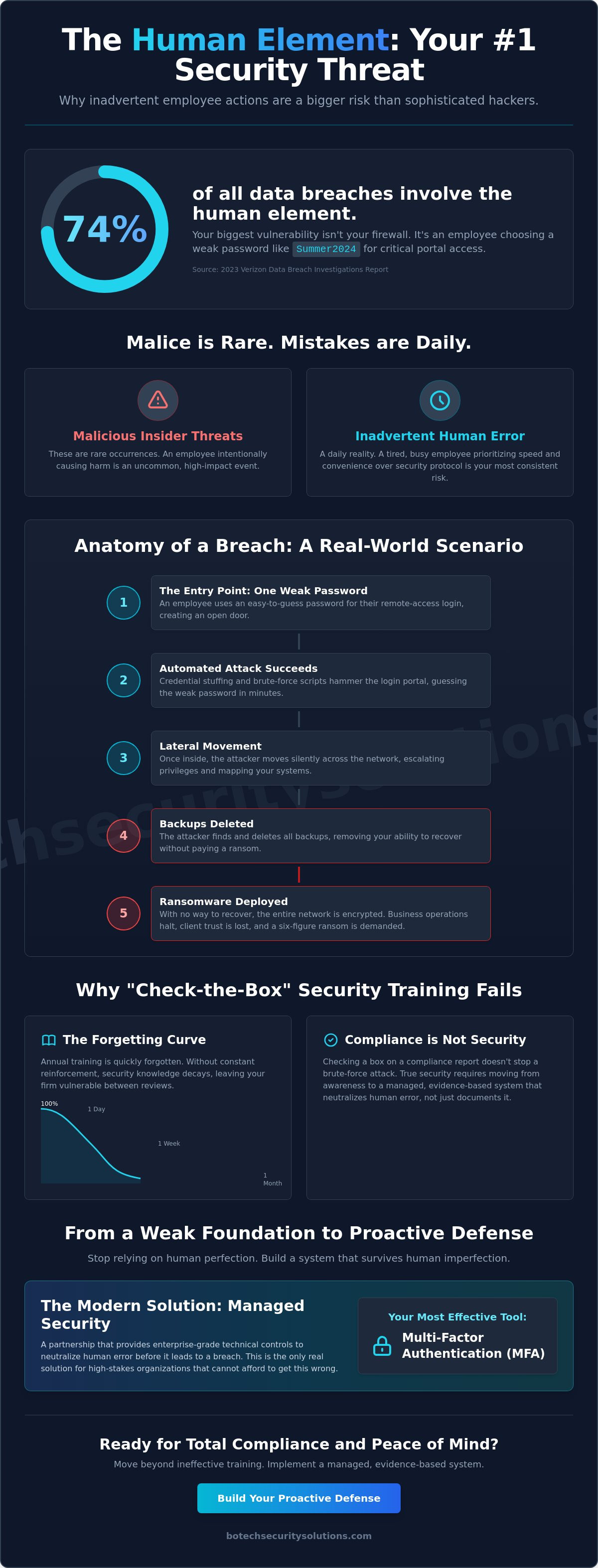
The 2023 Verizon Data Breach Investigations Report reveals that 74% of all breaches involve the human element. This means your biggest threat isn't a sophisticated foreign hacker; it's inadvertent actions such as using easy passwords by your own staff. Most are not aware that a single weak login can trigger a full scale HIPAA investigation or a permanent loss of client trust. You've invested in technology, yet your security still rests on whether an exhausted employee chooses "Summer2024" for their portal access.
It's exhausting to manage compliance reports filled with jargon while your team ignores the basic rules you've already taught them. You know that relying on human memory is a losing strategy for any organization that cannot afford to get this wrong. You'll learn why these common mistakes happen and how to move your firm toward enterprise grade protection that doesn't depend on employee perfection.
We'll break down the shift from simple training to a managed, evidence based system. This guide provides a clear path to human centric risk management and total compliance readiness for your next audit.
Key Takeaways
- Understand how inadvertent actions such as using easy passwords create a silent gateway for ransomware that most Kansas City firms ignore until it's too late.
- Discover the anatomy of a breach through a real-world scenario where one weak remote-access password led to total network encryption.
- Identify why "check-the-box" security training fails to protect your firm and how the "forgetting curve" leaves your organization vulnerable between annual reviews.
- Learn the specific technical controls that neutralize human error, including why Multi-Factor Authentication is your most effective tool against credential exploits.
- Explore the "One Partner" philosophy that bridges the gap between enterprise-grade protection and small business budgets for organizations that cannot afford to get this wrong.
Defining Inadvertent Actions Such as Using Easy Passwords
Most Kansas City business owners believe their biggest threat is a sophisticated hacker in a distant country. Most are not. The actual danger sits in your office, drinks your coffee, and hits their sales targets every month. We define inadvertent actions such as using easy passwords as the silent, unintentional choices made by reliable staff that create a primary gateway for malicious cyber activities and unauthorized data collection.
To better understand the risks associated with modern credential management, watch this helpful video:
An inadvertent action means your employee isn't a double agent. They are a busy professional trying to shave ten seconds off their login process to help a waiting client. The Cyber Awareness Challenge might treat this like a simple multiple-choice question, but for a Kansas City law firm, it's the difference between a productive Tuesday and a catastrophic breach of attorney-client privilege. Security isn't about achieving human perfection; it's about building managed security systems that survive human imperfection.
The Difference Between Malice and Mistakes
Inadvertent actions are significantly more common than insider threats. While a malicious employee is rare, a tired employee is a daily reality. There's a psychological trap in every fast-paced office environment where convenience wins over security. Your top-performing paralegal or lead nurse is often your biggest security hole because they prioritize speed over protocol. This "tough love" reality means your best people are often the ones most likely to take shortcuts that bypass your defenses. They don't mean to compromise the network, but the result is the same as if they had.
Why 'Easy Passwords' Are Still a Top Threat in 2026
Brute-force attacks have evolved to the point where "Spring2026!" provides zero protection against automated scripts. A single weak password in an Overland Park clinic can trigger a full HIPAA breach under 45 CFR § 164.308(a)(5)(ii)(D), which requires specific procedures for creating and changing passwords. Credential stuffing attacks now use massive databases of leaked info to hammer your login portals until something breaks. The password strength you relied on three years ago is now a liability. Modern inadvertent actions such as using easy passwords allow attackers to move laterally through your network before you even realize a single account was compromised.
The Anatomy of a Breach: How Local KC Practices Fall Victim
A medical practice in Lee's Summit recently discovered how quickly a business can collapse. They believed their size made them invisible to hackers. The reality was different. An employee used a simple variation of the season and year for their remote-access login. These inadvertent actions such as using easy passwords created an open door for a brute-force attack that succeeded in minutes. Most business owners assume their staff knows better; most are not actually checking the strength of those credentials.
The cascading effect was immediate and devastating. Once the attacker gained entry through that single weak password, they moved laterally across the network. They didn't just steal files. They found the backup server and deleted the archives before triggering a full network encryption. This isn't just a technical glitch. It's a total business freeze that stops patient care and halts revenue. Organizations that cannot afford to get this wrong must realize that a single "easy" password is often the only thing standing between them and a six-figure ransom demand.
The local impact in the Kansas City community goes beyond the immediate financial loss. Word travels fast in Johnson County and the surrounding areas. A breach leads to immediate regulatory scrutiny and a permanent stain on your reputation. The 2024 IBM Cost of a Data Breach Report notes that the average cost of a breach has reached $4.88 million. For a mid-sized firm in the US, these costs often exceed $5 million when you factor in forensic investigations, legal fees, and the loss of client trust. You can reach out to our team to see how we help firms avoid these local disasters.
Emailing Personal Files and Shadow IT
Staff members in Rogers and Bentonville firms often try to be productive by taking work home. They send sensitive spreadsheets to their personal Gmail accounts to finish a project over the weekend. This is a massive inadvertent action because it moves protected data into an unmanaged environment. It's a textbook example of Shadow IT where convenience trumps security. This practice is a direct violation of HIPAA Section 164.308(a)(1), which requires a rigorous risk analysis of all systems where data lives. Using strong password practices on a work laptop means nothing if that same data is sitting in a personal inbox with no multi-factor authentication.
The 'Innocent' Phishing Click
Imagine a busy office manager in Olathe balancing three phone calls while clearing an overflowing inbox. They see an email marked "Urgent Invoice" and click the link without thinking. This inadvertent action doesn't always download a virus that your software can catch. Instead, it often leads to a fake login page designed to harvest credentials. Traditional antivirus software is useless here because it's looking for malicious files, not the behavior of a person giving away their key. You need managed it support services that focus on identity protection and behavioral monitoring rather than just scanning for old viruses. It's the difference between having a lock on the door and having a guard who knows who is supposed to have a key.
Why Security Awareness Training Often Fails Kansas City Firms
Most Kansas City business owners treat security training like a fire drill. They gather the team, play a twenty minute video, and collect signed acknowledgments. This is a check-the-box exercise that fails to change actual behavior. It produces a compliance document but does nothing to stop inadvertent actions such as using easy passwords. You are left with a folder full of certificates and a network that is still wide open to exploitation.
The psychological reality of the forgetting curve makes annual training useless. Studies show that people forget 50 percent of new information within twenty four hours. Within thirty days, 90 percent of that training has evaporated. A once-a-year video is not a compliance program. It is a historical artifact that provides zero protection against modern threats.
Relying on 50 employees to never make a mistake is a mathematical certainty for failure. If your staff is 99 percent diligent, you still have a massive gap in your perimeter. Inadvertent actions such as using easy passwords become inevitable when your only defense is a memory of a video from six months ago. Organizations That Cannot Afford to Get This Wrong understand that human error must be managed with systems, not just speeches.
The Trap of Complacency in Regulated Industries
KC legal and financial firms often believe they are too small to be a primary target. Most are not. Hackers actually prefer small targets because they lack the enterprise fortresses of global banks. They look for the path of least resistance. A CISA advisory warns that common weak security controls are the most frequent entry points for ransomware. Security is binary; you are either protected or you are a target for the next breach.
Consider a local medical clinic that passes its annual HIPAA training every June. By October, a busy receptionist uses the same password for their work station and their personal social media. When that social media site is breached, the clinic’s patient data is suddenly at risk. The training certificate did not prevent the reuse of that password. A true compliance program would have identified the risk through active monitoring before the credentials were ever compromised.
Moving Beyond the 'Lunch and Learn'
Simulated phishing campaigns are better than static videos, but they are still insufficient on their own. They test the employee without providing a safety net for when they eventually fail. You need a model of Vigilant Guardianship where security layers work while your employees sleep. This requires a shift from passive education to active, managed defense. It is the difference between telling someone to be careful and installing an airbag in their car.
Effective security requires a partner who takes ownership of the outcome. You can start with BoTech’s Security Awareness Training as a foundation, but it cannot be the finish line. We move our clients from the anxiety of "did they watch the video?" to the confidence of "the system is defended." True protection comes from combining educated staff with enterprise-grade monitoring that catches the mistakes humans will inevitably make.
Proactive Defense: Fixing Weak Links in the KC Metro
Many Kansas City business owners view cybersecurity as a set-it-and-forget-it task. They assume that a basic firewall and a "strong" password policy are enough to keep the doors locked. This complacency is exactly what hackers rely on. They aren't always looking for a complex way in; they're looking for inadvertent actions such as using easy passwords that grant them immediate access to your server. Security is a binary state. You are either protected by enterprise-grade controls or you are waiting for a disaster to happen.
Implementing MFA Without the Friction
Your team might complain that Multi-Factor Authentication (MFA) slows them down. This is a common objection that usually masks a lack of discipline. The reality is simple: resetting a breached account or recovering from a ransomware attack takes significantly longer than tapping a push notification on a smartphone. Modern MFA is fast and seamless. It eliminates the risk of stolen credentials by requiring a second form of verification that a hacker in another country cannot replicate. The Cybersecurity and Infrastructure Security Agency (CISA) reports that MFA makes users 99% less likely to be hacked. If your business handles HIPAA data or sensitive legal files, skipping this step isn't just risky; it's negligent.
Dark Web Monitoring for KC Business Owners
Hackers don't always guess your passwords. They often buy them in bulk on the dark web after a third-party breach. BoTech finds your 'easy passwords' on these hidden forums before they can be used against you. This is why you need it solutions and services that include 24/7 monitoring of your digital footprint. For law firms and healthcare providers, proactive credential rotation is a requirement for compliance under frameworks like SOC 2 or HIPAA. We provide the evidence that these rotations occurred, moving you from a static document to a living compliance program.
Accidental clicks happen even to the most well-trained employees. Endpoint Detection and Response (EDR) serves as the safety net for these moments. While traditional antivirus looks for known threats, EDR monitors behavior. If an inadvertent action triggers a suspicious process, the EDR system isolates the device instantly. This prevents a single mistake from turning into a network-wide catastrophe. You need a partner who manages these alerts so you don't have to. You can find out where you actually stand by reviewing your current technical controls with our team.
Managed Security: The Only Real Solution for High-Stakes Organizations
Most Kansas City business owners think they can't afford enterprise-grade security. They assume that inadvertent actions such as using easy passwords are just an unavoidable risk of doing business. This is a dangerous gamble that ignores the reality of modern cybercrime. BoTech bridges the gap between massive corporate budgets and the actual needs of small, regulated firms. You shouldn't have to choose between financial stability and data integrity.
Consolidating security and compliance under one roof isn't just about saving money. It's about closing the gaps that emerge when you have multiple vendors pointing fingers at each other. Our "One partner" philosophy ensures that your defense and your documentation work in sync. This approach saves time and prevents critical details from falling through the cracks during a HIPAA or SOC 2 audit. It turns security from a source of anxiety into a measurable business asset.
Our 24/7 Managed Detection and Response (MDR) serves as the ultimate fail-safe for human error. Even when inadvertent actions such as using easy passwords lead to a compromised account, our team is already there to neutralize the threat. We don't wait for you to call us or submit a ticket. We act the moment an anomaly is detected in your network, providing a level of protection that individual software packages simply can't match. This is the standard for Organizations That Cannot Afford to Get This Wrong.
Why Kansas City Firms Trust a Veteran-Owned Partner
We founded BoTech on military discipline and integrity. You won't get corporate jargon or vague promises from us. Stephen’s voice is direct because honesty is the only way to stay secure in a high-stakes environment. We provide local support across the entire KC metro, from Overland Park to Blue Springs, ensuring you have an expert within reach when it matters most.
Your Next Step: Finding Out Where You Actually Stand
You need to know if your current password policy actually meets NIST 800-63B standards. This specific regulatory framework addresses digital identity and authentication, moving away from outdated "complex" passwords that are actually easy for hackers to crack. Most organizations believe they're compliant; most are not. We don't do high-pressure sales pitches or offer generic advice that you could find on any blog.
We provide a real risk assessment through our Compliance Services to show you exactly where the holes are. Don't wait for a breach to realize your defenses were inadequate. Take the first step toward genuine security today. Schedule your free assessment to find out where you actually stand and shift the burden of security from your shoulders to ours.
Securing Your Kansas City Practice Against the Next Human Error
Most KC business owners believe their current IT setup protects them until a breach proves otherwise. You can't rely on luck or a static document when inadvertent actions such as using easy passwords continue to bypass traditional firewalls. Real security requires a shift from passive checking to active, 24/7 monitoring that generates the evidence needed for HIPAA or SOC 2 compliance.
Since 2021, our veteran-owned team has specialized in providing enterprise-grade MDR at rates designed for the local metro business. We don't just hand you a policy; we build the infrastructure that defends your reputation every hour of every day. Organizations in the healthcare and legal sectors don't have the luxury of being mostly secure.
Your first step is to audit your current authentication standards against NIST 800-63B guidelines to ensure you've moved past simple character requirements. Once you've tightened those internal controls, you'll need an objective look at the rest of your perimeter. It's time to stop guessing and start knowing.
Find out where your Kansas City business actually stands with a free security assessment.
You've built something valuable in Kansas City, and protecting it shouldn't feel like a mystery. With the right partner, you can move from vulnerability to total confidence.
Frequently Asked Questions
What are inadvertent actions in cybersecurity?
Inadvertent actions are unintentional mistakes made by employees that create security vulnerabilities or lead to data exposure. These aren't malicious acts, yet the 2023 Verizon Data Breach Investigations Report found that 74 percent of breaches involve the human element. Common examples include misconfiguring a cloud database or falling for a phishing lure. You can't train away human nature, so you must build systems that assume mistakes will happen eventually.
How do easy passwords lead to a cyberattack?
Easy passwords facilitate cyberattacks by allowing hackers to use automated tools to guess credentials in seconds. When employees perform inadvertent actions such as using easy passwords, they bypass expensive firewalls by handing the keys to the front door to criminals. Hackers use "credential stuffing" to test these simple passwords across multiple platforms. If your team uses "Password123" or their dog's name, your organization is currently exposed to brute force attacks.
Is security awareness training enough to stop data breaches?
Training is a single component of a defense strategy, but it's never enough to stop breaches on its own. A 2022 study by Stanford University found that 88 percent of data breaches are caused by employee mistakes, regardless of how much training they've received. You need a Managed Security partner to implement technical guardrails that catch errors before they become catastrophes. Training tells people what to do; managed systems ensure they actually do it.
What is the most common inadvertent action employees take?
The most common inadvertent action is the misdelivery of sensitive information, such as emailing a file to the wrong recipient. According to the 2022 Ponemon Institute Cost of Insider Threats Report, 56 percent of incidents involve a negligent employee or contractor rather than a malicious actor. This often happens because employees are rushed or distracted. These small lapses in judgment can lead to massive regulatory fines if the data contains protected health information.
How can a Kansas City business prevent password-based attacks?
Prevention starts with moving beyond simple policies and implementing technical enforcement through a dedicated Compliance Services program. Kansas City businesses must enforce the use of long passphrases rather than short, complex passwords. NIST Special Publication 800-63B recommends passphrases of at least 15 characters to resist modern cracking tools. This shift removes the burden of choice from the employee and places it on a system that refuses to accept weak credentials.
Does HIPAA require specific password strengths?
HIPAA does not specify a character count, but 45 CFR § 164.308(a)(5)(ii)(D) requires "procedures for creating, changing, and safeguarding passwords." If an auditor finds your staff using "Summer2024" to access patient records, you've failed to implement this administrative safeguard. Compliance isn't a static document you sign once a year. It's a living program that generates evidence of your security efforts and protects your practice from OCR investigations.
What happens if an employee accidentally emails a sensitive file?
An accidental email constitutes a data breach under the Kansas Consumer Protection Act if it includes personally identifiable information. You must immediately determine what was sent, who received it, and whether the recipient has deleted the data. This inadvertent action often triggers mandatory notification requirements to the affected individuals and state authorities. Organizations that cannot afford to get this wrong use data loss prevention tools to block these emails before they leave the server.
How does Multi-Factor Authentication (MFA) stop inadvertent actions?
Multi-Factor Authentication stops the damage from a compromised password by requiring a second, independent verification. Microsoft reported in 2022 that MFA blocks 99.9 percent of account takeover attempts. Even if an employee loses their credentials through a phishing site, a criminal can't gain access without the physical token or biometric scan. It's the single most effective tool for organizations that want to transition from a state of anxiety to a state of secure partnership.