PCI DSS Compliance for Retailers in Kansas City: The 2026 Security Reality
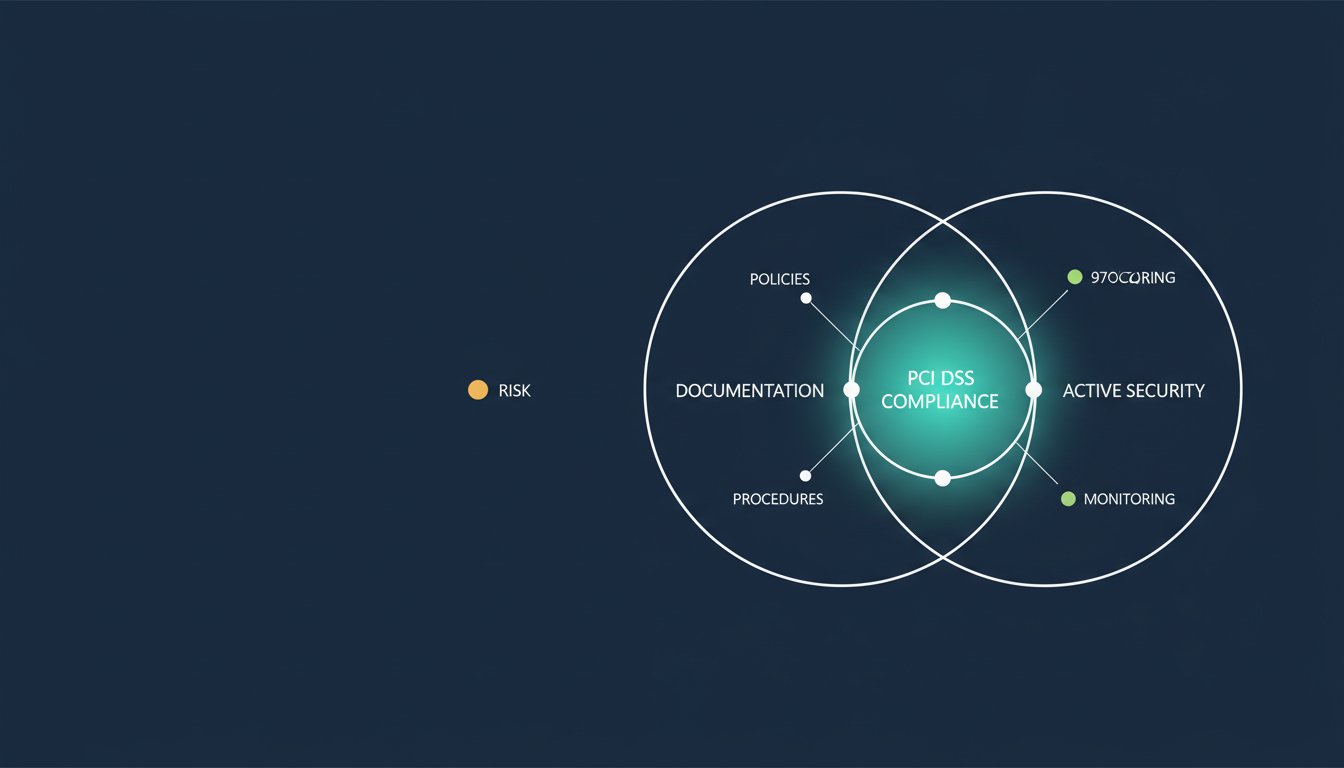
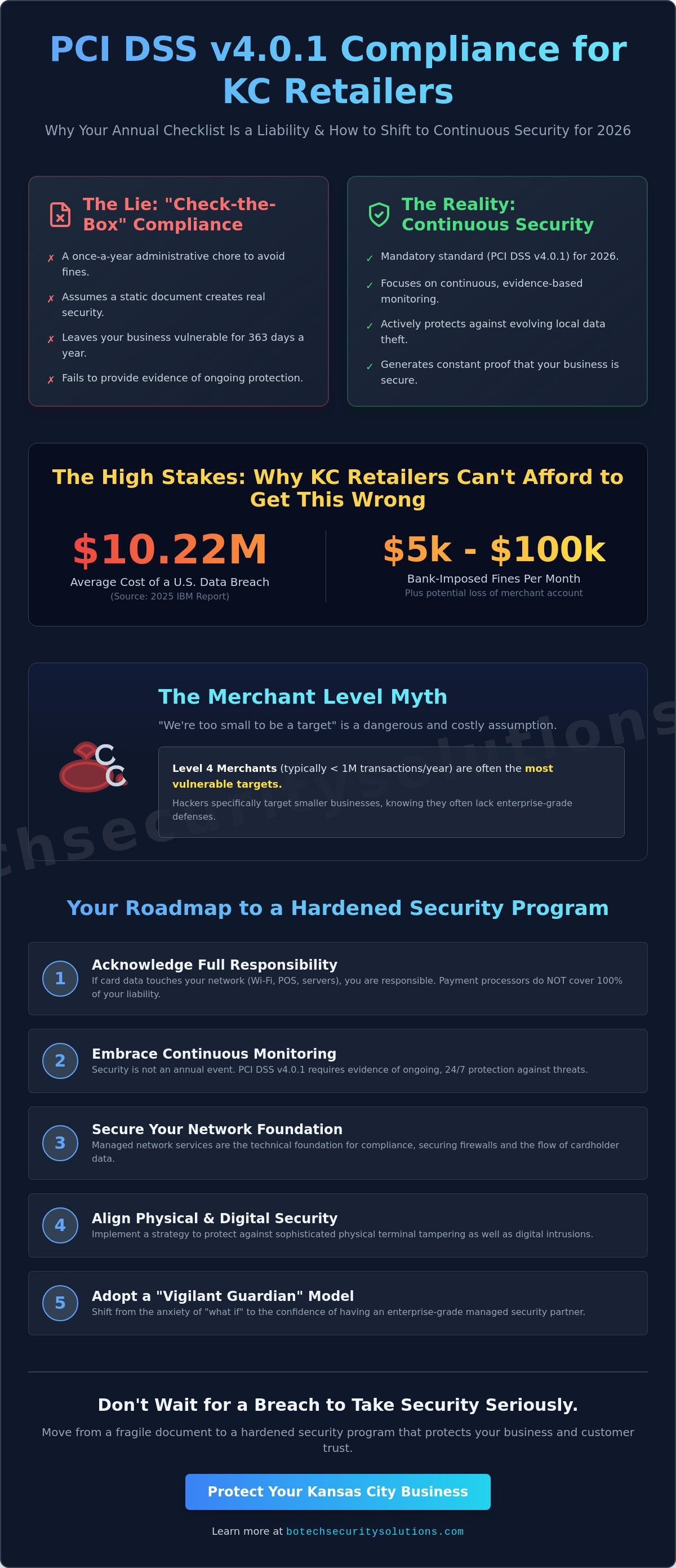
Your current PCI compliance checklist is likely a lie. Most business owners treat security as a once-a-year administrative chore to avoid bank fines. You sign the papers and assume your customer data is safe. Most are not. The reality of pci dss compliance for retailers kansas city in 2026 has shifted from simple documentation to continuous, evidence-based security. With the average cost of a U.S. data breach hitting $10.22 million in 2025 according to industry data, you cannot afford to get this wrong.
You probably feel the frustration of confusing merchant levels and "check-the-box" IT vendors who don't actually stop breaches. It's a common tension for any busy KC retailer. You'll learn how to transition from a fragile compliance document to a hardened security program that shields your business from local data theft. This guide provides a clear roadmap to navigate PCI DSS v4.0.1 requirements and protect your customer trust while avoiding audit failures and penalties.
Key Takeaways
- Understand why PCI DSS v4.0.1 is the mandatory standard for 2026 and how shifting local threats are targeting Kansas City storefronts.
- Learn the critical difference between a static compliance document and a security program that generates continuous evidence of protection.
- Discover how managed network services provide the technical foundation for pci dss compliance for retailers kansas city by securing firewalls and cardholder data.
- Implement a five-step checklist to align your physical terminal security with digital protections against sophisticated terminal tampering.
- Shift from a "check-the-box" mentality to a managed security model that provides enterprise-grade vigilance for organizations that cannot afford to get this wrong.
The High Stakes of PCI DSS Compliance for Retailers in Kansas City
Kansas City retailers are no longer just competing with the shop down the street. You are expanding into e-commerce and mobile payments to stay relevant in a digital economy. This growth brings a level of risk that many local owners are unprepared to manage. Achieving pci dss compliance for retailers kansas city is not a suggestion; it is a requirement for survival.
The current governing standard for your 2026 operations is version 4.0.1 of the Payment Card Industry Data Security Standard (PCI DSS). This update reflects a significant shift toward continuous security rather than annual audits. To better understand how these standards impact your business, watch this helpful video:
Here is an uncomfortable truth most payment processors won't tell you. They do not cover 100% of your liability. If a credit card number touches your Wi-Fi, your point-of-sale system, or your back-office server, you are responsible for that network's integrity. Most assume the terminal handles everything. It doesn't.
The Merchant Level Myth
Many retailers in the KC metro believe they are too small to be a target. This is a dangerous misconception. Merchant levels are based on transaction volume, but Level 4 merchants are often the most vulnerable targets. These are businesses processing fewer than 20,000 e-commerce or 1 million total transactions annually.
Hackers know smaller businesses often lack enterprise-grade defenses. Most are not prepared for a sophisticated intrusion. A single breach can lead to bank-imposed fines ranging from $5,000 to $100,000 per month according to industry facts. Even worse, it can lead to the permanent loss of your merchant processing abilities. You are either protected or you are out of business.
Why Kansas City Retailers Cannot Afford to Get This Wrong
In a tight-knit community like ours, reputation is your most valuable asset. If a boutique in the Crossroads or a local chain in Overland Park loses customer data, the news spreads quickly. The financial fallout is rarely survivable. According to the 2025 IBM Cost of a Data Breach Report, the average cost of a breach in the U.S. reached $10.22 million.
We work with organizations that cannot afford to get this wrong. Our PCI DSS Compliance Management takes a "Vigilant Guardian" approach. We move you from the anxiety of potential data theft to the confidence of having enterprise-grade protection. It's about protecting your customers as much as your bottom line.
Moving Beyond the Checklist: Why Compliance Documents Fail Without Evidence
A compliance document is a promise. Evidence is proof. Most business owners in the metro area fall into the trap of treating pci dss compliance for retailers kansas city as a paperwork exercise. They sign a Self-Assessment Questionnaire once a year and stick it in a drawer. This approach assumes that a signature creates security. It does not.
The PCI Security Standards Council designed the latest v4.0.1 requirements to dismantle this "one-and-done" mindset. The new standard shifts the focus from annual snapshots to continuous monitoring. If you only check your security posture once every 364 days, you are leaving your business vulnerable for the other 363. Cybercriminals do not wait for your audit window to open before they attack.
Consider Requirement 12.10.1 of the standard. It mandates that retailers maintain an incident response plan that is ready to be activated at any moment. Simply having a PDF on a server is not enough. You must have evidence that the plan is tested, updated, and that your team knows how to execute it. Most vendors avoid telling you that maintaining this evidence is a full-time job. We believe in providing PCI DSS Compliance Management that generates this proof automatically.
Requirement 4.0 and the Customized Approach
PCI DSS 4.0 introduces the "customized approach" for 2026 operations. This allows businesses to implement unique security controls that meet the specific objectives of a requirement without following the strict "defined" path. It offers flexibility for complex retail environments. However, this path requires a strategic partner who understands the "why" behind the security control. You cannot just guess. You must document exactly how your custom solution protects cardholder data as effectively as the standard method.
Automated Evidence Collection vs. Manual Audits
Manual audits are a fire drill. They are stressful, prone to human error, and often fail to catch real-time vulnerabilities. Modern compliance management uses automated tools to gather evidence every hour of every day. This shift ensures you are "audit-ready" at a moment's notice. It replaces the anxiety of a looming deadline with the calm of verified protection. If you want to see how your current systems measure up against these new standards, you can reach out for a direct conversation about your specific retail environment.
The Role of Network Management Services in Maintaining Continuous Compliance
Your network is the digital foundation of your storefront. If the pipes are leaking, the whole house is at risk. Achieving pci dss compliance for retailers kansas city starts with professional network management that treats security as a living process. It isn't enough to just have a router; you need a perimeter that actively fights back.
Requirement 1 of the PCI Security Standards Council mandates installing and maintaining a firewall configuration to protect cardholder data. Many KC business owners assume their ISP-provided modem is sufficient. It is not. You need a managed firewall that is configured to block unauthorized traffic and updated daily to counter new threats. Most are not.
We see an uncomfortable truth in the field: many retailers still use vendor-supplied default passwords on their back-office equipment. Requirement 2 explicitly forbids this. Using "admin" as your login is an open invitation for local data theft. Professional network management ensures that every device on your network is hardened and that 24/7 monitoring is in place to catch unauthorized access before it turns into a breach.
Managed Detection and Response for KC Retailers
Basic antivirus software is no longer enough to satisfy PCI Requirement 5. Modern malware is designed to bypass traditional signature-based detection. You need the "Vigilant Guardian" oversight provided by Managed Detection and Response (MDR). This technology looks for suspicious behavior rather than just known files. Our Managed Security services provide 24/7 monitoring, ensuring that if an intruder touches your network at 2:00 AM on a Sunday, someone is there to stop them.
Vulnerability Assessments: Finding Gaps Before Hackers Do
You cannot fix what you cannot see. PCI DSS requires regular internal and external vulnerability scans to identify weaknesses in your systems. These assessments provide a remediation roadmap, showing you exactly where your defenses are thin. Following a structured Kansas City Vulnerability Assessments methodology ensures you are identifying gaps before a criminal does. It's the difference between being proactive and being a victim. You get enterprise-grade protection for a small business price, making sure your organization is one that cannot afford to get this wrong.
Kansas City Storefront Security: Physical and Digital Requirements for 2026
Physical security is often the forgotten half of pci dss compliance for retailers kansas city. You can have the strongest firewall in Missouri, but it won't stop a criminal from swapping your card reader during a busy lunch rush. Requirement 9 of the standard mandates that you restrict physical access to cardholder data. This includes protecting your point-of-sale (POS) devices from tampering or substitution. Most IT vendors ignore the physical storefront, but we know it's where many breaches begin.
Cyberattacks against retail businesses saw a 34% increase in 2025 compared to the previous year according to verified industry research. This means your digital defenses must intersect perfectly with your in-store operations. If your guest Wi-Fi is leaking into your payment network, your compliance is paper-thin. You are either fully segmented or you are vulnerable.
Step 1: Secure Your Point-of-Sale (POS) Environment
You must implement daily physical inspection routines for every terminal in your building. Look for broken security seals, extra wires, or skimming overlays that don't belong. Implementing Point-to-Point Encryption (P2PE) is the most effective way to render any intercepted data useless. Watch out for "shadow IT" where employees plug personal tablets or music players into network ports reserved for payments. These small gaps are all an intruder needs to bypass your enterprise-grade protection.
Step 2: Segregate Your Networks
Your guest Wi-Fi must be physically and logically separate from the network handling your POS transactions. Requirement 1.2 focus on network segmenting to prevent an attacker from jumping from a customer's phone to your credit card environment. This rule also applies to IoT devices like smart thermostats and security cameras. If these "smart" devices live on your payment segment, you are out of compliance. Most retailers assume their router handles this automatically. Most are not correctly configured.
Step 3: Employee Vigilance and Training
Requirement 12.6 requires formal security awareness training for every person on your payroll. Consider a scenario where a "technician" enters your shop in the Power and Light District claiming they need to "service the terminals." An aware clerk follows protocol, asks for credentials, and calls the manager to verify the unscheduled visit. This human firewall is your last line of defense against local data theft. You can find more context on these threats in our guide on Common Cyber Attacks targeting local firms.
Establishing this level of vigilance requires a partner who understands the high stakes of retail security. You can find out where your storefront actually stands by scheduling a direct consultation with our team today.
Finding Out Where You Actually Stand: A Strategic Approach to Retail Security
Compliance is the byproduct of a vigilant security program. It is not the result of a signed document. Most business owners treat pci dss compliance for retailers kansas city as a hurdle to clear once a year. This mindset is dangerous because it ignores the 364 days between audits when your data is actually at risk. Most are not as secure as their paperwork suggests.
You must shift from a "check-the-box" mentality to a managed security model. A static checklist cannot stop an AI-powered phishing attack or a physical skimmer. We operate as a strategic ally for organizations that cannot afford to get this wrong. We provide enterprise protection for a small business price, ensuring your defenses are as robust as a global bank's defenses.
Consolidating Security and Compliance
Managing separate vendors for your firewall, your antivirus, and your compliance documentation is a recipe for gaps. We believe in the "One Partner" concept. By consolidating MDR and PCI management, you eliminate the finger-pointing that happens when something goes wrong. This unified approach ensures that every technical change is documented as evidence for your next audit automatically. It's the difference between guessing and knowing.
Our flat-rate monthly model acts as a budget stabilizer for KC retailers. You get predictable costs and relentless protection in one package. There are no hidden fees or "break-fix" bills that surprise you after a crisis. You can learn more about how we integrate these layers in our guide to Managed IT Support.
Your Actionable Next Step
Don't wait for your next official audit to find a failure. Conduct a self-audit of your physical terminal access today. Walk your retail floor and check every point-of-sale device for signs of tampering, extra wires, or broken security seals. Ensure that back-office servers are behind locked doors and that physical access is strictly limited to authorized personnel. This simple exercise often reveals vulnerabilities that software alone cannot detect.
Security is binary. You are either protected or you are not. If you want a clear picture of your current risks without the marketing fluff, we offer a free assessment to help you find out where you actually stand. This is a technical review designed to provide a clear remediation roadmap, not a high-pressure sales pitch. Contact us to find out where you actually stand and start building a security program that lasts.
Securing Your Kansas City Retail Future
The shift to PCI DSS 4.0.1 demands a move from annual paperwork to a culture of constant evidence. You've seen how physical terminal security and logical network segmentation are now inseparable components of a valid defense. Most vendors will sell you a document; we provide a living security program that protects your reputation.
Achieving pci dss compliance for retailers kansas city doesn't have to be a source of constant anxiety. As a veteran-owned and operated firm, we specialize in bringing enterprise-grade security to regulated small businesses at a predictable, flat monthly rate. We've built our reputation on helping organizations in high-stakes sectors like finance and healthcare stay ahead of the threats that others ignore.
You deserve a partner who takes your security as seriously as you take your business. Take the first step toward verified protection today. Find out where you actually stand with a free PCI assessment and move your organization from vulnerability to vigilance. You have the power to protect what you've built.
Frequently Asked Questions
What are the biggest changes in PCI DSS 4.0 for small retailers in 2026?
The most significant shift in v4.0 for 2026 is the move toward continuous security monitoring. It replaces the traditional annual audit with a requirement for ongoing evidence of protection rather than a one-time snapshot. This update also mandates stricter multi-factor authentication (MFA) and more rigorous management of third-party service providers to ensure no gaps exist in your digital perimeter.
Does using Square or Shopify make my Kansas City store 100% PCI compliant?
No, using these services does not grant you automatic immunity from the standard. While they secure the transaction data they process, you remain responsible for the physical and digital environment where the transaction occurs. This includes your store's Wi-Fi network, the physical security of your terminals, and your employee training. Most assume the processor handles everything. Most are wrong.
What are the actual fines for PCI non-compliance for a Level 4 merchant?
Level 4 merchants can face monthly fines ranging from $5,000 to $100,000 for non-compliance. These penalties are levied by card brands on your acquiring bank, which then passes them directly to your business. Beyond these fines, you face increased transaction fees and the potential loss of your ability to process credit cards entirely, which is a death sentence for retail.
How often does a Kansas City retailer need a vulnerability assessment?
You must conduct internal and external vulnerability scans at least quarterly and after any significant change to your network. This is mandated by Requirement 11.2 of the standard. Regular scans ensure that pci dss compliance for retailers kansas city remains an active defense rather than an administrative chore. This frequency allows you to find and patch gaps before criminals can exploit them.
Do I need to be PCI compliant if I only take credit cards over the phone?
Yes, you must be compliant if cardholder data enters your environment in any form. Taking card numbers over the phone means your staff and potentially your phone system are in scope. You will likely need to complete a specific Self-Assessment Questionnaire (SAQ) designed for virtual terminals. Ignoring this requirement because you lack a traditional e-commerce site is a major risk for local shops.
What happens if my Kansas City business has a data breach but I have a compliance document?
A compliance document without ongoing evidence of security will not shield you from liability. If a forensic investigation proves that your security controls were not consistently maintained, you will still face devastating fines and lawsuits. For many small businesses, 60% go out of business within six months of a major cyberattack according to industry data. A document is a promise, but evidence is proof.
Can network management services help me pass a PCI audit faster?
Professional network management services accelerate audits by providing a centralized source of truth for your security controls. Instead of hunting for logs and configuration files, you have automated evidence collection ready at a moment's notice. This turns the audit process from a stressful fire drill into a routine verification of your existing defenses. It ensures you are always audit-ready without the manual labor.
Is physical security part of PCI DSS compliance requirements?
Physical security is a core component of the standard under Requirement 9. You are required to restrict physical access to cardholder data and protect point-of-sale devices from tampering or substitution. This includes maintaining an up-to-date inventory of terminals and conducting regular inspections to look for skimming devices. Most retailers focus on firewalls, but a physical skimmer can bypass the strongest digital encryption.