Endpoint Protection for Small Business in Kansas City: Beyond the Antivirus Myth
Your $40 antivirus subscription is likely the biggest security liability in your office. It creates a false sense of safety while leaving your data wide open to modern threats. When you search for endpoint protection for small business kansas city, you might think you're just looking for a better piece of software. The uncomfortable truth is that software alone cannot stop a human attacker or satisfy a HIPAA auditor. You're likely overwhelmed by technical requirements and the constant fear that one mistake could lead to permanent reputation damage.
We understand that anxiety. You need to know your network is being watched every hour of the day without having to hire a full-time security team. This guide will show you why traditional antivirus fails and how to implement a strategy that generates real evidence for SOC 2 or HIPAA compliance. We'll move past marketing jargon to show you exactly how to secure your devices and meet your legal obligations under the Kansas Data Breach Notification Law.
Key Takeaways
- Stop relying on a basic antivirus to protect your reputation. It is a "check-the-box" myth that fails to stop modern, human-led attacks.
- Implement endpoint protection for small business kansas city that acts as a black box flight recorder, tracking every move on your devices for total visibility.
- Understand that a signed policy document won't satisfy a HIPAA or SOC 2 auditor. You need a system that generates continuous, verifiable evidence of security.
- Follow a practical, five-step roadmap to secure your firm without the overhead of a full-time CISO or an internal security team.
- Transition from being overwhelmed by technical alerts to a partnership where professional protectors take ownership of your network's safety 24/7.
The Dangerous Illusion of Basic Antivirus for Kansas City Small Businesses
Many Kansas City practice managers treat cybersecurity like a grocery list. You buy the software, install it, and check a box. You assume that a standard antivirus subscription is enough to keep hackers out of your patient files or legal briefs. This "set it and forget it" mentality is exactly what modern threat actors count on. They know that while you are busy running your business, your security tools are effectively asleep at the wheel.
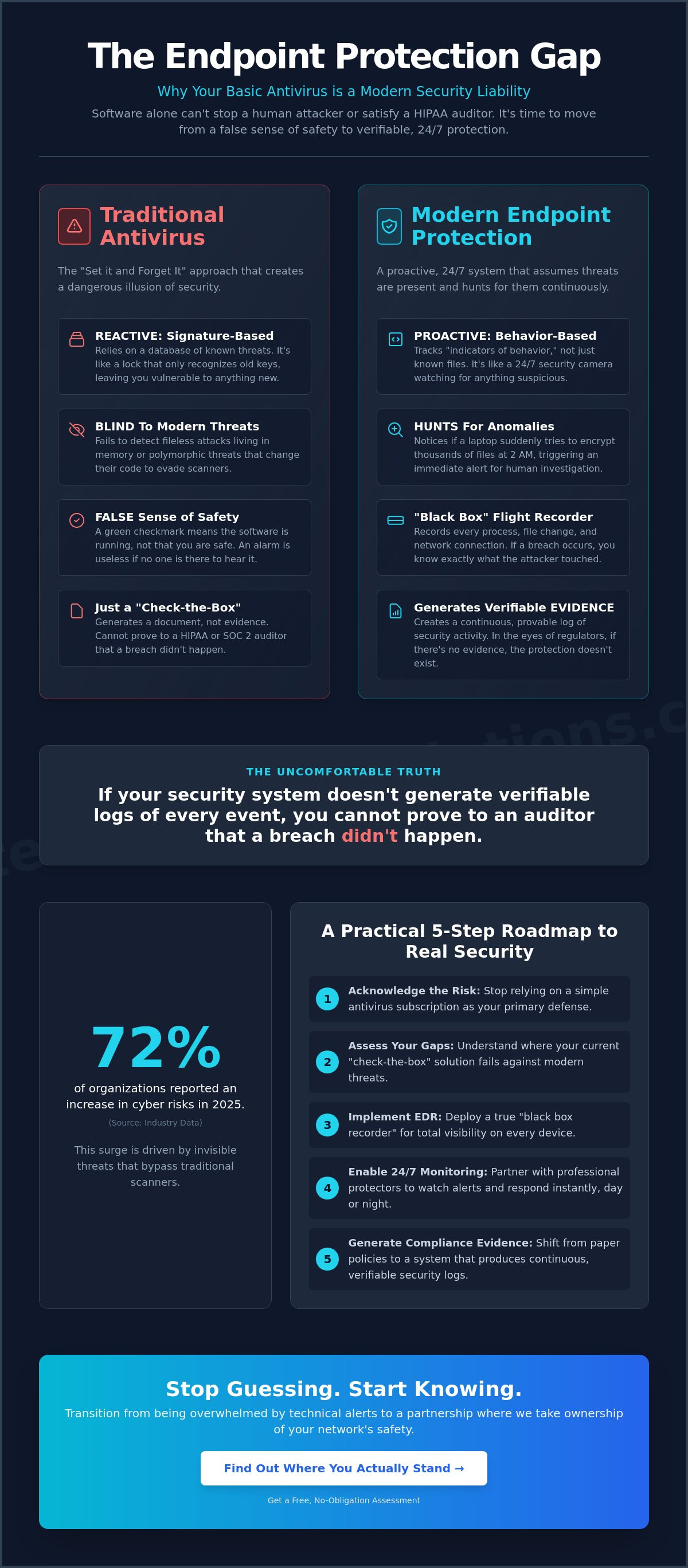
Traditional antivirus is a reactive tool, not a proactive shield. It relies on a database of known threats, acting as a lock that only recognizes old keys. If a hacker creates a new piece of malware today, your antivirus won't recognize it until the provider updates their list. This gap is why What is Endpoint Protection? has evolved into a necessity for any regulated firm. Implementing true endpoint protection for small business kansas city requires more than just a scanner; it requires constant vigilance.
To better understand how these tools have evolved, watch this helpful video:
Why Signature-Based Detection Fails in 2026
Modern attacks don't always use files that an antivirus can scan. Fileless attacks live entirely in your computer's memory, leaving no footprint on the hard drive for a traditional tool to find. Other threats are polymorphic, meaning they change their code every time they spread to avoid detection. In 2025, 72% of organizations reported an increase in cyber risks, according to current industry data. This surge is driven by these invisible threats that bypass traditional scanners during the critical first 24 hours of an attack.
The "It Works Until It Doesn't" Trap
That green checkmark on your dashboard provides a dangerous sense of comfort. It tells you the software is running, but it doesn't tell you if a sophisticated attacker is currently bypassing it. Hackers specifically target small businesses in Overland Park and Olathe because they assume you lack 24/7 monitoring. An alarm is useless if nobody is there to hear it and take action. The uncomfortable truth is that if your security system doesn't generate verifiable logs of every event, you cannot prove to an auditor that a breach didn't happen. In the eyes of HIPAA or SOC 2 regulators, if there is no evidence of protection, the protection doesn't exist.
Defining Modern Endpoint Protection for IT Network Support
Reliable it network support used to mean your server stayed up and your printers stayed connected. In the modern threat environment, that definition is dangerously incomplete. True support now requires a shift from just trying to prevent an attack to actively detecting and responding to one in real time. This is where Endpoint Detection and Response (EDR) comes in, acting as a black box flight recorder for every computer in your office.
Unlike traditional tools, EDR doesn't just look for a virus. It records every process, file modification, and network connection on the device. This provides the visibility needed to satisfy the FTC Cybersecurity Guidelines which emphasize knowing what is happening on your network. If a breach occurs, we don't have to guess what happened; we have the data to prove exactly what the attacker touched.
From Antivirus to EDR: What Actually Changes?
Think of traditional antivirus like a locked door. It works well until someone finds a way to pick the lock or crawl through a window. EDR is the security camera system that watches the entire house 24/7. It tracks "indicators of behavior" rather than just "indicators of compromise." For example, it might not recognize a specific piece of malware, but it will notice if a random laptop suddenly starts trying to encrypt thousands of files at 2:00 AM. That behavior triggers an immediate alert for our team to investigate.
This level of monitoring is the foundation of effective endpoint protection for small business kansas city. It filters out the noise of daily operations so that actual threats are isolated before they can spread through your network. If you're curious about how your current setup handles these silent threats, you can reach out for a quick discussion about your environment.
The Role of MDR in Small Business IT Network Support
There is a critical distinction between EDR and Managed Detection and Response (MDR). EDR is the software tool that provides the data, but MDR is the service where human experts manage those tools for you. A Kansas City law firm or medical practice doesn't have the time to investigate a security alert at 3:00 AM on a Sunday. Without a managed partner, an EDR tool is just a loud alarm that nobody is listening to.
The uncomfortable truth is that modern it network support is no longer a "9 to 5" job. Hackers don't work business hours, and your defense shouldn't either. Effective protection requires a Security Operations Center (SOC) that takes ownership of these alerts. This allows you to focus on your clients while we focus on the technical vigilance required to keep your data safe and your firm compliant.
The Compliance Gap: Evidence vs. Documentation in KC Healthcare and Legal Firms
A signed policy document will not save you during a HIPAA audit. Many Kansas City practice managers spend thousands of dollars on thick binders filled with security policies, assuming this "paper compliance" fulfills their legal obligations. The uncomfortable truth is that a binder sitting on a shelf is not a security program. Regulators from the Office for Civil Rights (OCR) or SOC 2 auditors don't want to see what you promised to do; they want to see what you actually did.
Compliance should never be a separate task that you "do" once a year. At BoTech, we believe that true compliance is simply a byproduct of good security. When you implement robust endpoint protection for small business kansas city, you aren't just stopping hackers. You're building a system that automatically generates the proof regulators demand. This is the difference between having a plan and having a defense.
HIPAA Section 164.308(a)(1)(ii)(D) specifically requires an "Information System Activity Review." This means you must regularly review records of system activity, such as audit logs and access reports. If you're relying on basic antivirus, these logs likely don't exist. Without them, you're in direct violation of federal law before a single hacker even touches your network.
Why Your Compliance Manual is Likely Useless
Consider a hypothetical scenario involving a medical practice in Lee’s Summit. After a minor data incident, they face an OCR investigation. They proudly present their 200-page compliance manual, but when the investigator asks for logs showing who accessed the patient database last Tuesday, the practice has nothing to show. Their "paper compliance" failed because it lacked operational evidence. Regulators view lack of evidence as a lack of action, which can lead to significant penalties under the Cybersecurity for Main Street Businesses guidelines.
Generating Audit-Ready Evidence Automatically
The beauty of modern endpoint protection is that it creates a continuous audit trail without any manual effort from your staff. Every file access, login attempt, and network connection is logged and stored. This provides the "Evidence of Review" that auditors crave. It proves that a human eye actually looked at the alerts and verified that your data remained secure. By moving to a model of HIPAA and SOC 2 compliance management, you replace the anxiety of an audit with the confidence of verifiable data. You stop hoping you're compliant and start knowing you are.
A Practical Roadmap for Securing Your Kansas City Business
Securing your organization shouldn't feel like an overwhelming overhaul that grinds your operations to a halt. Whether you are protecting sensitive data from the Plaza to Overland Park, you need a strategy that works without requiring a full-time, in-house IT team. This roadmap focuses on high-impact, low-friction changes that provide immediate relief from the anxiety of potential breaches. We move you from a reactive posture to a state of managed vigilance through a disciplined, five-step process.
Step 1: The Vulnerability Reality Check
You cannot protect what you don't know exists. A professional assessment is the first step to uncovering what your current provider might have missed, especially regarding "shadow IT." This includes the unauthorized apps or personal devices your employees use to access company data without your knowledge. To understand why this security-first approach is the only viable path forward, you should review our guide on managed IT support services.
Step 2: Implementing Managed Detection
Once the gaps are identified, we begin a silent rollout of EDR tools that won't disrupt your daily work. This isn't a "set it and forget it" installation; it includes a critical tuning phase where our Security Operations Center (SOC) learns your business's normal behavior. This allows us to provide effective endpoint protection for small business kansas city by isolating true threats from routine tasks. Managed Detection and Response (MDR) serves as the vital bridge between complex technical tools and your company's actual survival.
Step 3: Hardening the Human Element
Technology alone is never a complete solution. Even the most advanced EDR can be bypassed if an employee accidentally hands over their password to a convincing phisher. Security awareness training is the necessary companion to your technical tools, turning your staff into a human firewall. We teach your team to recognize the specific tactics used against Kansas City firms, ensuring they don't become the weak link in your defense.
Step 4: Proactive Vulnerability Management
Attackers look for the easiest way in, which is often an unpatched piece of software or an outdated operating system. We implement a systematic patch management protocol that closes these digital windows before they can be exploited. This removes the burden of manual updates from your staff while ensuring your systems remain resilient against known exploits. If you're ready to see how these steps apply to your specific environment, you can request a baseline security assessment to find out where you actually stand.
Step 5: The Continuous Evidence Loop
The final step is moving from one-time fixes to an ongoing cycle of operational compliance. We don't just stop threats; we document every action taken to defend your network. This creates the verifiable evidence required for HIPAA or SOC 2 audits, proving that your security isn't just a policy in a binder. Your security becomes a living process that adapts as new threats emerge in the Kansas City landscape.
Managed Detection and Response: The BoTech Security Difference
BoTech operates with the disciplined perspective of a veteran-owned firm. We don't believe in vague promises or technical "maybe." When you partner with us for endpoint protection for small business kansas city, you aren't just buying a software license. You're hiring a team that takes full ownership of every alert, every threat, and every compliance hurdle. We handle the technical heavy lifting so you can focus on running your business without looking over your shoulder.
Traditional IT vendors often hide their true costs behind a maze of hourly fees and emergency surcharges. We reject that model because it creates a conflict of interest. Our flat monthly rate provides predictable stability for your budget and ensures our goals are aligned with yours. You get elite protection without the "gotcha" billing that makes most office managers anxious about their monthly invoices.
The uncomfortable truth most vendors avoid is that security is binary. You're either fully protected and generating evidence, or you're entirely exposed to the next ransomware variant. There is no middle ground when it comes to regulatory scrutiny or data integrity. We act as your proactive partner, ensuring that your organization stays on the right side of that line every single day.
Enterprise Protection for the KC Mid-Market
Big corporations have the budget for massive, 24/7 Security Operations Centers. We believe a 10-person medical practice or law firm deserves that same level of vigilance. Hackers don't respect your office hours, so our monitoring never stops. You get "big company" security tailored for the Kansas City mid-market, delivered with candid honesty and zero corporate filler. We provide the high-level technical protection you need without the complex jargon you don't.
The Path Forward: Find Out Where You Actually Stand
You deserve to know if your current security is actually working or if you're just paying for a green checkmark on a dashboard. Take one specific action today: ask your current IT provider for a report of all blocked threats from the last 30 days. If they can't produce a detailed log of what was stopped, where it came from, and how it was handled, you have a dangerous documentation gap. This means they aren't generating the operational evidence you need to survive a HIPAA or SOC 2 audit.
If that report comes back empty or your provider can't provide it, it's time for a reality check. You can find out where you actually stand with a free assessment. This is your opportunity to move beyond the antivirus myth and secure your firm's future with a partner who takes your safety as seriously as you do.
Securing Your Firm’s Future Today
Security isn't a product you buy; it's a process of managed vigilance. You now understand that a paper manual won't satisfy a HIPAA auditor and that traditional antivirus leaves you exposed to fileless attacks. Real safety comes from generating continuous evidence through 24/7 monitoring. This is the only way to meet your legal obligations under the Kansas Data Breach Notification Law.
Implementing true endpoint protection for small business kansas city is a commitment to your clients and your reputation. BoTech provides this through our veteran-owned and operated team, specializing in complex HIPAA, PCI DSS, and SOC 2 requirements. Our 24/7 American-based SOC monitoring ensures that human eyes are always watching your network. We take ownership of the technical defense so you can lead your firm with confidence.
Take one immediate step: review your last security incident report to see if it contains actual forensic logs or just a summary of scans completed. If the evidence is missing, your protection is incomplete. You deserve to know the truth about your vulnerabilities before an auditor or an attacker finds them. Find out where you actually stand with a free security assessment.
Frequently Asked Questions
Is basic antivirus enough for a small business in Kansas City?
Basic antivirus is entirely insufficient for any business that handles regulated data or relies on digital uptime. It only recognizes known threats and misses the fileless attacks used in 72% of modern breaches, according to current industry reports. Without the ability to provide forensic logs, basic software fails to satisfy the notification requirements of the Kansas Data Breach Notification Law.
What is the difference between EDR and traditional antivirus?
Traditional antivirus acts like a list of "most wanted" posters; it only stops threats it has seen before. EDR is a behavioral tool that records every action on a device to identify suspicious patterns, such as a laptop suddenly trying to encrypt files at midnight. This behavioral approach allows us to stop brand-new threats that have never been documented by software vendors.
How does endpoint protection help with HIPAA compliance?
True endpoint protection generates the audit logs required by HIPAA Section 164.308(a)(1)(ii)(D) for Information System Activity Review. It moves your practice from "paper compliance" to "operational compliance" by providing verifiable evidence that a human eye is reviewing system alerts. Regulators demand proof of vigilance, and these tools provide the continuous data trail needed to survive an audit.
Do I need 24/7 monitoring if my business only operates during the day?
Cybercriminals specifically target after-hours windows to maximize their time inside your network before they are detected. If an attack begins on a Friday evening and you don't have a Security Operations Center watching, the damage will be catastrophic by Monday morning. Continuous monitoring ensures that a threat is isolated within minutes, regardless of when the attacker strikes.
Will installing endpoint protection slow down my employees' computers?
Modern EDR tools are designed to be lightweight and non-intrusive, unlike the resource-heavy antivirus scanners of the past. They operate silently in the background and only consume significant resources when they are actively isolating a threat. Your staff likely won't even notice the software is running until it stops a malicious process from executing.
How much does managed endpoint protection cost for a small firm?
We provide endpoint protection for small business kansas city through a flat monthly rate model that eliminates the hidden fees and hourly surcharges common with traditional IT vendors. This predictable pricing allows you to budget for elite security without worrying about unexpected costs during an incident. We prioritize a partnership model where our goals are aligned with your network's total stability.
Can endpoint protection stop ransomware before it encrypts my files?
Effective endpoint protection identifies the specific behavioral signatures of ransomware, such as the unauthorized deletion of backup shadow copies. The system can automatically kill the malicious process and isolate the infected device from the rest of your network in seconds. This speed is critical because ransomware can begin encrypting files faster than any human administrator can react manually.
What happens if an employee loses a laptop with endpoint protection installed?
We can immediately isolate the lost device from your corporate network to ensure that no one can use it as a doorway into your server. This remote isolation capability allows us to protect your data even if the hardware is no longer in your physical possession. It provides a vital layer of defense that satisfies the "reasonable steps" requirement of the Missouri Merchandising Practices Act regarding data protection.