How to Make a Strong Password: A 2026 Guide for Kansas City Businesses That Cannot Afford a Breach
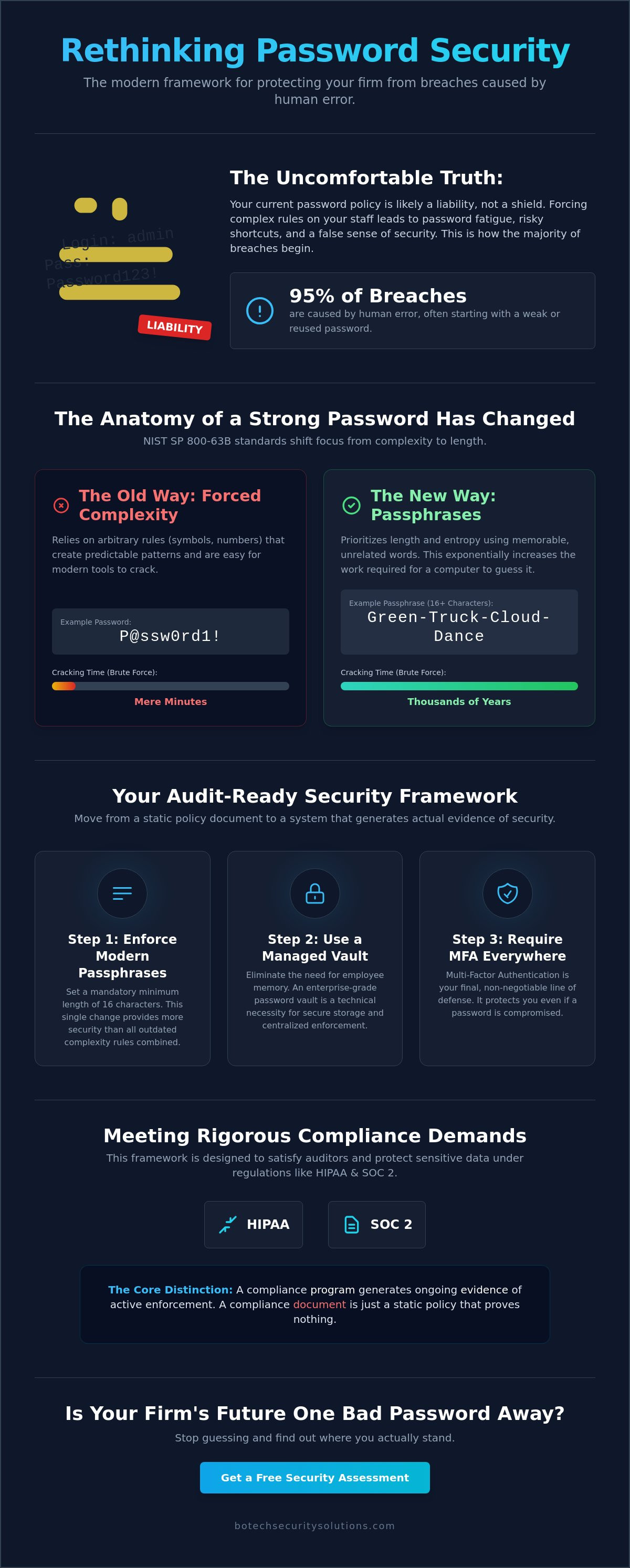
Your staff is one "Password123!" away from handing your firm's future to a ransomware group. After the 2024 breaches in Wichita and Franklin County, Kansas City business owners are rightfully anxious about their own vulnerabilities. You likely spent years teaching your team how to make a strong password using symbols and numbers, only to find they've scribbled those complex codes on sticky notes. This is the uncomfortable truth; your current password policy is probably a liability, not a shield.
It's a frustrating cycle of password fatigue that leaves your practice exposed to the 95% of breaches caused by human error. You need a strategy that moves beyond employee memory and satisfies the rigorous demands of HIPAA and SOC 2 auditors. This guide provides the exact framework for creating and enforcing enterprise-grade security that works in the real world.
We'll break down the 2026 NIST standards and the mandatory MFA requirements that now define regulatory compliance. You'll learn how to replace outdated complexity rules with a system that generates actual evidence of security. It's time to transition from the chaos of potential vulnerabilities to the organized calm of a fully protected environment.
Key Takeaways
- Learn how to make a strong password by prioritizing length and entropy over outdated complexity rules that frustrate your staff.
- Understand why enterprise-grade password vaults are a technical necessity for firms that cannot rely on employee memory.
- Discover the specific regulatory requirements under HIPAA and SOC 2 that demand active enforcement rather than just a static policy document.
- Identify the critical role of Multi-Factor Authentication (MFA) as the final, non-negotiable line of defense against credential harvesting.
- Transition from a culture of "Password123" to a structured, audit-ready environment that significantly reduces your risk of a data breach.
The Password Fatigue Crisis in Kansas City Offices
Your office manager is likely exhausted. Between managing billing cycles and patient schedules, they're juggling 25 different logins, each requiring a unique combination of symbols and numbers. You've likely seen the sticky notes on monitors or the "passwords" folder on a shared drive. This cognitive overload leads to a dangerous, predictable reality in Kansas City offices: the "Password123!" culture. It's a shortcut that feels safe because it meets the system's requirements, but it's actually an open door for attackers.
Consider a recent incident at a medical clinic in Lee’s Summit. A staff member, tired of reset prompts, used a variation of the clinic’s name and the current year for their EHR login. They hadn't yet learned how to make a strong password that could withstand a simple dictionary attack. A phishing email harvested those credentials in seconds. Within an hour, the attacker had initiated a full-scale credential harvest, accessing sensitive patient records and triggering a mandatory HIPAA reporting nightmare. This wasn't a failure of the firewall. It was a failure of a policy that prioritizes complexity over actual security.
The stakes in our region have never been higher. Whether you're protecting attorney-client privilege in a downtown law firm or patient histories in a suburban practice, one weak link can dismantle your reputation. According to data from 2026, 95% of all cybersecurity data breaches are due to human error. Most of these begin with "inadvertent actions," like an employee reusing a password across multiple platforms because they simply cannot remember anything more complex.
The Failure of the Traditional Complexity Model
For years, IT departments told you that adding symbols was the secret to password strength. This is false. Forcing specific symbols leads to predictable patterns. The uncomfortable truth is that complexity alone doesn't stop modern brute force. When staff manage dozens of "complex" codes, they stop trying to learn how to make a strong password and use shortcuts instead. You've traded security for a false sense of compliance.
Why Kansas City Businesses are Prime Targets
Mid-sized legal and financial firms in Kansas City are seeing a 17% increase in cyberattacks in 2026. Attackers know these organizations handle high-value data but lack rigorous enforcement. You might have a $50,000 firewall, but it's useless if an attacker uses a weak password. Phishing attempts are becoming more sophisticated, often mimicking local vendors. Read more about these common cyber attacks to see how local firms are being hit.
The Anatomy of a Strong Password in 2026
The old rules of digital security have become a roadmap for attackers. You were likely taught that a capital letter, a number, and a special symbol were the gold standard. That advice is now obsolete. The NIST SP 800-63B Revision 4 standard, finalized in 2025, represents a fundamental shift in how to make a strong password. It moves the focus away from arbitrary symbols and places it squarely on length and unpredictability.
Stolen credentials remain the path of least resistance for hackers. According to the Verizon 2024 Data Breach Investigations Report, these account for nearly one-third of all breaches. In many cases, the passwords stolen were "complex" by 2010 standards but were far too short to survive modern decryption tools. If your staff is still using 8-character passwords with a single exclamation point, you're effectively leaving your front door unlocked.
Length vs. Complexity: What Actually Stops Hackers
Complexity is a legacy concept that creates a massive cognitive load for your employees without providing much protection. Modern GPUs can crack an 8-character complex password in minutes using simple brute-force techniques. To protect a Kansas City law firm or clinic, 16 characters is the new minimum for enterprise-grade security. Entropy is the measure of unpredictability in a secret. The higher the entropy, the more guesses a computer must make to find the right combination. When you prioritize length over symbols, you increase entropy exponentially.
The Passphrase Advantage
A passphrase is a string of random, unrelated words, such as "Green-Truck-Dancing-Cloud." These are significantly easier for your team to remember than a string of gibberish like "Xj9!#kL2." However, because of their length, they're nearly impossible for machines to guess. This approach directly addresses the password fatigue that plagues local offices. Your staff won't need to write these down on sticky notes because they actually make sense to the human brain.
The 2026 standards also bring a sigh of relief for busy managers: mandatory 90-day password rotation is dead. NIST guidelines now state that you should only require a password change if there is evidence of a compromise. Forced rotations actually weaken security because employees tend to pick predictable variations of their old password, like "Summer2026" becoming "Autumn2026." Adhering to CISA password guidelines means moving toward these sustainable, high-length secrets. If you're concerned about how your current policies stack up against these modern requirements, you can reach out for a vulnerability assessment to identify your highest-risk accounts.
Moving Beyond Memory: Why Managed Vaults are Mandatory
You can teach your staff the nuances of length and entropy, but you cannot change human biology. The uncomfortable truth is that no employee can remember 50 unique, 16-character passphrases. When you demand the impossible, your team resorts to inadvertent actions like reusing the same secret across every portal. This creates a single point of failure for your entire firm. If one account is phished, every account is compromised.
A managed enterprise vault is the only way to bridge the gap between high security and daily productivity. Unlike personal browser-based tools, an enterprise vault gives you central control. If a lead attorney or office manager leaves your firm tomorrow, you must have a plan. You cannot wait for them to hand over their logins. A managed vault allows you to revoke access instantly, ensuring sensitive data stays behind your walls. It turns a chaotic departure into a controlled, secure event.
The Risk of Browser-Stored Credentials
Many Kansas City offices rely on the "Save Password" prompt in Chrome or Edge. This is a dangerous shortcut. Modern malware is specifically designed to scrape these local credential stores. These databases are often poorly encrypted and easily exported by basic malicious scripts. Learning how to make a strong password is a waste of time if that password is saved in an unencrypted browser file. Disabling browser-based saving across your entire organization is a non-negotiable step for HIPAA and SOC 2 readiness.
Zero-Knowledge Architecture for Professional Firms
Security is binary. You are either protected or you are exposed. Professional firms must insist on zero-knowledge architecture. In plain English, this means the vault provider has no way to see your data or your master keys. Even if the provider is hacked, your secrets remain encrypted and useless to the attacker. Your staff only needs to learn how to make a strong password for one single entry point: the master password. This one secret must be long, unique, and never written down. It is the literal key to your digital kingdom. If you lose this key, the data is gone, which is exactly why it is so secure.
Turning Policy into Evidence: Enforcing Standards for HIPAA and SOC 2
A static PDF in an employee handbook is not a compliance program. Most Kansas City firms have a document that explains how to make a strong password, but they have zero proof that their staff is actually doing it. This gap is where auditors find their easiest wins. HIPAA Section 164.308(a)(5)(ii)(D) is clear about this requirement. It mandates that covered entities implement procedures for creating, changing, and safeguarding passwords. If you can't show a log of these procedures in action, the policy might as well not exist.
The uncomfortable truth is that most IT vendors sell you a template and call it compliance. At BoTech Security Solutions, we operate on a different distinction: a compliance program generates ongoing evidence, whereas a compliance document does not. You need a system that doesn't just ask for better habits but technically forbids anything less. This moves the burden of security from your office manager's shoulders to an automated, managed system. It turns a vulnerable "hope-based" strategy into a verifiable security posture.
Evidence Collection for SOC 2 and HIPAA
Auditors for SOC 2 and HIPAA don't care about your intentions. They want the data. We contrast the "we have a policy" approach with "here is the report showing 100% compliance." Automated logs from a managed environment prove that your length and entropy requirements are being enforced in real time across every workstation. This is the core of our Compliance Services. We generate the ongoing evidence that turns a stressful audit into a routine verification of your existing standards.
The Role of Employee Testing
Your staff needs more than a one-time lecture. Simulated phishing acts as a reassuring reality check for your team. It identifies who still relies on weak habits before a real attacker finds them. BoTech Security Solutions handles this for local businesses as a recurring service, ensuring that training stays fresh and effective. This testing provides the final layer of evidence that your team understands how to make a strong password and, more importantly, how to protect it. If you want to see how your team handles a simulated threat, you can request a security assessment to find out where you actually stand.
Closing the Gap: Why Passwords Alone are Never Enough
You've done the work to learn how to make a strong password. You've implemented 16-character passphrases and moved your team away from the "Password123" culture. However, there's a sobering reality that most vendors hide from you. Even a 100-character password can be phished in seconds by a sophisticated attacker. AI-powered phishing is expected to account for 42% of all global intrusions by the end of 2026. If your security relies entirely on a secret string of text, you're still one bad click away from a total breach.
Multi-Factor Authentication (MFA) is the non-negotiable partner to your password strategy. It's no longer just an "extra layer" or a friendly suggestion. The 2026 HIPAA Security Rule update made MFA mandatory for all systems accessing electronic Protected Health Information (ePHI). Single-factor authentication is officially insufficient for regulatory compliance and cyber insurance. You must move away from vulnerable SMS-based codes, which attackers can intercept through SIM swapping or social engineering.
MFA: The Mandatory Safety Net
Current CISA recommendations prioritize phishing-resistant MFA, such as authenticator apps or hardware keys. These tools ensure that even if a staff member accidentally reveals their passphrase, the attacker cannot gain entry. This satisfies the "Technical Safeguards" requirement of HIPAA and provides the evidence auditors demand. Transitioning your office to app-based authentication removes the weakest link in your digital chain. It transforms your login process from a vulnerability into a documented security control.
Managed Security: The Final Layer
Managed security provides the protection that a password simply cannot offer. Even with strong credentials and MFA, attackers can sometimes bypass session tokens or exploit unpatched software. This is why Kansas City businesses need 24/7 Managed Detection and Response (MDR). Our team acts as a watchful protector, monitoring your environment for "Impossible Travel" alerts. If an account logs in from Overland Park and then three minutes later from an IP address in eastern Europe, we know a credential has been compromised. We take ownership of the response and stop the threat immediately.
Take one specific step today to secure your firm. Audit the security settings on your primary "Master" accounts, such as your domain registrar or your enterprise password vault. Ensure these specific accounts use the highest level of phishing-resistant MFA available. Learning how to make a strong password is only half the battle; enforcing it with a managed system is the other half. You can schedule a free assessment to find out where you actually stand and move your organization toward the organized calm of a compliant environment.
Securing Your Firm's Future Beyond the Login Screen
Protecting your Kansas City business requires more than just a list of rules. You now understand that how to make a strong password involves prioritizing length through passphrases and removing the friction of forced rotations. However, these standards only work when they are enforced by managed vaults and verified through ongoing evidence generation. Compliance is not a one-time document; it's a continuous state of readiness that protects your reputation and your clients' most sensitive data.
As veteran-owned and operated HIPAA and SOC 2 compliance specialists, we know the high stakes of a technical failure. Our local Kansas City response team is dedicated to moving you from a state of vulnerability to one of secure partnership. You don't have to manage these complex regulatory requirements alone while trying to run a busy practice or firm.
Take the final step to ensure your organization is truly protected. Find out where your security actually stands with a free assessment and get a clear picture of your current risks. You've done the hard work of learning the standards; let us help you implement the protection you deserve.
Common Questions About Password Security and Compliance
How long should a strong password be for a business account in 2026?
In 2026, 15 characters is the minimum standard for any password that acts as your only line of defense. If you've implemented Multi-Factor Authentication (MFA), NIST SP 800-63B allows for a minimum of 8 characters. However, for maximum entropy, your systems should support secrets up to 64 characters long.
Is it better to have a complex password or a long passphrase?
A long passphrase is significantly more secure and much easier for your staff to remember than a short, complex string. Length is the primary driver of unpredictability. Shifting your team's focus toward passphrases is the most effective way to teach them how to make a strong password without causing total fatigue.
Does HIPAA require me to change my passwords every 90 days?
No, the HIPAA Security Rule does not mandate a specific 90-day rotation cycle. Modern standards from NIST actually discourage forced periodic changes because they lead employees to choose weak, predictable variations. You should only require a password reset when there's evidence of a compromise or a specific security event.
Why shouldn't my employees use their browser to save work passwords?
Browsers like Chrome and Edge store credentials in local files that are primary targets for modern info-stealing malware. These built-in tools lack the zero-knowledge encryption and central administrative control required for professional firms. It's a convenience that effectively bypasses your organization's security protocols.
What is the best way to share passwords securely within a legal team?
Use an enterprise-managed vault that supports shared collections or folders with granular permissions. This allows your team to access shared credentials without ever seeing or knowing the actual password. It also ensures you can revoke access instantly when a staff member or associate leaves the firm.
How does MFA protect my business if a password is leaked on the Dark Web?
MFA acts as a circuit breaker that stops an unauthorized login attempt even if the attacker has your correct credentials. While Dark Web monitoring can alert you that a leak occurred, the second factor prevents the immediate breach. It's the difference between a lost key and an open front door.
Can a password manager be hacked, and what happens if it is?
Any system can be a target, but professional vaults use zero-knowledge architecture to protect your data. This means the provider never has access to your master key or your unencrypted secrets. If their servers are breached, the attackers find only encrypted gibberish that is impossible to decode without your unique master secret.
What is the "uncomfortable truth" about password security most vendors won't tell me?
The truth is that even the most perfect 20-character passphrase can be phished in seconds. Most vendors focus on how to make a strong password because it's an easy fix, but passwords alone are a liability. Real protection requires a managed system where passwords, MFA, and active monitoring work as a single unit.